
Automated ERP Reporting Software: The 2026 Guide to AI-Powered Insights

Why does it still take weeks of manual data extraction to produce a report that is obsolete the moment it reaches the boardroom? You likely face the same friction every month. You wait on IT for custom queries, fix human errors in spreadsheets, and struggle to find strategic context in standard ERP outputs. Modern automated erp reporting software allows you to reclaim your schedule and your strategy.
This 2026 guide reveals how to bypass traditional reporting hurdles. You'll discover how an ERP Intelligence Workspace transforms raw exports into executive-ready reports and actionable risk detection in minutes. We'll show you how to automate the identification of cash and stock risks while improving data quality for future migrations. Most importantly, you can achieve this immediately without a six-month IT integration project. By the end of this article, you'll have a clear roadmap for scaling human intelligence with an AI data analyst that values your time and professional requirements.
Key Takeaways
- Identify why manual spreadsheet cycles create dangerous data latency in modern finance environments.
- Discover how automated erp reporting software uses AI to detect cash flow and stock risks across disparate ERP exports.
- Compare the resource requirements of direct API integrations versus the speed of zero-integration export models.
- Establish a clear framework for auditing data export capabilities to ensure reports meet executive-ready standards.
- Learn how an AI Data Analyst scales human intelligence by transforming raw CSV or Excel data into polished strategic insights.
Table of Contents
- The Evolution of ERP Reporting: Why Manual Exports Fail in 2026
- Core Capabilities of Automated ERP Reporting Software
- Integration vs. Export Models: Selecting Your Deployment Strategy
- Evaluation Framework: How to Buy ERP Reporting Software
- Stratoryn: The ERP Intelligence Workspace for 2026
The Evolution of ERP Reporting: Why Manual Exports Fail in 2026
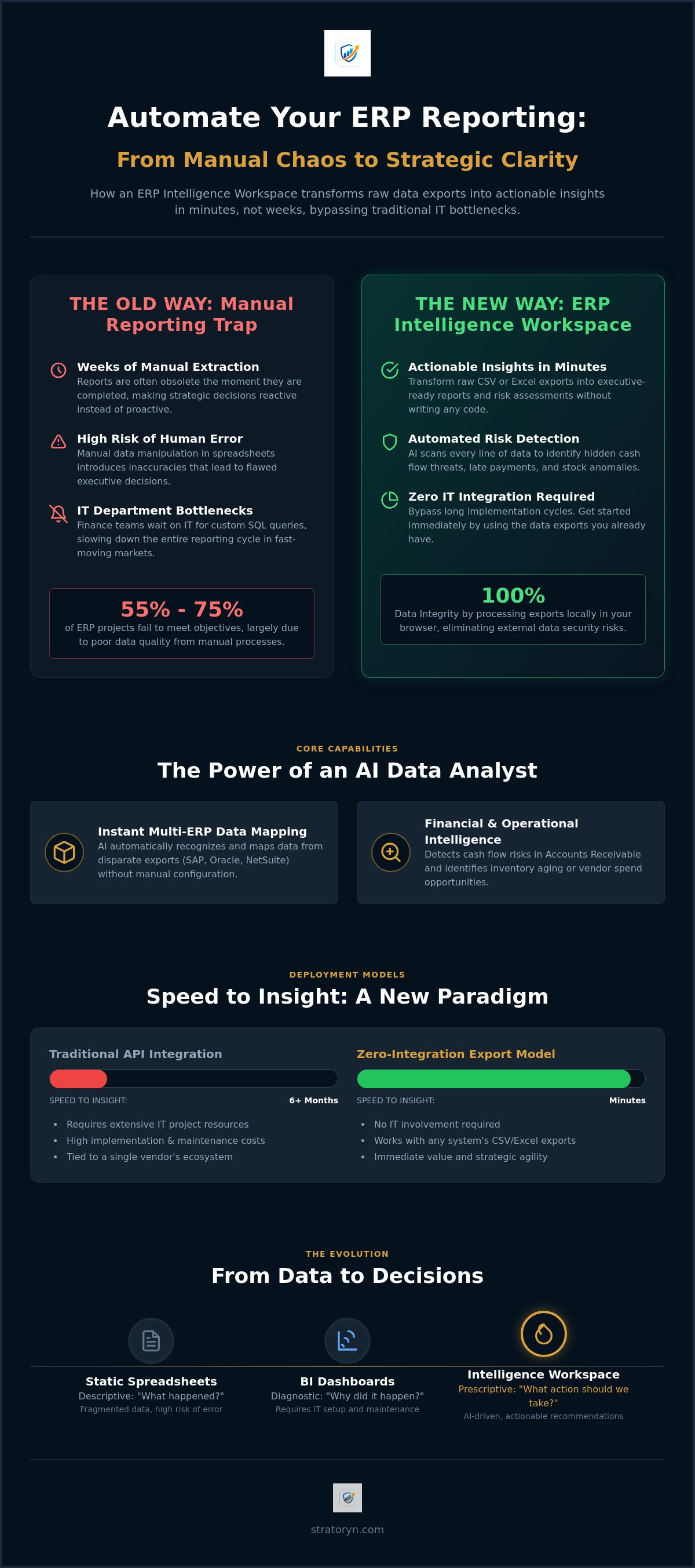
Static spreadsheets have become a liability. Finance teams in 2026 are escaping the "Excel Trap" because manual data manipulation can't keep pace with market volatility. Relying on disconnected files creates a fragmented view of the business. It’s no longer just an efficiency problem; it’s a strategic risk that leaves your organization vulnerable to competitors who move faster. When your data stays trapped in rows and columns, you lose the ability to see the bigger picture.
Beyond data accessibility, maintaining a competitive edge in 2026 requires robust internal connectivity. Enterprise-grade communication solutions from Stratelegy complement data-driven strategies by ensuring that critical insights are shared across the organization without friction.
Traditional Enterprise Resource Planning (ERP) systems are massive, complex databases. They serve as reliable systems of record, but they often lack the agility required for 2026's fast-moving markets. This creates a persistent IT bottleneck. Waiting for custom SQL reports from technical teams is no longer viable when business conditions change hourly. Modern automated erp reporting software bypasses this friction by allowing finance leads to generate insights directly from their exports without writing a single line of code.
The industry is shifting from descriptive reporting to prescriptive reporting. It's not enough to see that revenue dipped last month. You need to know why it happened and what specific actions will fix it. Decisions based on outdated information are essentially guesses. If your reporting cycle takes a week, your strategy is already seven days behind the reality of your cash flow and stock levels. In highly competitive sectors like car rentals, this requires real-time strategy; you can learn more about RateHighway to see how automated pricing tools address these needs. Efficiency is no longer optional; it's a requirement for survival.
The High Cost of Reporting Inaccuracy
Manual data manipulation is inherently risky. Research indicates that the average ERP implementation takes 17 months, yet 55% to 75% of these projects fail to meet their original objectives. Much of this failure stems from poor data quality. Inaccurate manual exports lead to flawed executive decisions that can cost millions. In this context, Data Integrity means maintaining the absolute accuracy and consistency of your financial information as it moves from an export to a final report; you can read more about optimizing SAP and Microsoft systems to prevent such failures. Without it, executive trust evaporates.
From Dashboards to Intelligence Workspaces
Visual dashboards were the standard for years, but they are now insufficient. Finance leaders don't just need to see data; they need to understand it. Visualization tools often require months of IT setup and constant maintenance. The AI Data Analyst represents a shift toward software that actually thinks. Stratoryn operates as an ERP Intelligence Workspace that processes exports locally in your browser. The adoption of automated erp reporting software transforms raw data into Executive-Ready Reports without the security risks of external storage. It moves you from looking at charts to acting on insights in seconds.
Core Capabilities of Automated ERP Reporting Software
Modern automated erp reporting software does more than visualize data. It analyzes it. The primary goal is to bridge the gap between raw exports and strategic action. It eliminates the manual labor of cleaning data and identifying patterns. By automating the extraction and mapping process, you move from data collection to data intelligence in seconds. For businesses seeking a broader application of these capabilities, Nodal AI provides an AI-powered insights and analytics platform that empowers teams to make faster, data-driven decisions. This shift is essential for finance teams that need to respond to market changes without waiting for IT intervention.
This shift toward automated intelligence is also visible in business development; for agencies targeting the restoration and HVAC sectors, LeadOpsIQ provides weekly lead intelligence to help scale their outreach efforts.
Mapping data across different platforms like SAP, Oracle, or NetSuite used to take months of technical configuration. AI now handles this instantly. For organizations managing complex ecosystems like PeopleSoft, PS WebSolution provides specialized automation that further streamlines these workflows. It recognizes data types and relationships across disparate exports regardless of the source system. This means your reporting isn't tied to a single vendor's ecosystem. You gain a unified view of your operations by simply uploading the files you already generate. It's a direct, efficient path to clarity.
Automated Financial Risk Detection
AI excels at spotting what humans miss during manual audit sampling. It scans every line of your Accounts Receivable exports to identify hidden cash flow threats. By implementing automated financial risk detection, you can flag late-paying customers or unusual credit trends before they impact liquidity. This isn't just "chatting" with your data; it's a structured approach to oversight. You receive specific alerts on anomalies that require immediate executive attention.
Operational and Inventory Intelligence
If your organization is navigating a transition involving Microsoft Dynamics 365, you can learn more about NaviWorld (Thailand) Co., Ltd. to see how specialized support for Business Central and Supply Chain Management can optimize your data for future reporting.
The final output is the generation of Executive-Ready Reports. These aren't just rows of numbers. They are polished management summaries that highlight exactly what the board needs to see. The impact of AI on ERP systems is clear: it shifts the focus from data entry to data activation. Automated auditing detects gaps in your records before they hit the bottom line. It ensures that every report you present is backed by verified data. If you want to see this transformation in your own workflows, starting with an ERP Intelligence Workspace provides the fastest route to results.
Integration vs. Export Models: Selecting Your Deployment Strategy
Real-time data is often a distraction. Many vendors claim that direct API integration is the only way to manage modern finance, but they ignore the massive IT burden it creates. For most organizations, automated erp reporting software that utilizes an export-based model provides a faster, more secure path to insights. You must choose between a system that requires months of technical configuration and one that delivers value in minutes. Speed and autonomy are the new benchmarks for finance operations.
Direct API integration offers real-time synchronization. This sounds ideal, but the reality is complex. Implementation timelines for these projects average 17 months, and costs can escalate rapidly. Beyond the expense, every direct connection increases your security risk by expanding the "attack surface" of your core ERP database. You become reliant on IT for every update, creating a new bottleneck that negates the speed of the software itself. It's a high-stakes commitment that often fails to meet its original objectives.
Export-based analysis offers a streamlined alternative. By using the CSV or Excel exports your team already generates, you bypass the integration queue entirely. This "near real-time" approach is sufficient for executive reporting and risk detection, where strategic decisions are made on a daily or weekly basis rather than second-by-second. It's a pragmatic solution for teams that value speed. You can start analyzing data today instead of next year.
The Security Advantages of Browser-Side Processing
Security is the primary concern for any finance professional. Stratoryn uses browser-side processing to ensure your data never leaves your local environment. We don't store raw files on our servers. This approach eliminates the need for complex data processing agreements and significantly reduces your organization's risk profile. You maintain total control over your sensitive financial information while still benefiting from advanced AI analysis. It is the gold standard for data privacy in 2026.
Power BI Alternatives for Finance Teams
Visualization alone is no longer enough. While tools like Power BI are excellent for creating aesthetic charts, they often fail to explain the "why" behind the numbers. They require significant manual setup to identify specific risks like inventory aging or cash flow anomalies. Finance leaders are increasingly looking for power bi alternatives for finance that provide built-in intelligence rather than just a blank canvas. A tool built specifically for ERP data exports understands the nuances of your ledger, allowing it to detect opportunities that generic visualization platforms miss.
Evaluation Framework: How to Buy ERP Reporting Software
Buying the wrong tool is a costly mistake. Many organizations invest in complex platforms only to realize they still require a dedicated IT team to manage them. When selecting automated erp reporting software, you must prioritize the speed of insight over the quantity of integrations. Use this five-step framework to ensure your chosen solution delivers immediate strategic value without becoming another technical burden. If you are also researching other digital services for your business, you can learn more about Alternative Radar to compare various software and online platform alternatives.
- Step 1: Audit your current data export capabilities. Confirm if your team can consistently generate CSV, Excel, or PDF exports. Your reporting tool must work with what you have today, not what you hope to have after a multi-year database overhaul.
- Step 2: Define your "Executive Readiness" requirements. Identify the specific metrics your board demands. If the software cannot translate raw rows into a polished management summary, it isn't solving your primary problem.
- Step 3: Evaluate the "Intelligence Depth." Does the platform actually find risks, or does it just draw aesthetic charts? You need a tool that highlights cash flow anomalies and inventory aging automatically.
- Step 4: Assess implementation friction. Determine if the software requires deep API access or IT approval. Tools that process data locally often bypass these hurdles, allowing you to start in minutes.
- Step 5: Verify data privacy protocols. Ensure the vendor uses browser-side processing. You shouldn't have to store sensitive financial files on a third-party server to get the answers you need.
Assessing Tool Flexibility Across ERP Systems
Your reporting strategy must be vendor-agnostic. Most mid-to-large organizations operate across multiple entities, often using a mix of SAP, NetSuite, and Microsoft Dynamics. Your tool should handle these disparate formats simultaneously to provide a unified view of the business. Relying on a platform that only supports one specific ERP creates a new silo. Exploring specialized business intelligence tools for ERP exports ensures you maintain flexibility as your tech stack evolves.
The Importance of Executive-Ready Outputs
A report is only useful if it drives action. To be "Executive-Ready," a document must prioritize clarity and brevity. AI now assists in this process by automating the narrative. It can help write the "Management Discussion" section by identifying the drivers behind the numbers. This allows you to tailor reports for different stakeholders instantly. A CFO needs to see liquidity risks, while an Operations Manager needs to see stock inefficiencies. Your automated erp reporting software should bridge these gaps without manual reformatting.
Effective communication doesn't stop at internal reports; it extends to how you engage with your entire professional network. For those looking to refine their external messaging and newsletters, click here to see how Enginemailer can help you build professional email campaigns.
Stop waiting for IT to build the reports you need. Start your analysis with the Stratoryn ERP Intelligence Workspace today to see how quickly your data can become a strategic asset.
Stratoryn: The ERP Intelligence Workspace for 2026
Stratoryn is not just another dashboard; it is a focused automated erp reporting software solution designed for the speed of 2026. By functioning as a zero-integration workspace, it removes the friction of technical implementation. You don't need to wait for IT approval or spend months on API configuration. You simply use the data you already have to get the answers you need. It is a streamlined response to the complex data challenges faced by modern finance teams.
Security is built into the architecture. Our "No Storage" promise means your raw financial files stay in your browser. Stratoryn uses browser-side processing to analyze your exports locally. This ensures that your sensitive data never touches our servers, eliminating the need for raw file storage. It is a pragmatic, secure way to leverage AI without compromising your organization's risk profile. You maintain total control of your information while benefiting from advanced data processing.
The AI Data Analyst scales your team's output. It processes exports from NetSuite, SAP, or Sage instantly. It doesn't just display numbers; it scans for anomalies. Whether it's identifying a looming cash flow gap or spotting inventory that has been stagnant for too long, the system provides the strategic context that standard reports miss. It transforms raw rows into polished, professional outputs that are ready for immediate executive review.
Getting Started with Early Access
Transitioning from a raw CSV to an executive-ready report takes exactly three clicks. We are currently in the early-access phase, offering finance professionals a way to build a data-driven culture without the enterprise price tag. You can move from data extraction to strategic insight in seconds. This speed allows you to respond to market shifts as they happen, rather than weeks later. It's a frictionless way to handle high-stakes data management.
Beyond financial reporting, adopting a comprehensive strategy for automation is essential for long-term success. Resources from Entourage Insider can help you integrate these AI-driven principles into every facet of your digital business operations.
A Guide to AI-Powered ERP Analysis
Stratoryn functions as your modern guide through complex data challenges. By automating the mapping and analysis of your exports, it allows your team to focus on high-level strategy rather than manual entry. This approach scales human intelligence by providing a clear, logical progression from raw information to actionable insight. For a deeper dive into our methodology, explore our full ERP Intelligence Workspace guide. It outlines how to maximize the value of your existing systems with minimal IT involvement.
Don't let your data remain stagnant. Start your first analysis for free today and experience the clarity of truly automated erp reporting software.
Modernize Your Financial Oversight with AI-Driven Clarity
The era of manual data manipulation and technical bottlenecks has ended. You've seen how shifting from static dashboards to an intelligence workspace provides the strategic context needed for 2026. By prioritizing export-based analysis over complex API integrations, you gain immediate autonomy and superior data security. This transition moves your team from data collection to data activation without the traditional IT burden.
Implementing automated erp reporting software shouldn't be a multi-month project. It should be a streamlined path to executive-ready clarity. Stratoryn offers this through browser-side processing, ensuring no raw file storage ever touches our servers. You receive AI-powered risk detection and polished reports in seconds. You can start today with free early access to transform your CSV exports into strategic assets.
Join the Stratoryn Early Access for AI-Powered ERP Insights and see how quickly your finance team can scale its intelligence. Your data is ready to work for you. Take the first step toward frictionless reporting and reclaim your strategic focus today.
Frequently Asked Questions
What is automated ERP reporting software?
Automated ERP reporting software is a category of tools that eliminates manual data entry by automating the extraction and analysis of financial information. It replaces static spreadsheets with dynamic intelligence. By using advanced algorithms, it identifies trends and anomalies that human eyes often miss during routine audits. This ensures your reporting remains accurate, timely, and relevant to your strategic goals.
Does automated reporting require direct integration with my ERP?
No, you don't need a direct API connection to automate your reporting. Stratoryn uses an export-based model that works with the CSV or Excel files you already generate. This eliminates the need for IT approval and avoids the high costs of complex database integrations. You maintain your current workflow while gaining advanced analytical capabilities without any technical friction.
How does AI help with ERP data reporting?
AI scales human intelligence by automatically mapping data types and detecting operational risks across disparate systems. It identifies hidden patterns in your accounts receivable or inventory levels that suggest future liquidity issues. Instead of just showing what happened, the AI Data Analyst explains the drivers behind the numbers. This allows for prescriptive decision-making that addresses problems before they escalate.
Is my financial data secure with browser-based analysis tools?
Your data is extremely secure when using browser-side processing. This methodology ensures that your raw financial records never leave your local environment. Because the analysis occurs within your browser, there is no raw file storage on external servers. This architecture meets the highest compliance standards for data privacy and security while reducing the overall attack surface for your organization.
Can automated reporting software help with ERP migration?
What is the difference between Power BI and an ERP Intelligence Workspace?
Power BI focuses on visualization, whereas an ERP Intelligence Workspace focuses on automated analysis. Power BI requires you to tell the software what to look for and how to display it. In contrast, an intelligence workspace already understands ERP structures. It automatically surfaces risks and opportunities without requiring you to build complex dashboards or write custom code.
How long does it take to set up automated ERP reporting?
You can achieve full setup in under five minutes. Traditional automated erp reporting software projects often take months of IT configuration and testing. With an export-based tool, you simply sign up and upload your first file. The transition from raw data to a polished executive report happens in three clicks, allowing you to focus on strategy instead of setup.
Does Stratoryn store my raw ERP files?
Stratoryn never stores your raw ERP exports on its servers. All data processing happens locally in your browser to maintain maximum security and privacy. This "no storage" approach means you don't have to worry about the exposure of your sensitive financial records. You get the insights you need without the risk of external data handling or storage fees.
Frequently asked questions
What is automated ERP reporting software?
Automated ERP reporting software is a category of tools that eliminates manual data entry by automating the extraction and analysis of financial information. It replaces static spreadsheets with dynamic intelligence. By using advanced algorithms, it identifies trends and anomalies that human eyes often miss during routine audits. This ensures your reporting remains accurate, timely, and relevant to your strategic goals.
Does automated reporting require direct integration with my ERP?
No, you don't need a direct API connection to automate your reporting. Stratoryn uses an export-based model that works with the CSV or Excel files you already generate. This eliminates the need for IT approval and avoids the high costs of complex database integrations. You maintain your current workflow while gaining advanced analytical capabilities without any technical friction.
How does AI help with ERP data reporting?
AI scales human intelligence by automatically mapping data types and detecting operational risks across disparate systems. It identifies hidden patterns in your accounts receivable or inventory levels that suggest future liquidity issues. Instead of just showing what happened, the AI Data Analyst explains the drivers behind the numbers. This allows for prescriptive decision-making that addresses problems before they escalate.
Is my financial data secure with browser-based analysis tools?
Your data is extremely secure when using browser-side processing. This methodology ensures that your raw financial records never leave your local environment. Because the analysis occurs within your browser, there is no raw file storage on external servers. This architecture meets the highest compliance standards for data privacy and security while reducing the overall attack surface for your organization.
Can automated reporting software help with ERP migration?
Yes, it is a vital tool for ensuring data quality during a system transition. The software identifies inconsistencies and missing fields in your current exports before you move them to a new platform. This auditing process ensures that your migration is based on clean, verified data. It reduces the risk of project failure and ensures your new system provides value from day one.
What is the difference between Power BI and an ERP Intelligence Workspace?
Power BI focuses on visualization, whereas an ERP Intelligence Workspace focuses on automated analysis. Power BI requires you to tell the software what to look for and how to display it. In contrast, an intelligence workspace already understands ERP structures. It automatically surfaces risks and opportunities without requiring you to build complex dashboards or write custom code.
How long does it take to set up automated ERP reporting?
You can achieve full setup in under five minutes. Traditional automated erp reporting software projects often take months of IT configuration and testing. With an export-based tool, you simply sign up and upload your first file. The transition from raw data to a polished executive report happens in three clicks, allowing you to focus on strategy instead of setup.
Does Stratoryn store my raw ERP files?
Stratoryn never stores your raw ERP exports on its servers. All data processing happens locally in your browser to maintain maximum security and privacy. This "no storage" approach means you don't have to worry about the exposure of your sensitive financial records. You get the insights you need without the risk of external data handling or storage fees.
- automated erp reporting software
- ERP Reporting
- AI in Finance
- Data Automation
- Business Intelligence
- Financial Reporting
- Risk Management
- ERP Software
- Data Analysis
- erp reporting tools
- ai data analysis
- erp intelligence
- automated financial reporting
- business intelligence software