
How to Identify Cash Risks in Accounts Receivable: A 2026 Data Guide

Why is your finance team still waiting for an invoice to hit 90 days past due before flagging it as a threat? By the time a debt appears "overdue" on a standard aging report, your window for effective intervention has likely already closed. With global B2B Days Sales Outstanding averaging between 50 and 65 days in 2026, you can't afford to wait for a default to occur. You need to see it coming.
It's a common challenge; the raw data in your ERP exports holds the answers, but the sheer volume makes those insights inaccessible. Manual reporting takes too long during the month-end crunch, which prevents you from spotting risk patterns until it's too late. This guide shows you how to identify cash risks in accounts receivable by transforming raw exports into a proactive detection system. You'll learn a reliable framework to spot threats early, accelerate your reporting, and reduce bad debt provisions through faster intervention.
Key Takeaways
- Look beyond traditional aging reports to uncover hidden liquidity gaps that standard ERP views often mask.
- Master the specific data markers used to identify cash risks in accounts receivable, such as erratic payment volatility and partial payment trends.
- Follow a structured workflow to export and normalize transaction data from systems like SAP and NetSuite for immediate risk assessment.
- Understand how AI-powered detection eliminates the cognitive load and manual errors typical of month-end Excel reporting.
- Transform raw CSV exports into executive-ready insights that enable earlier intervention and significantly lower bad debt provisions.
Table of Contents
- Understanding the Anatomy of Cash Risks in Accounts Receivable
- 4 Red Flags to Identify Cash Risks in Accounts Receivable Exports
- The Limits of Manual Analysis vs. AI-Powered Detection
- Step-by-Step: How to Detect AR Risks in Your Data Files
- Strategic Risk Oversight with the Stratoryn ERP Intelligence Workspace
Understanding the Anatomy of Cash Risks in Accounts Receivable
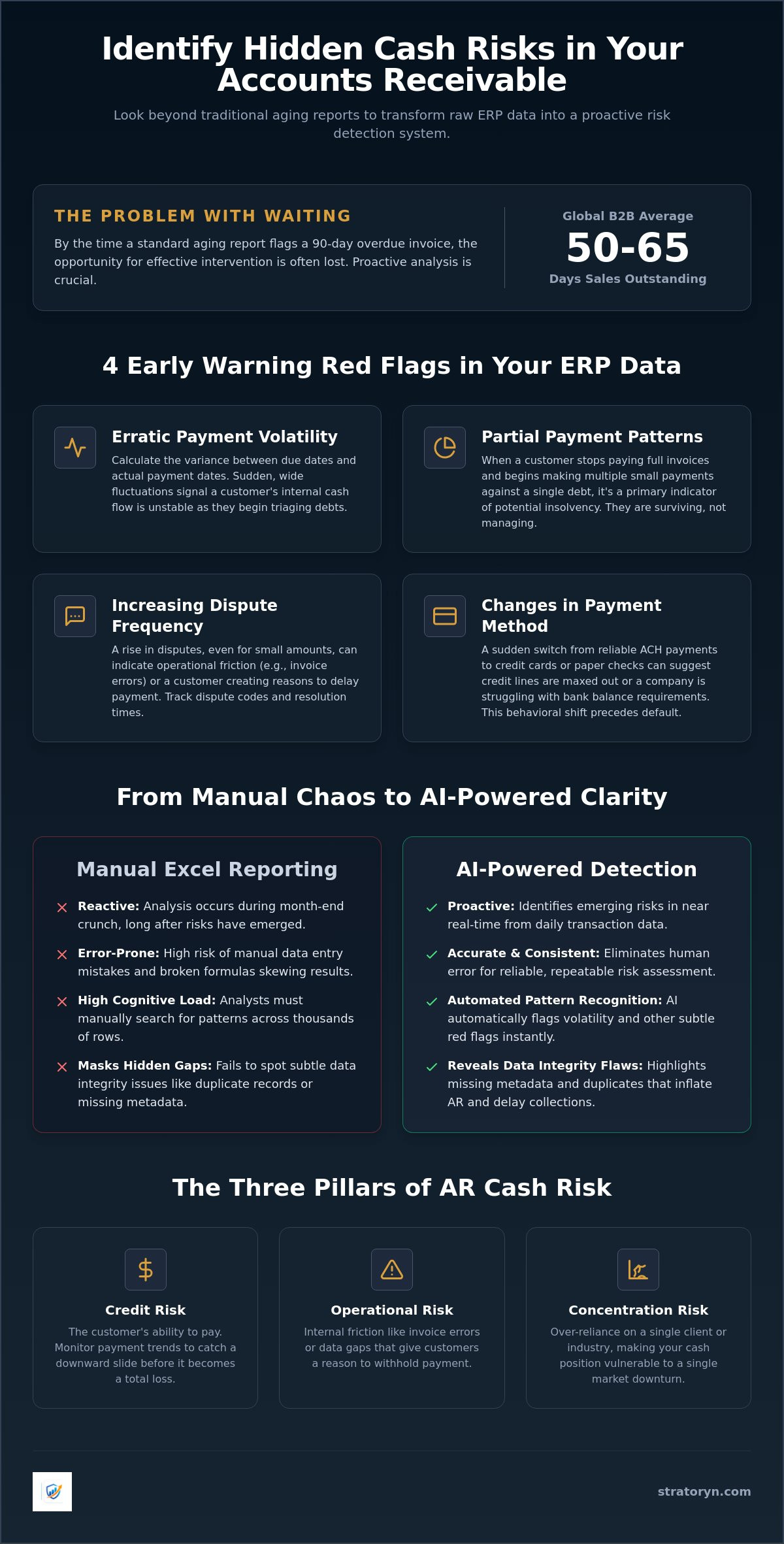
Most finance leaders view accounts receivable as a static asset on the balance sheet. In reality, it's a dynamic flow of potential liquidity that is constantly under threat. We define accounts receivable cash risk as the specific gap between recognized revenue and actual liquidity. When you book a sale, you recognize revenue; however, until that cash hits your bank account, it remains a risk. Traditional ERP aging reports often fail to show the full picture because they are inherently reactive. They categorize debt based on how long it has sat on the books, which ignores the behavioral shifts that occur before a payment deadline is actually missed.
To accurately identify cash risks in accounts receivable, you must look beyond the "days past due" column. You need to distinguish between credit risk and operational risk. Credit risk involves the customer's financial health and their ability to pay. Operational risk involves internal friction, such as billing disputes or data entry errors that give customers a reason to withhold payment. Understanding Accounts receivable fundamentals is the first step in recognizing that a high DSO isn't always a customer problem; it's often a data problem. Data integrity gaps in ERP exports create blind spots that directly lead to cash flow leakage through unrecovered or delayed payments.
The Three Pillars of AR Cash Risk
- Credit Risk: This is the most visible pillar. It measures the probability that a customer will face insolvency or bankruptcy. It requires constant monitoring of payment trends to catch a downward slide before it becomes a total loss.
- Operational Risk: This risk stems from internal inefficiencies. If your invoice contains an error or lacks the necessary metadata, the customer's automated system may reject it. These "invisible" delays can add weeks to your collection cycle.
- Concentration Risk: If a single client or a specific industry accounts for a large percentage of your AR, you're vulnerable. A single market downturn or one client's financial struggle could jeopardize your entire cash position.
Why ERP Data Quality Impacts Your Cash Flow
Your ability to identify cash risks in accounts receivable depends entirely on the quality of your raw data. Missing metadata in customer files, such as incorrect tax IDs or missing purchase order numbers, leads to unallocated payments that sit in limbo. Duplicate records in AR exports are another hidden danger. They inflate your perceived assets and cause collection teams to chase the same debt twice, which wastes time and irritates clients. You can solve these visibility issues by using the ERP Intelligence Workspace to analyze your exports. This tool highlights data integrity gaps that manual Excel checks consistently miss, allowing you to clean your records and secure your cash flow before the month-end close.
4 Red Flags to Identify Cash Risks in Accounts Receivable Exports
Spotting a payment failure after it happens is easy; identifying the behavioral shifts that precede it requires a deeper look at your raw data. When you analyze your ERP exports, you aren't just looking for overdue balances. You're looking for patterns that suggest a customer is losing their ability to pay or that your internal processes are failing. To effectively identify cash risks in accounts receivable, you must monitor four specific red flags that frequently appear in transaction history files before a debt becomes uncollectible.
Analyzing Payment Volatility Trends
The first red flag is erratic payment volatility. You can detect this by calculating the variance between the "Due Date" and the "Actual Payment Date" for every transaction over a six month period. If a customer typically pays within 5 days of the due date but suddenly fluctuates between 10, 20, and 2 days, their internal cash flow is likely unstable. A rising trend line in this variance often signals that the customer is triaging their debt and prioritizing other creditors over your firm. Using automated cash flow risk assessment can help you flag these specific volatility markers across thousands of rows of data without manual calculation.
Partial payment patterns are a second, more severe indicator. When a customer begins paying only portions of individual invoices, it's a primary indicator of insolvency. They're no longer managing their accounts; they're surviving day-to-day. In your ERP export, look for multiple credit entries against a single invoice number. If this becomes a recurring pattern, the risk of a total default is high. Early intervention is critical here to secure whatever liquidity remains.
The Danger of "Silent" Disputes
Third, watch for an increase in dispute frequency, particularly "silent" disputes. These occur when an invoice remains unpaid not because the customer can't pay, but because a clerical error in the ERP export has caused a processing block. You'll see these as high-volume, low-value discrepancies that stay open for months. These errors create a significant long-term cash risk because they hide the true age of the debt. If you aren't careful, these "process risks" eventually turn into "bad debt" simply because the trail has gone cold. You can audit your data quality to ensure these clerical blocks are removed before they impact your liquidity.
The final red flag involves stagnant aging buckets. This happens when debt that is technically "current" or in the "1 to 30 days" bucket never moves, even as new invoices are issued. Often, this is because the data is "stuck" due to a missing purchase order number or a duplicate record that prevents the automated matching of payments. In a raw export, these look like perfectly healthy invoices, but they represent a total loss of cash flow if the underlying data error isn't corrected. Identifying these stagnant entries early allows your team to fix the data and release the cash before the month-end closing deadline.
The Limits of Manual Analysis vs. AI-Powered Detection
Manual analysis relies on human intuition and static rules. It's the "Human in Excel" approach that has dominated finance departments for decades. While finance professionals are highly skilled, they're limited by cognitive bandwidth. During a month-end close, the pressure to finalize figures is intense. This high-stakes environment makes it easy to overlook subtle anomalies that signal trouble. AI-powered detection doesn't get tired or distracted. It processes thousands of rows of ERP data in seconds to find non-linear risks. These are threats that don't follow a simple rule, like a customer who suddenly shifts their payment behavior in a way that doesn't yet trigger an overdue alert.
Why Rule-Based Systems Fail
Most spreadsheets rely on rigid "If/Then" logic. For example, a rule might state: "If an invoice is 30 days overdue, then flag it for follow-up." This logic is too linear for the complexities of 2026. It cannot catch sophisticated insolvency patterns or the early stages of a billing dispute. Rule-based systems only find what you specifically tell them to look for. Machine learning is different. It looks for the outliers you haven't thought to define. There is a significant strategic benefit to detecting anomalies in financial data using AI. It identifies behavioral shifts across your entire ledger, highlighting risks that would remain invisible in a standard spreadsheet.
Scaling Finance Oversight without New IT Infrastructure
Traditional "Big IT" projects take months to implement. They require direct ERP integrations, security audits, and massive budgets. Modern finance teams are shifting toward "Agile AI." This approach works with the exports you already generate. You don't need a direct integration to identify cash risks in accounts receivable. You simply use your existing CSV or Excel files. This empowers your finance team to function as data analysts without needing to write a single line of code. It's a frictionless way to scale oversight, ensuring that your cash flow is protected by advanced technology without the burden of a traditional software rollout. It's about visibility, not complexity.
Step-by-Step: How to Detect AR Risks in Your Data Files
Transforming raw ERP data into a proactive defense system requires a methodical approach. You can't simply scan a spreadsheet and hope to catch every anomaly. To effectively identify cash risks in accounts receivable, you must follow a structured workflow that prioritizes data integrity and trend analysis. This process begins with a comprehensive export from your existing ERP system, whether you use SAP, NetSuite, Oracle, or Microsoft Dynamics. You'll need both your AR Aging report and your full Transaction History to build a complete picture of customer behavior.
Once you have the files, your first task is to clean the data. Remove duplicate records and normalize customer names; inconsistencies here often lead to fragmented risk profiles where one client appears as two different entities. Next, apply risk filters to highlight high-value outliers and worsening payment trends. Focus on invoices that deviate from historical averages rather than just those that are overdue. Finally, generate a "Risk Summary" that aggregates these findings into a single view for management review. You can automate this entire workflow by uploading your files to the Stratoryn ERP Intelligence Workspace for instant AI analysis.
Preparing Your ERP Export for Analysis
Data quality is the foundation of any risk assessment. To identify cash risks in accounts receivable accurately, your export must include these essential columns: Invoice Date, Due Date, Payment Date, Amount, and Customer ID. Don't ignore missing data points. Incomplete records often skew risk scores and lead to false negatives. If your ERP export is messy, use the methodology for automated financial risk detection to ensure your data remains clean and actionable. High-quality input is the only way to get high-quality insights.
Creating Executive-Ready Risk Reports
Management needs to see the impact of risk, not just the technical details. You should translate technical findings like "DSO Variance" into business language such as "Cash at Risk." This shift in terminology makes the stakes clear to non-finance stakeholders. Visualizing risk concentration is equally important. If a large percentage of your potential default is tied to a single industry or client, it represents a strategic vulnerability that requires immediate attention. Stratoryn generates these Executive-Ready Reports instantly from your raw uploads, allowing you to present a clear, professional analysis without spending hours in Excel. This visibility prompts faster decision-making and protects your liquidity before the month-end close.
Strategic Risk Oversight with the Stratoryn ERP Intelligence Workspace
Traditional accounts receivable management often feels like a choice between manual labor and massive IT overhaul. Stratoryn offers a third path. It functions as a streamlined solution to identify cash risks in accounts receivable without the friction of direct ERP integration. You don't need to wait for a six month implementation cycle or a security audit of your core infrastructure. Instead, you simply upload your existing CSV or Excel exports. This "No Integration" advantage allows you to move from raw data to executive-level clarity in a single afternoon.
Data security is a primary concern for finance leaders. Stratoryn addresses this through browser-side processing. Your raw financial data stays on your machine and is never stored on a remote server. This approach provides a calm, reassuring way to handle sensitive information while still leveraging the power of an AI Data Analyst. You get the speed of modern automation with the security of a local workflow. It's a professional tool designed for high-stakes environments where both visibility and privacy are non-negotiable.
From Raw Data to Actionable Intelligence in Minutes
The transition from a messy spreadsheet to a strategic report is automated. Once you upload your file, the ERP Intelligence Workspace automatically detects data types and identifies inconsistencies that human eyes often miss. It highlights both stock issues and cash flow threats simultaneously. This automated detection removes the cognitive load of month-end closing, allowing you to spot anomalies before they impact your liquidity. For a broader view of your financial health, you can also learn how to analyze trial balance with AI for faster month-end closing. This integrated approach ensures that your risk oversight covers the entire ledger, not just a few isolated accounts.
Empowering the Modern Finance Team
Modern finance teams shouldn't spend their time cleaning data or fixing duplicate records. Stratoryn shifts the focus from manual processing to strategic oversight. By automating the detection phase, you give your team the time they need to engage with customers and resolve disputes early. This proactive stance is what separates efficient operations from those struggling with high bad debt provisions. It's about building a data-driven culture where every decision is backed by clear, executive-ready insights. We're currently in a free early-access phase to help innovators transform their reporting workflows without an initial barrier to entry. Start identifying your hidden cash risks for free with Stratoryn today.
Securing Your Liquidity with Data-Driven Oversight
The ability to predict payment failures is no longer a luxury; it's a requirement for modern finance teams. You've learned that traditional aging reports often hide the very threats they are supposed to reveal. By moving beyond static data, you can proactively identify cash risks in accounts receivable before they disrupt your operations. Shifting from manual Excel sorting to automated pattern recognition allows your team to focus on strategic intervention rather than data entry. This transformation ensures that your cash flow remains stable even as market conditions fluctuate.
Stratoryn provides the tools to make this transition frictionless. Our automated risk detection works with your standard ERP exports; there is no IT integration required. Browser-side processing ensures your raw file data is never stored on our servers, which maintains your security standards at every step. You can generate executive-ready reports in seconds to drive faster decision-making across your organization. It's time to turn your raw data into a strategic asset.
Analyze your AR exports for hidden cash risks with Stratoryn’s free AI workspace. Taking control of your data is the first step toward a more resilient financial future.
Frequently Asked Questions
How do I identify cash risks in accounts receivable without a BI tool?
You can identify cash risks in accounts receivable by exporting your transaction history and aging files into a spreadsheet. Focus on the variance between the "Due Date" and "Actual Payment Date" across your top 20% of customers. While manual, this process reveals behavioral shifts that indicate a customer is triaging debt. The cognitive load of manual month-end closing often leads to missed anomalies in larger datasets if you don't use a specialized analyzer.
What are the most common indicators of bad debt risk in an ERP export?
The primary indicators are partial payment patterns and erratic payment volatility. When a customer begins paying only portions of individual invoices, it's a strong signal of insolvency. Additionally, look for "stagnant" invoices that remain in the current bucket despite having missing metadata or clerical errors. These data integrity gaps often mask debt that is effectively uncollectible if the underlying process error isn't addressed immediately.
How can AI help in detecting financial anomalies in AR data?
AI detects non-linear patterns that standard rule-based systems miss. Instead of just flagging overdue invoices, machine learning identifies subtle behavioral shifts, such as a customer who pays early but suddenly starts paying exactly on the due date. These shifts are often the first sign of a liquidity crisis. This proactive approach helps you identify cash risks in accounts receivable weeks before a default occurs on your ledger.
Why is data quality important for accounts receivable risk management?
High-quality data is the foundation of accurate risk forecasting. Missing metadata, such as purchase order numbers or tax IDs, leads to unallocated payments that sit in limbo. This inflates your perceived assets and hides the true age of your debt. Clean data ensures that every invoice is searchable and matchable; this prevents "process risks" from turning into permanent bad debt provisions that damage your bottom line.
What is the difference between DSO and cash risk analysis?
DSO measures historical performance, while cash risk analysis focuses on future liquidity. DSO provides a broad average of how long it takes to collect payment across your entire portfolio. In contrast, cash risk analysis identifies the specific gap between recognized revenue and actual liquidity. It highlights the probability of non-payment for specific high-value invoices, which allows for targeted intervention rather than broad policy changes.
How do I create an executive-ready report from my AR data?
An executive-ready report must translate technical data into strategic business language. Instead of presenting a raw list of overdue invoices, highlight "Cash at Risk" and identify concentration risks where one client represents a significant portion of your exposure. Use visualizations that show the impact on your monthly liquidity targets to prompt faster decision-making from senior leadership. This clarity moves the conversation from data cleaning to strategic action.
Is it safe to upload financial data exports to an AI analysis platform?
Security depends on the platform's architecture. Stratoryn uses browser-side processing, which means your raw financial data never leaves your machine and is never stored on our servers. This architecture eliminates the traditional security risks associated with cloud storage and direct ERP integrations. It allows you to leverage advanced AI analysis while maintaining total control over your sensitive financial exports during the 2026 fiscal year.
Frequently asked questions
How do I identify cash risks in accounts receivable without a BI tool?
You can identify cash risks in accounts receivable by exporting your transaction history and aging files into a spreadsheet. Focus on the variance between the "Due Date" and "Actual Payment Date" across your top 20% of customers. While manual, this process reveals behavioral shifts that indicate a customer is triaging debt. The cognitive load of manual month-end closing often leads to missed anomalies in larger datasets if you don't use a specialized analyzer.
What are the most common indicators of bad debt risk in an ERP export?
The primary indicators are partial payment patterns and erratic payment volatility. When a customer begins paying only portions of individual invoices, it's a strong signal of insolvency. Additionally, look for "stagnant" invoices that remain in the current bucket despite having missing metadata or clerical errors. These data integrity gaps often mask debt that is effectively uncollectible if the underlying process error isn't addressed immediately.
How can AI help in detecting financial anomalies in AR data?
AI detects non-linear patterns that standard rule-based systems miss. Instead of just flagging overdue invoices, machine learning identifies subtle behavioral shifts, such as a customer who pays early but suddenly starts paying exactly on the due date. These shifts are often the first sign of a liquidity crisis. This proactive approach helps you identify cash risks in accounts receivable weeks before a default occurs on your ledger.
Why is data quality important for accounts receivable risk management?
High-quality data is the foundation of accurate risk forecasting. Missing metadata, such as purchase order numbers or tax IDs, leads to unallocated payments that sit in limbo. This inflates your perceived assets and hides the true age of your debt. Clean data ensures that every invoice is searchable and matchable; this prevents "process risks" from turning into permanent bad debt provisions that damage your bottom line.
What is the difference between DSO and cash risk analysis?
DSO measures historical performance, while cash risk analysis focuses on future liquidity. DSO provides a broad average of how long it takes to collect payment across your entire portfolio. In contrast, cash risk analysis identifies the specific gap between recognized revenue and actual liquidity. It highlights the probability of non-payment for specific high-value invoices, which allows for targeted intervention rather than broad policy changes.
How do I create an executive-ready report from my AR data?
An executive-ready report must translate technical data into strategic business language. Instead of presenting a raw list of overdue invoices, highlight "Cash at Risk" and identify concentration risks where one client represents a significant portion of your exposure. Use visualizations that show the impact on your monthly liquidity targets to prompt faster decision-making from senior leadership. This clarity moves the conversation from data cleaning to strategic action.
Is it safe to upload financial data exports to an AI analysis platform?
Security depends on the platform's architecture. Stratoryn uses browser-side processing, which means your raw financial data never leaves your machine and is never stored on our servers. This architecture eliminates the traditional security risks associated with cloud storage and direct ERP integrations. It allows you to leverage advanced AI analysis while maintaining total control over your sensitive financial exports during the 2026 fiscal year.
- identify cash risks in accounts receivable
- Accounts Receivable
- Risk Management
- Bad Debt
- Cash Flow
- Data Analysis
- AR Automation
- ERP Reporting
- Credit Risk
- accounts receivable management
- credit risk management
- bad debt reduction
- AR analytics
- cash flow forecasting
- ERP data analysis