
ERP Data Health Check: The 2026 Diagnostic Checklist for Finance Teams

How much of your decision-making is currently built on a foundation of "dirty" data? If you've ever hesitated before hitting "send" on a board deck because the numbers don't quite align with the sales team's CRM, you're dealing with a visibility crisis. Relying on manual spot-checks is no longer a viable strategy for modern finance teams. A systematic erp data health check is the bridge between chaotic spreadsheets and executive-ready insights.
It's exhausting to lose entire afternoons to manual data cleansing just to ensure your reports are accurate. You deserve to trust your exports without the constant fear of hidden integrity gaps or duplicated entries. This guide outlines the 2026 diagnostic checklist designed to help you identify hidden risks within your data instantly. We'll walk through the specific red flags you need to watch for and provide a streamlined process to ensure every export is audit-ready and reliable.
Key Takeaways
- Identify why data consistency and business risk visibility are more vital for finance leaders than basic system performance.
- Detect structural integrity gaps by auditing mandatory fields and removing redundant vendor or SKU entries.
- Surface hidden operational threats like unapplied credits and slow-moving inventory before they impact the bottom line.
- Execute a systematic erp data health check using a repeatable workflow for standard CSV and Excel file exports.
- Discover how to automate your entire diagnostic process with an AI Data Analyst to eliminate manual cleansing hours.
Table of Contents
- What is an ERP Data Health Check and Why Does it Matter?
- The Data Integrity Checklist: Identifying Structural Gaps
- The Operational Risk Checklist: Surfacing Hidden Business Threats
- How to Execute Your Health Check: A Step-by-Step Workflow
- Automating the Diagnostic with Stratoryn’s ERP Intelligence Workspace
What is an ERP Data Health Check and Why Does it Matter?
An erp data health check is a methodical diagnostic focused on the accuracy, consistency, and underlying business risk within your transactional environment. It isn't just a check on whether the software is running. It's a deep dive into whether the information it produces is actually true. While Enterprise resource planning (ERP) systems are designed to centralize business functions, the data within them often degrades over time. Manual entry errors, broken process flows, and inconsistent naming conventions create a layer of "dirty data" that obscures your actual financial position.
The cost of ignoring these issues is high. Inaccurate records lead to cash flow leakage through unapplied credits or missed vendor discounts. It causes inventory bloat when phantom stock levels trigger unnecessary procurement cycles. By 2026, the industry standard has moved beyond reactive system maintenance. Modern finance teams are adopting proactive, data-first diagnostics. This shift prioritizes the integrity of the numbers over the maintenance of the infrastructure. You can't lead a business with reports that require hours of manual adjustment before they're presentable to the board.
To help your organization transition toward these data-first standards and improve overall efficiency through better digital strategy, you can learn more about Business Analysis & Solutions.
The Difference Between a System Audit and a Data Health Check
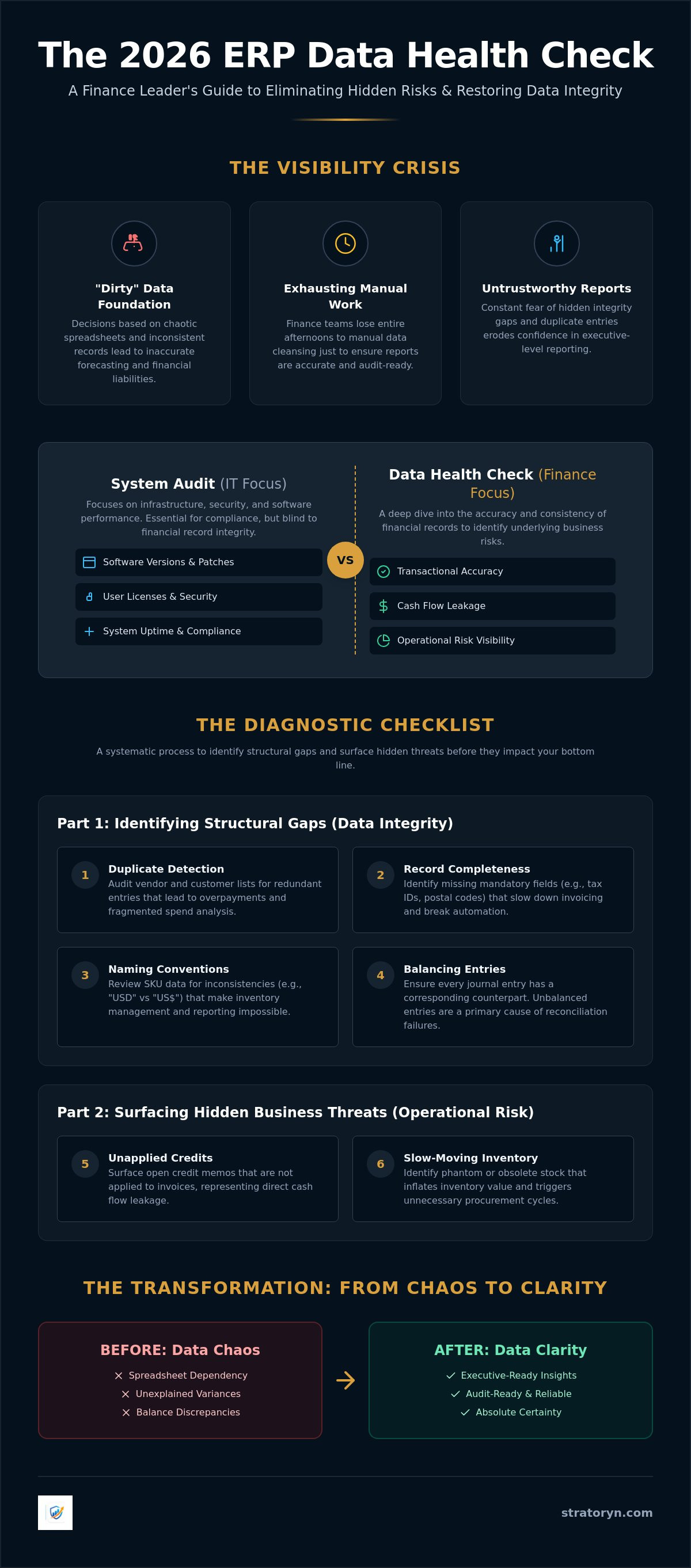
System audits are the domain of IT departments. They focus on software versions, user licenses, and security patches. While essential for compliance, a system audit won't tell you if a vendor has been paid twice or if your SKU data is duplicated across three departments. An erp data health check focuses specifically on the integrity of financial and operational records. It provides the visibility finance teams need to make decisions without waiting for IT's quarterly schedule. You need to know if your data is reliable today, not after the next server migration, and you can discover Distemicha if you need help with broader IT infrastructure and support.
Signs Your ERP Data Needs an Immediate Check-Up
If you're noticing certain red flags, your data integrity is likely already compromised. Look for these indicators of a failing system:
- Balance Discrepancies: Your trial balance doesn't reconcile with your sub-ledgers without significant manual intervention.
- Spreadsheet Dependency: Your team spends more time in "offline" Excel workarounds than in the ERP itself because the system data is untrustworthy.
- Unexplained Variances: You see sudden, illogical spikes in vendor spend or inventory levels that don't match physical reality.
When these signs appear, a diagnostic check-up is the only way to stop the bleed. It's the difference between guessing your cash position and knowing it with absolute certainty.
Whether you are managing a corporate campus and need to learn more about We Love Trees for expert tree health assessments, or managing a global ERP, the need for professional diagnostics remains the same.
The Data Integrity Checklist: Identifying Structural Gaps
System uptime is an IT metric. Data integrity is a finance metric. Just as IT professionals might discover StatusPulse to maintain transparency during service disruptions, finance leaders must ensure the underlying data remains reliable. While your ERP might be running smoothly, the information inside it could be structurally compromised. A comprehensive erp data health check starts with an audit of your master data and transactional logs to ensure the foundation of your reporting is sound. If the underlying data structure is broken, every dashboard you present to the executive team becomes a liability rather than an asset.
Structural gaps often manifest as missing mandatory fields or inconsistent formatting. When a customer profile lacks a tax ID or a postal code, invoicing cycles slow down. When currency codes vary between "USD" and "US$" across different tables, your automated consolidation will fail. These aren't just clerical errors. They are systemic risks that lead to inaccurate financial forecasting. Industry experts now agree that Data Integrity is the New ERP Mandate for businesses that want to maintain a competitive edge through 2026.
Master Data Accuracy
Master data is the DNA of your ERP environment. Inaccuracies here ripple through every transaction. You must prioritize the following during your erp data health check:
- Duplicate Detection: Audit vendor and customer lists for redundant entries. Duplicates often lead to overpayments, fragmented spend analysis, and skewed credit limits.
- Record Completeness: Identify missing mandatory fields in master files. Incomplete data prevents your system's automation features from functioning correctly.
- Naming Conventions: Review SKU data for inconsistent naming. Variations in product descriptions make inventory management and demand planning nearly impossible.
Transaction Consistency
Transactions must follow a logical, balanced path to be considered healthy. Your diagnostic should flag any entry that violates standard accounting principles or internal controls.
- Balancing Entries: Ensure every journal entry has a corresponding counterpart. Unbalanced entries are a primary cause of reconciliation delays.
- Fiscal Period Validation: Verify that transaction dates align with valid, open fiscal periods. Entries posted to closed periods or future dates distort your current cash flow visibility.
- Orphaned Records: Detect transactions linked to deleted or inactive master files. These "ghost" entries remain in your ledger but lack the context needed for an audit trail.
Identifying these gaps manually is a grueling process that consumes valuable hours. If your team is stuck in a cycle of manual spreadsheet audits, utilizing an AI Data Analyst can automate these structural checks, surfacing risks in seconds rather than days. This allows you to move directly from detection to resolution without the cognitive load of manual data cleansing.
The Operational Risk Checklist: Surfacing Hidden Business Threats
Structural integrity is the foundation of your system, but operational risk is where the financial damage occurs. An erp data health check must bridge the gap between "clean data" and "profitable operations." Hidden threats often sit in the blind spots of standard reporting, manifesting as cash flow leaks or supply chain bottlenecks. If your diagnostic process doesn't surface these risks, your data is merely organized, not useful.
Operational health requires looking beyond the ledger to the physical reality of your business. Inaccurate data leads to revenue leakage through unbilled shipments or incorrect tax applications. It results in spend anomalies where procurement costs spike without justification. By identifying these red flags early, finance teams move from reactive troubleshooting to proactive risk management. You gain the clarity needed to protect margins and optimize working capital.
Financial and Cash Risks
Cash flow is the lifeblood of the organization. Data gaps in your receivables or payables directly impact your liquidity. Your diagnostic should focus on these critical areas:
- Aging Report Accuracy: Analyze aging reports to identify high-risk debtors. Fragmented credit notes often mask the true status of overdue accounts.
- Uncaptured Discounts: Search for missed early-payment discounts in accounts payable. These small leaks accumulate into significant annual losses.
- Trial Balance Anomalies: Detect inconsistencies in trial balance exports. AI-driven analysis can spot patterns that manual reviews miss, such as unusual account mappings or rounding errors.
Beyond internal ERP data, external costs can also hide risks. Finance teams should explore Software-as-a-Service (SaaS) subscriptions and marketplace fees to ensure that specialized performance software like ArmIQ is managed with the same level of fiscal scrutiny as core enterprise systems.
Supply Chain and Inventory Risks
Inventory is a cash trap. When your ERP fails to flag slow-moving stock, you're effectively locking capital into a depreciating asset. Utilizing inventory stock problem detection ai allows you to surface hidden risks in your stock levels before they impact your balance sheet. This automation identifies aging stock and stock-out risks by comparing historical demand against current levels.
Vendor performance is another area where data health dictates success. You should audit lead times for consistency against actual delivery dates. If your system assumes a 14-day lead time but the vendor consistently takes 21, your procurement cycles are fundamentally broken. Implementing automated procurement data analysis ensures your purchasing decisions are based on reality rather than outdated system defaults. This level of visibility transforms your erp data health check from a technical exercise into a strategic advantage.
How to Execute Your Health Check: A Step-by-Step Workflow
Executing an erp data health check shouldn't take weeks of consulting or complex IT tickets. The most effective diagnostics happen at the data level, focusing on the CSV and Excel exports your team already uses. By following a structured workflow, you can transform raw file exports into a clear map of your operational risks. This process moves you from chaotic data collection to actionable financial clarity without the friction of traditional system audits.
Speed is essential. In a high-stakes finance environment, a diagnostic that takes twelve steps and three weeks of training is a failure. You need a streamlined approach that prioritizes visibility and accuracy. This workflow ensures that your data remains clean, consistent, and ready for executive-level reporting at any moment.
Step 1: Data Extraction Strategy
Your analysis is only as good as your extraction. Start by identifying the core tables that drive your business logic. For a comprehensive erp data health check, you typically need exports of your Trial Balance, Accounts Receivable (AR), Accounts Payable (AP), and Inventory Master. Ensure these exports include all necessary metadata, such as timestamps, user IDs, and currency codes, to provide the full context of every record.
Avoid manual data entry at all costs. Every time a human touches a cell in a spreadsheet before the analysis begins, you introduce a new integrity risk. Export your data directly into flat files like CSV or Excel to maintain a clean audit trail. This method allows for rapid cross-table comparison without the need for direct system integrations that often stall in the IT backlog.
Step 2: Analysis and Interpretation
Once you have your files, the focus shifts to detecting patterns. Don't waste time chasing isolated clerical blips. Instead, look for systemic gaps, such as a vendor list where 5% of entries are duplicates or an inventory table where lead times haven't been updated in two years. These patterns reveal the root causes of your data decay.
Quantify the financial impact of every risk you surface. If your erp data health check identifies $50,000 in unapplied credits, that is a direct hit to your cash flow. Prioritize your fixes based on this financial weight and business urgency. Addressing a high-value cash flow leak is always more critical than fixing a minor naming convention error in a secondary SKU category.
Reporting your findings is the final piece of the puzzle. Stakeholders don't need to see the raw data; they need to see the risk profile. Create executive-ready summaries that highlight the health of your data and the steps required to mitigate identified threats. If you want to bypass the manual labor of this entire workflow, you can use an AI Data Analyst to run these diagnostics automatically. This allows your team to focus on strategic resolution rather than the tedious mechanics of data cleansing.
Automating the Diagnostic with Stratoryn’s ERP Intelligence Workspace
Manual erp data health check processes are a significant drain on your team's cognitive bandwidth. You've identified the risks and mapped the workflow, but the execution often remains a bottleneck. Stratoryn removes this friction by automating the entire diagnostic process. Our platform functions as your dedicated AI Data Analyst, transforming raw exports into actionable intelligence in seconds. This allows your team to move from data preparation to strategic resolution without the usual spreadsheet fatigue.
The primary barrier to data clarity is often the IT backlog. Traditional tools require direct system access and months of configuration before they deliver value. Stratoryn eliminates this requirement entirely. By focusing on the data itself rather than the software architecture, we provide a streamlined path to visibility. You get the answers you need today, not after the next system migration.
While Stratoryn focuses on data-level intelligence, having a robust technology foundation is equally important for long-term success. For businesses needing to modernize their infrastructure, SolaaS Limited offers tailored IT and telecommunications solutions designed for flexibility and scalability.
Similarly, for organizations looking to reduce the environmental footprint of their digital infrastructure, Ethernetics offers advanced energy-saving solutions to decarbonise data centres and telecommunications networks.
This need for specialized monitoring extends beyond the office; in the equine world, BovEquine provides professional foaling surveillance and horse health monitoring systems to ensure operational safety and data-backed care.
Instant Visibility for Finance Teams
The "No Integration" advantage is a strategic differentiator for agile finance departments. You don't need to wait for a quarterly IT window to start improving your data quality. Because the workspace analyzes flat file exports, you can run a comprehensive erp data health check across multiple systems or entities simultaneously. This provides a unified view of your financial landscape that traditional, siloed ERP modules often fail to deliver.
To begin, you simply upload your exports to the ERP Intelligence Workspace. The system automatically surfaces hidden cash risks, duplicate entries, and data quality gaps without a single line of code or a direct API connection. This allows you to scale your oversight without increasing your headcount, ensuring that every report you produce is backed by verified, clean data.
Privacy-First Architecture
Security shouldn't be an obstacle to efficiency. Most cloud-based analysis tools require you to store sensitive financial files on their servers, creating a potential point of failure. Stratoryn uses a security-by-design approach called browser-side processing. This is the safest way to analyze financial information in 2026. Your data is processed locally within your web browser. This means your raw CSV or Excel files are never stored on our servers. You maintain total control over your information while still benefiting from advanced AI diagnostics.
Just as you secure your internal financial data, you must also protect user privacy on your public-facing platforms. To streamline your compliance with GDPR and ePrivacy regulations, you can check out Conzent for a source-available cookie consent platform.
Once the diagnostic is complete, the platform generates Executive-Ready Reports. You don't need to spend hours formatting charts or explaining technical errors to stakeholders. The output is professional, concise, and focused on the bottom-line impact. You can start your first health check today with our early-access free tools and experience the speed of automated data quality analysis. It's time to stop cleaning data and start using it. For example, Chatterbots allows you to turn that verified information into automated customer service and lead generation, ensuring your growth tools are powered by accurate data.
Secure Your Financial Visibility for 2026
Maintaining a high standard of data integrity is no longer optional for finance leaders. By prioritizing structural accuracy in your master records and surfacing hidden operational risks in your cash flow, you protect the business from costly blind spots. A proactive erp data health check transforms your raw exports into a reliable foundation for every board-level decision. You've seen how manual audits drain resources; it's time to shift to a more efficient model.
Automation is the key to maintaining this clarity without exhausting your team's bandwidth. Stratoryn provides an efficient, security-first path to total data visibility. Our AI-powered risk detection ensures you find gaps in seconds, while browser-side processing means your sensitive files never leave your control. You get executive-ready reporting without the need for complex IT integrations or raw file storage.
Take the first step toward audit-ready confidence today. Run your first ERP data health check for free in the Stratoryn Workspace and eliminate the guesswork from your financial reporting. You're ready to turn fragmented data into a clear strategic advantage.
Frequently Asked Questions
What is the primary goal of an ERP data health check?
The primary goal is to verify the accuracy and integrity of your financial records to ensure they are reliable for strategic decision-making. By performing an erp data health check, you identify structural gaps and operational risks that often remain hidden in standard dashboards. This process transforms raw information into a verified asset that the executive team can trust without manual validation.
How often should a business perform an ERP health check?
Most organizations should conduct a diagnostic at least once per quarter to maintain data standards. High-volume businesses often benefit from monthly reviews to catch anomalies before they compound into systemic issues. Regularity prevents the accumulation of "data debt" and ensures your reporting remains audit-ready throughout the fiscal year.
Do I need my IT department to run a data health check?
You don't need IT involvement if you use a data-first diagnostic approach focused on file exports. Modern finance teams can execute a comprehensive erp data health check using CSV or Excel tables without waiting for system integrations. This autonomy allows you to get immediate answers and resolve quality issues on your own schedule.
What are the most common data quality issues found in ERP systems?
The most frequent problems include duplicate vendor records, missing mandatory fields in customer profiles, and inconsistent formatting across different tables. You'll also often find orphaned transactions that aren't linked to active master files. These structural flaws lead to overpayments and reconciliation delays that impact your bottom line.
Can an ERP health check help with a future migration?
Cleaning your data is a critical first step for any system migration to prevent "garbage in, garbage out" scenarios. Identifying and resolving integrity gaps in your current environment reduces the complexity and cost of moving to a new platform. It ensures that your new system starts with a foundation of high-quality, reliable information. To assist with this transition, you can learn more about Switch My Books and their specialized migration services.
What happens if I ignore ERP data health issues?
Ignoring data decay leads to significant financial consequences, including cash flow leakage and inventory bloat. You risk making critical business decisions based on "dirty" data, which can result in missed revenue opportunities or audit failures. Over time, the manual labor required to fix these errors manually becomes a permanent drain on your team's productivity.
Frequently asked questions
What is the primary goal of an ERP data health check?
The primary goal is to verify the accuracy and integrity of your financial records to ensure they are reliable for strategic decision-making. By performing an erp data health check, you identify structural gaps and operational risks that often remain hidden in standard dashboards. This process transforms raw information into a verified asset that the executive team can trust without manual validation.
How often should a business perform an ERP health check?
Most organizations should conduct a diagnostic at least once per quarter to maintain data standards. High-volume businesses often benefit from monthly reviews to catch anomalies before they compound into systemic issues. Regularity prevents the accumulation of "data debt" and ensures your reporting remains audit-ready throughout the fiscal year.
Do I need my IT department to run a data health check?
You don't need IT involvement if you use a data-first diagnostic approach focused on file exports. Modern finance teams can execute a comprehensive erp data health check using CSV or Excel tables without waiting for system integrations. This autonomy allows you to get immediate answers and resolve quality issues on your own schedule.
What are the most common data quality issues found in ERP systems?
The most frequent problems include duplicate vendor records, missing mandatory fields in customer profiles, and inconsistent formatting across different tables. You'll also often find orphaned transactions that aren't linked to active master files. These structural flaws lead to overpayments and reconciliation delays that impact your bottom line.
Can an ERP health check help with a future migration?
Cleaning your data is a critical first step for any system migration to prevent "garbage in, garbage out" scenarios. Identifying and resolving integrity gaps in your current environment reduces the complexity and cost of moving to a new platform. It ensures that your new system starts with a foundation of high-quality, reliable information.
What happens if I ignore ERP data health issues?
Ignoring data decay leads to significant financial consequences, including cash flow leakage and inventory bloat. You risk making critical business decisions based on "dirty" data, which can result in missed revenue opportunities or audit failures. Over time, the manual labor required to fix these errors manually becomes a permanent drain on your team's productivity.
- erp data health check
- ERP
- Finance
- Data Health
- Data Integrity
- Data Cleansing
- Financial Reporting
- Audit Checklist
- AI Data Analyst
- erp data integrity
- finance data audit
- data cleansing process
- erp data quality
- financial data management
- erp reporting