
AI Data Analyst for ERP Data: Transforming Exports into Executive Insights

Most ERP systems function as expensive data graveyards where valuable insights are buried under thousands of rigid CSV rows. You likely spend hours manually cleaning exports, only to find that the resulting reports are too static for high-level decision-making. It's a frustrating cycle where hidden financial risks remain undetected simply because the data is too massive to parse manually. Leveraging an ai data analyst for erp data changes this dynamic by automating the heavy lifting and providing immediate clarity.
We understand that your time is better spent on strategy than on spreadsheet maintenance. This article demonstrates how you can transform raw ERP exports into actionable financial and operational intelligence without the need for complex, months-long IT integrations. You'll learn how to identify cash risks instantly and generate executive-ready reports in minutes rather than days. We also examine how automated analysis improves your data quality for future migrations, ensuring your enterprise remains agile, secure, and informed.
Key Takeaways
- Learn why manual Excel analysis fails at 2026 scales and how a specialized software layer interprets raw enterprise data more effectively.
- Understand the mechanism behind automated data detection and how an ai data analyst for erp data identifies critical relationships between accounts receivable and cash flow.
- Compare the rapid time-to-insight of AI workspaces against manual pivot tables to eliminate human error and close data integrity gaps.
- Discover the essential best practices for standardizing CSV and Excel exports to ensure seamless AI processing and descriptive header consistency.
- See how the Stratoryn ERP Intelligence Workspace offers a frictionless, "no-integration" path to generating executive-ready reports from your existing system exports.
Table of Contents
- Beyond Spreadsheets: The Need for an AI Data Analyst for ERP Data
- How AI Data Analytics Decodes Complex ERP Exports
- AI vs. Manual Analysis: Efficiency and Accuracy in 2026
- Best Practices for Preparing ERP Data for AI Processing
- Stratoryn: Your Instant AI Data Analyst for ERP Intelligence
Beyond Spreadsheets: The Need for an AI Data Analyst for ERP Data
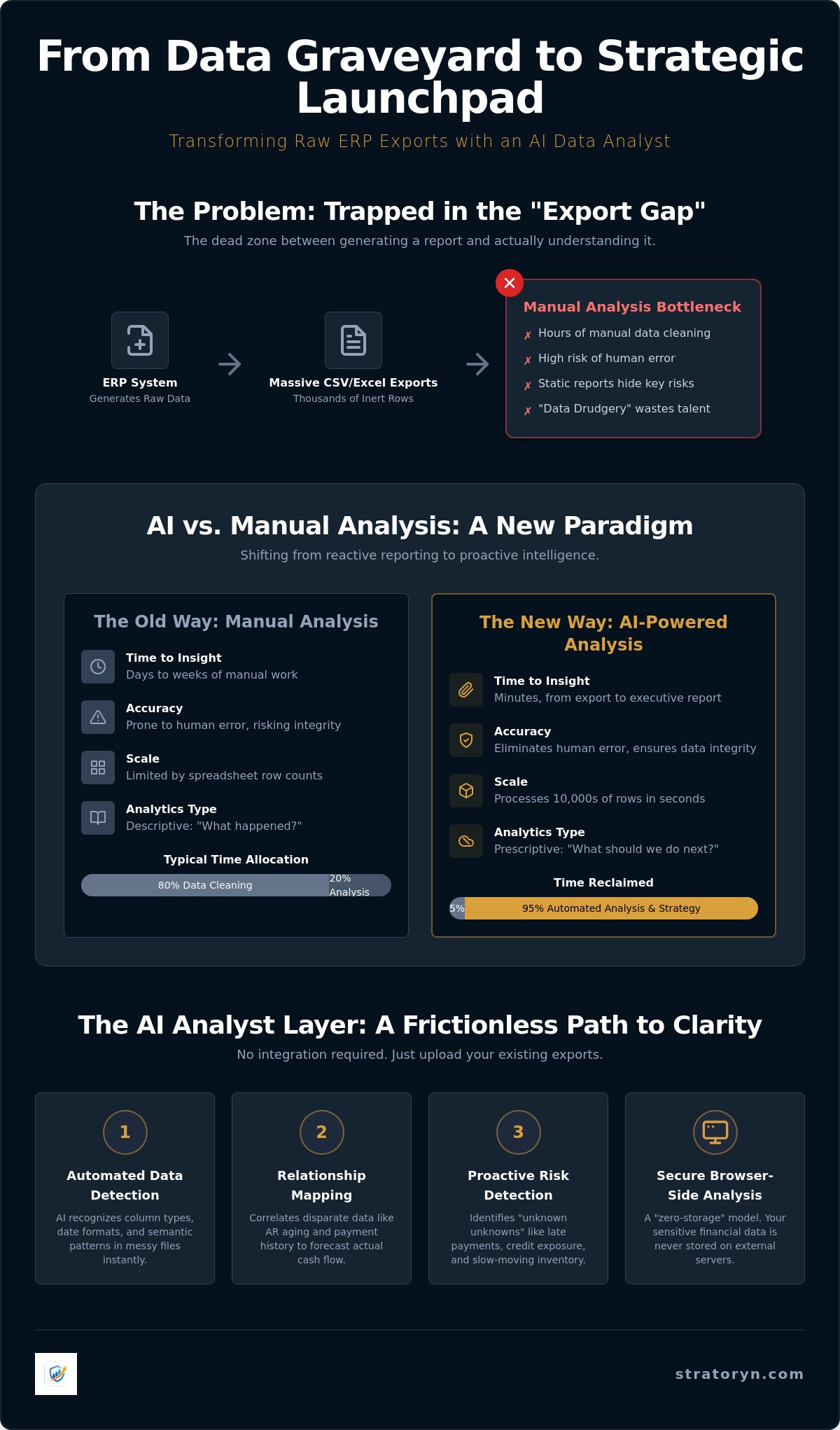
Most finance teams operate in the "Export Gap." This is the dead zone between generating a report and actually understanding it. You download a massive CSV from your system, and it sits in your folder, inert and unread. In 2026, relying on manual Excel analysis to bridge this gap is a liability. Data volumes have scaled beyond the capacity of traditional pivot tables. When you're dealing with tens of thousands of rows across multiple entities, human error isn't just a risk; it's a certainty.
The Limitations of Traditional ERP Reporting
Legacy reporting modules are notoriously rigid. They provide standardized views that lack the specific context your executive team needs for rapid decision-making. Customizing these reports is often a slow, expensive process involving external consultants or backlogged IT departments. This creates "Data Drudgery." High-value finance professionals end up spending 80% of their time cleaning data and only 20% analyzing it. It's a waste of talent and a bottleneck for growth. When reports are too static, your business remains reactive rather than proactive.
This "Data Drudgery" doesn't just affect corporate productivity; it often manifests as physical tension and fatigue, which is why high-performing professionals turn to holistic platforms like Face Up for specialized facial sculpting and somatic bodywork to maintain their executive presence.
Why AI Data Analytics is the Solution
An ai data analyst for erp data processes thousands of rows in seconds. It uses advanced pattern recognition to spot anomalies that a human eye would miss in a 50MB spreadsheet. It identifies "unknown unknowns," such as subtle shifts in vendor pricing or emerging cash flow risks that haven't hit the balance sheet yet. By automating the interpretation of CSV and Excel files, you bridge the gap between raw data and executive action. It turns your downloads folder from a graveyard of information into a launchpad for strategic insights. Efficiency isn't just about speed; it's about the clarity that allows you to move with confidence.
This need for operational clarity isn't limited to digital data; many enterprise leaders visit DroneWorksIQ to harness aerial intelligence and drone-based analysis for a more complete view of their physical assets and site operations.
How AI Data Analytics Decodes Complex ERP Exports
Raw exports are often a chaotic mix of inconsistent date formats, truncated strings, and nested values. An ai data analyst for erp data begins by performing automated data type detection across these messy files. Instead of a human manually mapping columns or writing macros, the AI recognizes semantic patterns. It understands that a specific string in one column is a customer ID, while a decimal in another represents tax-inclusive revenue. This initial layer of interpretation is what separates a simple parser from a true intelligence tool.
The true value emerges when the system identifies complex relationships between disparate data points. It doesn't just see a list of invoices; it correlates accounts receivable aging with historical payment behavior to forecast actual cash flow. This transformation of flat files into structured intelligence happens almost instantly. It builds a multi-dimensional model of your business health without requiring a six-month database consolidation project. By focusing on the exports you already generate, the technology bypasses the traditional hurdles of enterprise software.
Automated Risk and Opportunity Detection
Automated Risk Detection is the proactive identification of financial anomalies without manual queries. The AI scans your exports to spot late payments and rising credit exposure before they impact your quarterly results. It acts as a continuous monitor for your financial health. Beyond cash, it identifies inventory stock problems by flagging aging or slow-moving items that drain your liquidity. These insights allow you to reallocate capital to more productive areas of the business, just as ArmIQ enables baseball organizations to monitor player health and optimize their most valuable human assets.
This principle of continuous, specialized oversight extends to other high-stakes environments as well; for example, professional breeders can visit BovEquine to implement advanced health monitoring and foaling surveillance systems that protect their most valuable assets.
Security First: The Browser-Side Analysis Model
Security remains a primary concern for finance leaders. The browser-side analysis model addresses this by ensuring your raw files are not stored on external servers. The processing occurs locally within your browser, meaning sensitive financial data never leaves your controlled environment. This "zero-storage" approach satisfies strict data privacy requirements and eliminates the risks associated with third-party data hosting. You gain the power of advanced AI without compromising your internal security protocols.
Maintaining high-stakes integrity is equally critical in technical recruitment; for organizations looking to secure their assessment process, Aiseptor offers a network-layer solution to prevent AI-assisted cheating during technical interviews and certification exams.
Deploying an ai data analyst for erp data allows you to maintain this high security standard while gaining executive-level visibility. If you want to move from raw data to insights without the security risks, consider trying the ERP Intelligence Workspace today.
AI vs. Manual Analysis: Efficiency and Accuracy in 2026
Manual analysis is a relic of a slower era. When you rely on pivot tables and VLOOKUPs to interpret massive exports, you aren't just losing time; you're inviting error. In 2026, the complexity of enterprise data demands a more robust approach. An ai data analyst for erp data provides a significant efficiency gain by automating the diagnostic phase of analysis. While a human analyst might spend hours verifying data integrity across thousands of rows, an AI workspace completes these checks in seconds. This isn't about replacing your team. It's about scaling their intelligence. By removing the burden of rote data cleaning, your finance professionals can focus on high-level strategic planning, a transition that Trainetics Academy facilitates through dedicated corporate training programs.
The cost-benefit analysis heavily favors intelligent automation. Hiring additional analysts to manage increasing data volumes is a slow and expensive process. In contrast, a SaaS-based AI tool offers immediate scalability. It provides a level of accuracy that human oversight simply cannot match at scale. Human fatigue leads to missed anomalies and formula errors. AI remains consistent, ensuring that every data integrity gap is detected before it influences a decision. It turns a reactive department into a proactive intelligence hub.
While AI streamlines internal workflows, it is equally powerful for external growth; to see how these technologies can boost your search performance and online visibility, check out RANE Digital.
Speed to Executive-Ready Management Reports
Executive decision-making requires speed. Traditional reporting cycles often leave leaders looking at data that is already weeks old. With automated analysis, you can move from a raw CSV export to polished Executive-Ready Reports in under five minutes. This speed is critical during the high-stress "Close-of-Month" period. Instead of rushing to build decks, you can spend that time reviewing insights and preparing for board-level discussions. The formatting is professional and consistent, ensuring that your data tells a clear, impact-driven story every time, a level of narrative clarity that agencies like Branding TITANS™ champion for corporate identities.
Data Quality and Migration Readiness
High-stakes enterprise transitions are often derailed by poor data quality. Before moving to a new system, you must ensure your current records are clean. Using AI as an ERP migration data quality tool allows you to spot duplicates, missing values, and inconsistent formatting instantly. It acts as a final gatekeeper, ensuring that only high-quality data enters your new environment. This proactive approach prevents the "garbage in, garbage out" scenario that plagues many ERP implementations. By verifying data integrity early, you protect the long-term ROI of your technology investments.
Best Practices for Preparing ERP Data for AI Processing
An ai data analyst for erp data is built to handle complexity, but its output speed correlates directly with the clarity of your inputs. You don't need a background in data science to prepare your files for analysis. Efficiency begins with standardization. While modern AI workspaces process both CSV and Excel files, raw CSVs are often preferred for their lack of hidden formatting. Ensure your column headers are descriptive and consistent across different entities. If your SAP export uses different headers than your NetSuite export, align them before uploading to ensure a unified view of your operations.
Filtering unnecessary noise is a critical step that many finance managers overlook. If your goal is cash flow analysis, you don't need 200 columns containing warehouse bin locations or shipping weights. Select only the fields that drive your specific KPIs. This focus reduces the cognitive load on the system and ensures the resulting reports are concise. Data profiling plays a vital role here; it acts as a diagnostic tool that highlights the general health of your ERP data before you even begin a deep dive. It's about ensuring your foundation is solid.
Optimizing Exports for Rapid Analysis
Selecting the right fields is the difference between a cluttered report and a strategic insight. For inventory analysis, focus on stock levels, lead times, and unit costs. For cash flow, prioritize payment dates, credit terms, and outstanding balances. Global organizations must pay close attention to date formats and currency symbols. Standardizing these to a single format across all regions prevents interpretation errors during the analysis phase. Cleaner exports don't just save time; they lead to significantly more accurate AI-powered insights that executives can trust.
This principle of using specialized data to gain a competitive edge is also vital for business development; agencies looking to scale in the restoration and HVAC sectors can visit LeadOpsIQ to access targeted weekly lead intelligence.
Maintaining a Clean ERP Environment
Automation works best when the source data is disciplined. Conduct regular data quality analysis to identify and prevent the "garbage in, garbage out" cycle. Use the feedback generated by your AI workspace to fix root-cause errors in your primary ERP system. If the AI consistently flags duplicate vendor entries or missing tax codes, it's a signal to update your internal data entry protocols. Training your staff on these consistencies ensures that your AI tools have the best possible material to work with. This proactive approach turns your ERP from a static record-keeper into a dynamic intelligence engine.
Stop struggling with messy spreadsheets and start generating insights. You can begin your first Data Quality Analysis with Stratoryn today to see the difference immediately.
Stratoryn: Your Instant AI Data Analyst for ERP Intelligence
Traditional ERP intelligence requires months of technical integration and significant capital expenditure. Stratoryn disrupts this model with a "No Integration Needed" philosophy. We recognize that your most valuable data already exists in the CSV and Excel exports you generate daily. An ai data analyst for erp data should work with your existing workflow, not force you to rebuild it. By providing a frictionless software layer, we enable finance and operations teams to move from raw files to strategic insights in minutes. It's a modern approach for businesses that value speed and precision over monolithic system deployments.
Our ERP Intelligence Workspace functions as an instant analyst for teams using SAP, NetSuite, or Microsoft Dynamics. Unlike competitors who demand deep access to your database, Stratoryn operates on the outputs you already have. This removes the "Export Gap" discussed earlier, turning inert files into dynamic assets. You don't need a team of data engineers to unlock the value in your exports. You only need a tool that understands the language of enterprise data and can interpret it with high-level business logic.
Key Features for Finance and Operations
The core of the platform is built for action. Stratoryn provides automated detection of cash risks and stock problems, surfacing anomalies that often go unnoticed in massive spreadsheets. You receive high-level executive summaries generated instantly from your uploaded data. These summaries are designed for immediate impact, allowing you to present findings to the board without hours of manual preparation. Security is never an afterthought. Our browser-side processing model ensures your raw files are not stored on our servers, prioritizing your data privacy and meeting the strictest enterprise security standards.
Getting Started with AI Data Analytics
The path to clarity is simple and direct. The process follows a logical four-step sequence: Export, Upload, Analyze, and Report. This streamlined workflow allows you to maintain momentum during critical reporting periods. In 2026, we're offering a free early-access phase to help modern businesses experience the power of automated ERP intelligence firsthand. This is your opportunity to eliminate "Data Drudgery" and focus on the strategic decisions that drive growth. Use an ai data analyst for erp data to transform your financial operations into a proactive intelligence hub.
Ready to see what your data is actually telling you? Start your AI-powered ERP analysis with Stratoryn today and generate your first executive-ready report in minutes.
Modernize Your Financial Intelligence Strategy
The transition from static spreadsheet maintenance to dynamic business intelligence is no longer a luxury. By adopting an ai data analyst for erp data, you eliminate the manual bottlenecks that stall executive decision-making. You've seen how automated workflows can detect hidden cash and stock risks while maintaining absolute data privacy through browser-side processing. This model ensures your raw files are never stored on external servers, providing a secure and frictionless path to operational clarity.
Effective leadership requires speed. Moving from raw CSV exports to Executive-Ready Reports instantly allows your team to focus on high-stakes strategy rather than repetitive data cleaning. Stratoryn provides the tools to bridge the gap between raw information and actionable insight without the burden of traditional, months-long IT integrations. You already have the data; now you have the means to activate it with precision. It's time to shift your focus from managing spreadsheets to leading with data-driven confidence.
Beyond financial data, many organizations are also applying these principles to their human capital; you can discover Humae to learn how AI-powered platforms are streamlining workforce management for modern teams.
Access the AI ERP Intelligence Workspace for Free and start transforming your enterprise exports into a competitive advantage today. Reclaiming your professional time starts with a single, secure upload.
Frequently Asked Questions
What is an AI data analyst for ERP data?
An ai data analyst for erp data is a specialized software layer that interprets raw enterprise data exports to surface strategic insights. It automates the diagnostic phase of analysis, identifying patterns and financial risks within CSV or Excel files that would take a human hours to parse manually. This tool acts as a bridge between raw system outputs and executive-level decision-making.
Do I need to integrate Stratoryn with my SAP or Oracle system?
No, Stratoryn operates on a "No Integration Needed" philosophy to ensure rapid deployment. You simply export your data as a CSV or Excel file and upload it directly to the workspace. This approach bypasses the technical hurdles and security risks associated with direct database connections, allowing your team to generate insights immediately without waiting for IT approval.
How does browser-side processing protect my sensitive financial data?
Browser-side processing ensures that your raw files never leave your local environment. All analysis occurs within your web browser; this means sensitive financial records are not stored on external servers. This model meets strict data privacy requirements and provides a secure, "zero-storage" solution for enterprise data management, giving you the power of AI without compromising security.
Can AI detect data quality issues in my ERP exports?
Yes, the system performs comprehensive Data Quality Analysis to identify duplicates, missing values, and inconsistent formatting. It functions as a diagnostic tool that highlights the health of your data before you begin strategic reporting. This feature is particularly valuable for ensuring data integrity during high-stakes enterprise transitions or preparing for a system migration.
What kind of reports can an AI data analyst generate?
The platform generates Executive-Ready Reports that summarize financial and operational health instantly. These reports include automated detection of cash risks, accounts receivable aging, and inventory stock problems. The output is formatted for immediate impact, allowing you to present polished, professional findings to board members or stakeholders in minutes rather than days.
Is there a cost to use Stratoryn during the early-access phase?
Stratoryn is currently offering a free early-access phase in 2026 for businesses looking to modernize their data operations. This allows finance and operations teams to experience the full capabilities of the ERP Intelligence Workspace without an initial financial commitment. It's a frictionless way to evaluate how automated analysis can improve your decision-making speed and data accuracy.
Will this work with data exports from any ERP system?
Yes, the workspace is designed to be system-agnostic. It processes standard CSV and Excel exports from any major platform, including SAP, NetSuite, Microsoft Dynamics, or Oracle. As long as your system can generate a flat-file export, the ai data analyst for erp data can decode the relationships and surface actionable intelligence regardless of the source system's complexity.
Frequently asked questions
The Limitations of Traditional ERP Reporting
Legacy reporting modules are notoriously rigid. They provide standardized views that lack the specific context your executive team needs for rapid decision-making. Customizing these reports is often a slow, expensive process involving external consultants or backlogged IT departments. This creates "Data Drudgery." High-value finance professionals end up spending 80% of their time cleaning data and only 20% analyzing it. It's a waste of talent and a bottleneck for growth. When reports are too static, your business remains reactive rather than proactive.
Why AI Data Analytics is the Solution
An ai data analyst for erp data processes thousands of rows in seconds. It uses advanced pattern recognition to spot anomalies that a human eye would miss in a 50MB spreadsheet. It identifies "unknown unknowns," such as subtle shifts in vendor pricing or emerging cash flow risks that haven't hit the balance sheet yet. By automating the interpretation of CSV and Excel files, you bridge the gap between raw data and executive action. It turns your downloads folder from a graveyard of information into a launchpad for strategic insights. Efficiency isn't just about speed; it's about the clarity that allows you to move with confidence. Raw exports are often a chaotic mix of inconsistent date formats, truncated strings, and nested values. An ai data analyst for erp data begins by performing automated data type detection across these messy files. Instead of a human manually mapping columns or writing macros, the AI recognizes semantic patterns. It understands that a specific string in one column is a customer ID, while a decimal in another represents tax-inclusive revenue. This initial layer of interpretation is what separates a simple parser from a true intelligence tool. The true value e
Automated Risk and Opportunity Detection
Automated Risk Detection is the proactive identification of financial anomalies without manual queries. The AI scans your exports to spot late payments and rising credit exposure before they impact your quarterly results. It acts as a continuous monitor for your financial health. Beyond cash, it identifies inventory stock problems by flagging aging or slow-moving items that drain your liquidity. These insights allow you to reallocate capital to more productive areas of the business.
Security First: The Browser-Side Analysis Model
Security remains a primary concern for finance leaders. The browser-side analysis model addresses this by ensuring your raw files are not stored on external servers. The processing occurs locally within your browser, meaning sensitive financial data never leaves your controlled environment. This "zero-storage" approach satisfies strict data privacy requirements and eliminates the risks associated with third-party data hosting. You gain the power of advanced AI without compromising your internal security protocols. Deploying an ai data analyst for erp data allows you to maintain this high security standard while gaining executive-level visibility. If you want to move from raw data to insights without the security risks, consider trying the ERP Intelligence Workspace today. Manual analysis is a relic of a slower era. When you rely on pivot tables and VLOOKUPs to interpret massive exports, you aren't just losing time; you're inviting error. In 2026, the complexity of enterprise data demands a more robust approach. An ai data analyst for erp data provides a significant efficiency gain by automating the diagnostic phase of analysis. While a human analyst might spend hours verifying data
Speed to Executive-Ready Management Reports
Executive decision-making requires speed. Traditional reporting cycles often leave leaders looking at data that is already weeks old. With automated analysis, you can move from a raw CSV export to polished Executive-Ready Reports in under five minutes. This speed is critical during the high-stress "Close-of-Month" period. Instead of rushing to build decks, you can spend that time reviewing insights and preparing for board-level discussions. The formatting is professional and consistent, ensuring that your data tells a clear, impact-driven story every time.
Data Quality and Migration Readiness
High-stakes enterprise transitions are often derailed by poor data quality. Before moving to a new system, you must ensure your current records are clean. Using AI as an ERP migration data quality tool allows you to spot duplicates, missing values, and inconsistent formatting instantly. It acts as a final gatekeeper, ensuring that only high-quality data enters your new environment. This proactive approach prevents the "garbage in, garbage out" scenario that plagues many ERP implementations. By verifying data integrity early, you protect the long-term ROI of your technology investments. An ai data analyst for erp data is built to handle complexity, but its output speed correlates directly with the clarity of your inputs. You don't need a background in data science to prepare your files for analysis. Efficiency begins with standardization. While modern AI workspaces process both CSV and Excel files, raw CSVs are often preferred for their lack of hidden formatting. Ensure your column headers are descriptive and consistent across different entities. If your SAP export uses different headers than your NetSuite export, align them before uploading to ensure a unified view of your operatio
Optimizing Exports for Rapid Analysis
Selecting the right fields is the difference between a cluttered report and a strategic insight. For inventory analysis, focus on stock levels, lead times, and unit costs. For cash flow, prioritize payment dates, credit terms, and outstanding balances. Global organizations must pay close attention to date formats and currency symbols. Standardizing these to a single format across all regions prevents interpretation errors during the analysis phase. Cleaner exports don't just save time; they lead to significantly more accurate AI-powered insights that executives can trust.
Maintaining a Clean ERP Environment
Automation works best when the source data is disciplined. Conduct regular data quality analysis to identify and prevent the "garbage in, garbage out" cycle. Use the feedback generated by your AI workspace to fix root-cause errors in your primary ERP system. If the AI consistently flags duplicate vendor entries or missing tax codes, it's a signal to update your internal data entry protocols. Training your staff on these consistencies ensures that your AI tools have the best possible material to work with. This proactive approach turns your ERP from a static record-keeper into a dynamic intelligence engine. Stop struggling with messy spreadsheets and start generating insights. You can begin your first Data Quality Analysis with Stratoryn today to see the difference immediately. Traditional ERP intelligence requires months of technical integration and significant capital expenditure. Stratoryn disrupts this model with a "No Integration Needed" philosophy. We recognize that your most valuable data already exists in the CSV and Excel exports you generate daily. An ai data analyst for erp data should work with your existing workflow, not force you to rebuild it. By providing a frictionl
Key Features for Finance and Operations
The core of the platform is built for action. Stratoryn provides automated detection of cash risks and stock problems, surfacing anomalies that often go unnoticed in massive spreadsheets. You receive high-level executive summaries generated instantly from your uploaded data. These summaries are designed for immediate impact, allowing you to present findings to the board without hours of manual preparation. Security is never an afterthought. Our browser-side processing model ensures your raw files are not stored on our servers, prioritizing your data privacy and meeting the strictest enterprise security standards.
Getting Started with AI Data Analytics
The path to clarity is simple and direct. The process follows a logical four-step sequence: Export, Upload, Analyze, and Report. This streamlined workflow allows you to maintain momentum during critical reporting periods. In 2026, we're offering a free early-access phase to help modern businesses experience the power of automated ERP intelligence firsthand. This is your opportunity to eliminate "Data Drudgery" and focus on the strategic decisions that drive growth. Use an ai data analyst for erp data to transform your financial operations into a proactive intelligence hub. Ready to see what your data is actually telling you? Start your AI-powered ERP analysis with Stratoryn today and generate your first executive-ready report in minutes. The transition from static spreadsheet maintenance to dynamic business intelligence is no longer a luxury. By adopting an ai data analyst for erp data, you eliminate the manual bottlenecks that stall executive decision-making. You've seen how automated workflows can detect hidden cash and stock risks while maintaining absolute data privacy through browser-side processing. This model ensures your raw files are never stored on external servers, provi
What is an AI data analyst for ERP data?
An ai data analyst for erp data is a specialized software layer that interprets raw enterprise data exports to surface strategic insights. It automates the diagnostic phase of analysis, identifying patterns and financial risks within CSV or Excel files that would take a human hours to parse manually. This tool acts as a bridge between raw system outputs and executive-level decision-making.
Do I need to integrate Stratoryn with my SAP or Oracle system?
No, Stratoryn operates on a "No Integration Needed" philosophy to ensure rapid deployment. You simply export your data as a CSV or Excel file and upload it directly to the workspace. This approach bypasses the technical hurdles and security risks associated with direct database connections, allowing your team to generate insights immediately without waiting for IT approval.
How does browser-side processing protect my sensitive financial data?
Browser-side processing ensures that your raw files never leave your local environment. All analysis occurs within your web browser; this means sensitive financial records are not stored on external servers. This model meets strict data privacy requirements and provides a secure, "zero-storage" solution for enterprise data management, giving you the power of AI without compromising security.
Can AI detect data quality issues in my ERP exports?
Yes, the system performs comprehensive Data Quality Analysis to identify duplicates, missing values, and inconsistent formatting. It functions as a diagnostic tool that highlights the health of your data before you begin strategic reporting. This feature is particularly valuable for ensuring data integrity during high-stakes enterprise transitions or preparing for a system migration.
What kind of reports can an AI data analyst generate?
The platform generates Executive-Ready Reports that summarize financial and operational health instantly. These reports include automated detection of cash risks, accounts receivable aging, and inventory stock problems. The output is formatted for immediate impact, allowing you to present polished, professional findings to board members or stakeholders in minutes rather than days.
Is there a cost to use Stratoryn during the early-access phase?
Stratoryn is currently offering a free early-access phase in 2026 for businesses looking to modernize their data operations. This allows finance and operations teams to experience the full capabilities of the ERP Intelligence Workspace without an initial financial commitment. It's a frictionless way to evaluate how automated analysis can improve your decision-making speed and data accuracy.
Will this work with data exports from any ERP system?
Yes, the workspace is designed to be system-agnostic. It processes standard CSV and Excel exports from any major platform, including SAP, NetSuite, Microsoft Dynamics, or Oracle. As long as your system can generate a flat-file export, the ai data analyst for erp data can decode the relationships and surface actionable intelligence regardless of the source system's complexity.
- ai data analyst for erp data
- ERP
- AI Data Analysis
- Business Intelligence
- Financial Reporting
- Data Automation
- Executive Reporting
- ERP Data
- erp data analysis
- automated financial reporting
- erp intelligence
- business intelligence for erp
- erp reporting tools