
Best Power BI Alternatives for Finance Teams in 2026: Beyond Visualization

Why is your finance team still waiting on IT to build reports that should be available at the click of a button? Searching for power bi alternatives for finance usually begins when the friction of the "IT bottleneck" outweighs the benefit of a colorful chart. You need immediate answers, not another complex DAX formula for a standard liquidity ratio. Following the 40% price increase for Power BI Pro in 2025 and the complex transition to Microsoft Fabric, many leaders are realizing that technical overhead has become a significant liability.
We know the frustration of dashboards that break every time your ERP data is exported. You shouldn't need a data engineer to maintain basic visibility. This guide reveals the most efficient alternatives to Power BI that automate financial reporting and risk detection without the technical debt. We'll examine the 2026 landscape of agentic analytics and semantic layers that prioritize executive-ready insights over manual labor. It's time to move beyond basic visualization and reclaim the speed your operations require.
Key Takeaways
- Eliminate the "DAX Tax" by moving from manual data modeling to automated financial intelligence.
- Evaluate the best power bi alternatives for finance based on their ability to process raw ERP exports without engineering support.
- Discover why "export-first" workflows provide superior security and speed compared to complex API integrations.
- Identify the differences between traditional BI platforms and modern AI-driven workspaces that prioritize automated risk detection.
- Learn how to generate executive-ready reports directly from your existing spreadsheets in minutes.
Table of Contents
- Why Finance Teams are Moving Beyond Power BI in 2026
- Evaluating Power BI Alternatives: 4 Critical Criteria for Finance
- Top Power BI Alternatives for Finance: From Traditional BI to AI-First Tools
- Overcoming the Implementation Hurdle: No-Integration vs. Full-Stack BI
- Stratoryn: The AI-Powered Workspace for Instant Financial Intelligence
Why Finance Teams are Moving Beyond Power BI in 2026
Power BI has long been the default choice for organizations entrenched in the Microsoft ecosystem. However, the requirements for financial reporting have evolved past simple bar charts and line graphs. As we move through 2026, the limitations of general-purpose tools are becoming clear. A true finance-first BI alternative isn't just a different way to look at data; it's a system that prioritizes automated insights over manual modeling. While traditional business intelligence software focuses on broad data visualization across every department, finance teams require a specialized environment that understands the logic of a balance sheet or a rolling forecast without manual intervention.
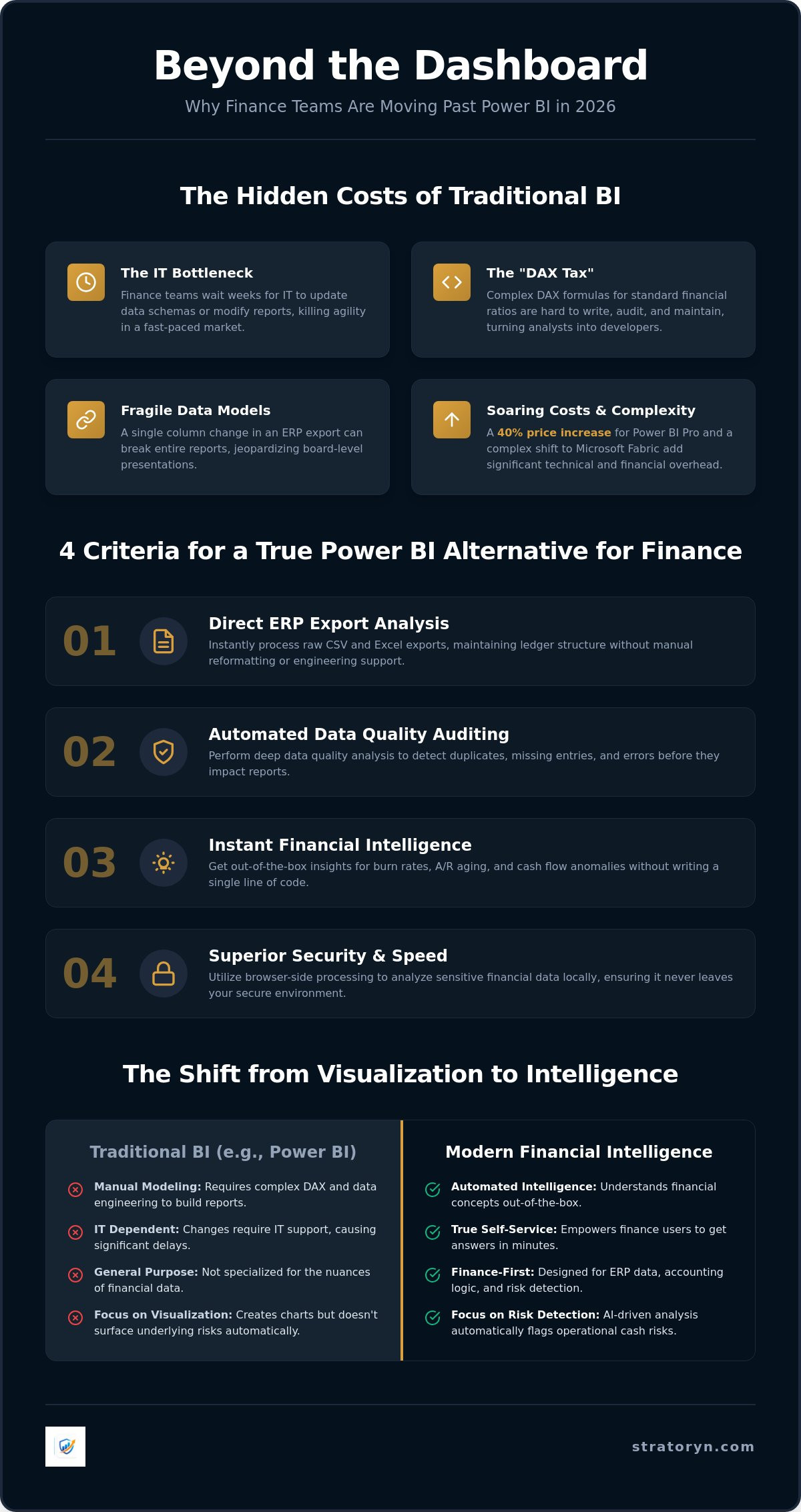
The "DAX Tax" is perhaps the most significant hidden cost of staying with legacy platforms. Creating standard financial ratios or year-over-year comparisons often requires complex Data Analysis Expressions (DAX) that are difficult to write and even harder to audit. This technical burden forces senior finance professionals to act as amateur developers. When your team spends most of their week troubleshooting formulas instead of analyzing variance, productivity stalls. Visualization alone fails to surface operational cash risks. A dashboard might look polished, but if it doesn't automatically flag a data quality error in an ERP export, it provides a false sense of security.
The IT Bottleneck and the Death of Self-Service
Finance teams often wait weeks for IT departments to update data schemas or modify a report's underlying structure. This delay is unacceptable in a fast-paced market where yesterday's data is already obsolete. Rigid dashboards lack the flexibility to handle ad-hoc financial queries, forcing teams back into the manual spreadsheet cycles they tried to escape. The IT bottleneck is the primary barrier to agile financial decision-making.
Data Modeling Complexity vs. Financial Speed
The "build-it-yourself" approach of Power BI creates a fragile reporting environment. If a single column name changes in an ERP export, the entire data model can break, leading to "broken" reports that jeopardize board-level presentations. Modern power bi alternatives for finance eliminate this risk by using intelligent automation to detect data types and quality issues instantly. In 2026, speed and accuracy are the only metrics that matter. Finance leaders now prioritize time-to-insight over dashboard aesthetics, choosing tools that deliver executive-ready answers without the technical overhead of traditional data engineering.
Evaluating Power BI Alternatives: 4 Critical Criteria for Finance
Finance teams don't need another generic dashboard tool. They need a system designed for the rigors of financial accounting and operational oversight. When vetting power bi alternatives for finance, look beyond the ability to connect to a database. You need a platform that handles the messy reality of ERP data without requiring a full-scale engineering project. The following four criteria define a high-performance financial intelligence environment.
First, prioritize direct analysis of ERP exports. Most BI tools fail because they require a "perfect" API connection that IT must maintain. In reality, finance teams rely on CSV and Excel exports for speed and flexibility. A superior alternative processes these raw files instantly, maintaining the structure of your general ledger without manual reformatting. Second, insist on automated data quality auditing. Financial integrity is non-negotiable. If your underlying data has duplicates or missing entries, your reports are worthless. Look for tools that perform deep data quality analysis before you ever see a chart.
Third, ensure the platform provides instant financial intelligence. This means the software understands concepts like burn rates, accounts receivable aging, and inventory turnover right out of the box. It should detect cash flow anomalies and stock risks without you writing a single line of code. Finally, consider security and privacy. Large-scale cloud integrations often raise security red flags for sensitive financial information. Browser-side processing is the new standard. It ensures that data is analyzed locally within your secure environment, rather than being stored on a third-party server.
Automated Insight Generation
Speed is the ultimate competitive advantage for a modern finance department. Evaluate tools based on their ability to highlight operational risks without user prompts. AI-driven platforms can identify hidden opportunities in vendor spend or identify leakage in accounts receivable that a human analyst might miss. This technology results in executive-ready reports produced in minutes, not days. It shifts the team's focus from data preparation to strategic intervention.
Zero-Integration Deployment
Implementation shouldn't take months of planning. Zero-integration tools function without a direct ERP connection, significantly reducing the security review cycle and IT workload. This approach allows you to transition from raw data to actionable insight in seconds. If you want to experience this speed, explore how a modern ERP Intelligence Workspace handles complex data without the technical debt. By removing the need for direct database access, you eliminate the primary cause of project delays and security vulnerabilities.
Top Power BI Alternatives for Finance: From Traditional BI to AI-First Tools
Selecting the right power bi alternatives for finance requires a clear understanding of your team's technical capacity. You must decide if you want to build a complex data factory or receive instant answers. The current market in 2026 has split into three distinct categories. Each serves a different organizational maturity level and technical requirement. Whether you prioritize aesthetic flexibility or operational speed, your choice will determine how much time your team spends on data preparation versus strategic intervention.
Traditional BI: Tableau and Looker
Traditional BI platforms like Tableau and Looker represent the legacy of high-end data engineering. They offer powerful visualization capabilities and massive community support. These tools are ideal for centralized corporate reporting where dedicated data teams manage every metric. However, the overhead is massive. For finance professionals, these platforms often create significant technical debt. High licensing costs and the constant need for IT to update data schemas make them inefficient for agile, day-to-day financial queries. Use these if your organization has the budget for full-time data engineers to maintain your dashboards.
Finance Specialists: Datarails and Mosaic
Specialized tools like Datarails, Vena, and Mosaic focus on deep Excel integration and specialized FP&A workflows. They are designed for mid-market finance teams that live in spreadsheets but need cloud-based consolidation. These platforms excel at budgeting and long-term planning. The downside is the implementation hurdle. They often require complex setup phases and focus heavily on financial planning rather than immediate operational risk detection. If your primary goal is month-end consolidation and multi-entity reporting, these are strong contenders, provided you have the patience for a multi-month rollout.
AI Innovators: The ERP Intelligence Workspace
This category represents the most significant shift in financial technology. An ERP Intelligence Workspace prioritizes speed, security, and automated insight. Stratoryn leads this space by offering an AI Data Analyst that scans raw ERP exports to identify risks you didn't even think to ask about. This approach is the fastest path to insight for CFOs who need immediate clarity on cash risks and stock problems.
- Pros: Instant analysis of CSV exports and automated risk flagging.
- Cons: Not intended for custom-built, highly specific visual art.
- Ideal use case: Leaders who value actionable intelligence over complex dashboard construction.
By moving away from manual modeling, these AI-driven power bi alternatives for finance eliminate the "DAX tax" entirely. They allow your team to upload a simple export and receive an executive-ready report in seconds. This shift from "building" to "analyzing" is the hallmark of a modern finance department.
Overcoming the Implementation Hurdle: No-Integration vs. Full-Stack BI
Implementation is often where ambitious data projects fail. Traditional "full-stack" BI requires months of API mapping, IT oversight, and complex data modeling. For many, this friction is the primary reason to seek power bi alternatives for finance that offer a lighter touch. In 2026, we're seeing a significant shift toward "export-first" workflows. This approach leverages the standard CSV and Excel files your ERP already generates, bypassing the need for permanent, vulnerable data tunnels that require constant maintenance.
Choosing power bi alternatives for finance that prioritize no-integration models allows your team to maintain full control over the data lifecycle. You shouldn't have to wait for a database administrator to grant permissions every time you need a new report. By utilizing AI tools to analyze ERP exports, you can achieve the same level of depth as a live connection without the associated technical debt. One common objection is the perceived need for "real-time" data. In practice, most critical financial decisions rely on validated snapshots or closed periods. Live connections often introduce noise and unvalidated entries that complicate the audit trail and lead to conflicting numbers.
The Security Advantage of Browser-Side Processing
Modern SaaS solutions are moving away from centralized data storage. Browser-side processing allows your data to be analyzed locally within your secure session. Raw files are never stored on a third-party server, which drastically reduces the surface area for potential data leaks. This non-storage model is winning the trust of compliance officers who are wary of permanent data warehouses. It provides the insights you need without the liability of a permanent data footprint.
Fixing Data Quality at the Source
A major flaw in traditional BI is the "garbage-in, garbage-out" cycle. If your ERP contains duplicate records or stock anomalies, a standard dashboard will simply visualize those errors as truth. Advanced alternatives use AI to perform a deep Data Quality Analysis before any reporting begins. They detect integrity gaps and provide early warnings on potential inaccuracies. Automated data quality audits prevent "garbage-in, garbage-out" scenarios by ensuring every executive-ready report is built on a foundation of verified information.
Ready to simplify your workflow? Explore how an ERP Intelligence Workspace handles complex data without the technical debt of a traditional integration.
Stratoryn: The AI-Powered Workspace for Instant Financial Intelligence
Traditional data tools often demand more from your team than they provide in return. Stratoryn changes this dynamic by functioning as a streamlined alternative to the inherent complexity of legacy platforms. While most power bi alternatives for finance still require you to build the logic from scratch, our ERP Intelligence Workspace arrives with financial logic already built in. You don't need to spend weeks mapping fields or writing code. The platform automatically detects data types and structures from simple CSV uploads, allowing you to bypass the technical hurdles that typically stall financial reporting projects.
Our focus isn't just on making data look better; it's on making it more useful. We prioritize specific financial outcomes like identifying urgent cash risks and surfacing stock problems before they impact your bottom line. By using Stratoryn, you move from a state of reactive troubleshooting to proactive management. The system generates Executive-Ready Reports that require zero manual formatting, ensuring that the insights you present to the board are polished, accurate, and professional every time.
From Raw Export to Executive Insight in Seconds
The transition from raw data to actionable intelligence follows a logical, four-step sequence. First, you upload your standard ERP export. Second, our AI Data Analyst performs a deep scan of the information. Third, the system automatically flags risks such as duplicate payments, aging receivables, or inventory imbalances. Finally, it produces a comprehensive report ready for distribution. This workflow acts as a force multiplier for small finance teams, allowing you to reduce the month-end reporting cycle from several days to just a few minutes. It's about reclaiming your time for high-level strategic analysis.
Zero Risk, High Reward: Early Access in 2026
The landscape of financial technology is moving toward automation and speed. As part of our 2026 rollout, we're offering a free early-access phase for forward-thinking finance leaders. This is an opportunity to see how your current SAP, NetSuite, or Oracle exports look when processed through a modern, intelligent workspace. You can start analyzing your data today without committing to a long-term integration project or a complex infrastructure overhaul. It's the most direct way to evaluate power bi alternatives for finance while seeing immediate value from your existing ERP data.
Don't let technical debt slow your decision-making. Take the first step toward a more efficient reporting process and Get Early Access to the ERP Intelligence Workspace today. Experience the clarity that comes when your data works for you, rather than the other way around.
Modernizing Your Financial Intelligence Strategy
The shift from manual visualization to automated intelligence is no longer optional. You've explored how the landscape for power bi alternatives for finance has evolved to prioritize speed, security, and the elimination of the IT bottleneck. Choosing a workflow that leverages raw ERP exports removes the technical debt that often cripples traditional reporting cycles. You no longer need to wait for IT to build the clarity you need to lead effectively.
Stratoryn offers the most direct path to this efficiency. Our workspace provides automated risk detection for cash and stock alongside zero-integration browser-side processing. You can generate executive-ready reports in seconds, shifting your focus from data preparation to strategic intervention. It's the frictionless way to handle high-stakes data without the overhead of traditional data engineering or permanent storage risks.
Start Analyzing Your ERP Exports for Free with Stratoryn. Reclaim the agility your organization requires. The future of finance is automated, secure, and remarkably fast.
Frequently Asked Questions
Why is Power BI so difficult for finance teams to use?
Power BI is a general-purpose tool that requires significant technical overhead to function effectively for finance. You must master complex DAX formulas and data modeling just to calculate standard financial ratios. This creates a dependency on IT departments that slows down critical decision-making. Finance professionals often find themselves acting as amateur data engineers rather than focusing on high-level strategic analysis.
Can I use Power BI alternatives without a data warehouse?
Yes, you can bypass the need for a permanent data warehouse by using export-first platforms. Many power bi alternatives for finance allow you to analyze data directly from your existing ERP exports. This eliminates the need for expensive infrastructure and months of integration work. You gain immediate visibility into your numbers without the technical debt of a traditional data stack.
What is the best Power BI alternative for analyzing ERP exports?
The best alternative is an ERP Intelligence Workspace that prioritizes automated analysis over manual dashboard building. Stratoryn is specifically designed to handle raw CSV and Excel exports from any major system. It uses an AI Data Analyst to scan your data for integrity issues and operational risks instantly. This approach provides a much faster time-to-insight than traditional BI tools.
How do AI-powered finance tools handle data security?
Modern AI tools utilize browser-side processing to keep your sensitive financial data secure. This means the analysis happens locally within your secure session rather than being stored on a third-party server. This non-storage model significantly reduces the risk of data leaks and simplifies the compliance review process. It ensures your proprietary financial information remains under your direct control at all times.
Do Power BI alternatives support Excel and CSV files?
High-performance power bi alternatives for finance prioritize Excel and CSV support because these are the universal languages of finance. You don't need a direct API connection to get professional results. By uploading a simple export, you can trigger automated risk detection and report generation. This ensures your workflow remains agile and independent of IT's schedule or technical constraints.
What is an ERP Intelligence Workspace?
An ERP Intelligence Workspace is a specialized platform that automates the transformation of raw ERP data into executive insights. Unlike general BI tools, it contains built-in financial logic to detect cash risks and stock anomalies. It functions as a force multiplier for finance teams by handling the heavy lifting of data quality analysis and report formatting automatically without manual intervention.
Can I generate executive reports automatically from NetSuite or SAP?
Yes, you can generate Executive-Ready Reports automatically by uploading your exports from systems like NetSuite, SAP, or Oracle. The platform identifies the data structure and applies financial intelligence to surface key trends. This process removes the need for manual spreadsheet manipulation. You receive a polished, professional output that is ready for board-level presentations in just a few minutes.
How does AI detect financial risks better than a standard dashboard?
AI scans every transaction for anomalies, duplicates, and patterns that are often invisible on a standard bar chart. While a dashboard only shows you the data you've chosen to visualize, an AI Data Analyst proactively identifies leakage in accounts receivable or vendor spend. It acts as an automated auditor that ensures your financial integrity remains intact before you ever present your findings.
Frequently asked questions
The IT Bottleneck and the Death of Self-Service
Finance teams often wait weeks for IT departments to update data schemas or modify a report's underlying structure. This delay is unacceptable in a fast-paced market where yesterday's data is already obsolete. Rigid dashboards lack the flexibility to handle ad-hoc financial queries, forcing teams back into the manual spreadsheet cycles they tried to escape. The IT bottleneck is the primary barrier to agile financial decision-making.
Data Modeling Complexity vs. Financial Speed
The "build-it-yourself" approach of Power BI creates a fragile reporting environment. If a single column name changes in an ERP export, the entire data model can break, leading to "broken" reports that jeopardize board-level presentations. Modern power bi alternatives for finance eliminate this risk by using intelligent automation to detect data types and quality issues instantly. In 2026, speed and accuracy are the only metrics that matter. Finance leaders now prioritize time-to-insight over dashboard aesthetics, choosing tools that deliver executive-ready answers without the technical overhead of traditional data engineering. Finance teams don't need another generic dashboard tool. They need a system designed for the rigors of financial accounting and operational oversight. When vetting power bi alternatives for finance, look beyond the ability to connect to a database. You need a platform that handles the messy reality of ERP data without requiring a full-scale engineering project. The following four criteria define a high-performance financial intelligence environment. First, prioritize direct analysis of ERP exports. Most BI tools fail because they require a "perfect" API conn
Automated Insight Generation
Speed is the ultimate competitive advantage for a modern finance department. Evaluate tools based on their ability to highlight operational risks without user prompts. AI-driven platforms can identify hidden opportunities in vendor spend or identify leakage in accounts receivable that a human analyst might miss. This technology results in executive-ready reports produced in minutes, not days. It shifts the team's focus from data preparation to strategic intervention.
Zero-Integration Deployment
Implementation shouldn't take months of planning. Zero-integration tools function without a direct ERP connection, significantly reducing the security review cycle and IT workload. This approach allows you to transition from raw data to actionable insight in seconds. If you want to experience this speed, explore how a modern ERP Intelligence Workspace handles complex data without the technical debt. By removing the need for direct database access, you eliminate the primary cause of project delays and security vulnerabilities. Selecting the right power bi alternatives for finance requires a clear understanding of your team's technical capacity. You must decide if you want to build a complex data factory or receive instant answers. The current market in 2026 has split into three distinct categories. Each serves a different organizational maturity level and technical requirement. Whether you prioritize aesthetic flexibility or operational speed, your choice will determine how much time your team spends on data preparation versus strategic intervention.
Traditional BI: Tableau and Looker
Traditional BI platforms like Tableau and Looker represent the legacy of high-end data engineering. They offer powerful visualization capabilities and massive community support. These tools are ideal for centralized corporate reporting where dedicated data teams manage every metric. However, the overhead is massive. For finance professionals, these platforms often create significant technical debt. High licensing costs and the constant need for IT to update data schemas make them inefficient for agile, day-to-day financial queries. Use these if your organization has the budget for full-time data engineers to maintain your dashboards.
Finance Specialists: Datarails and Mosaic
Specialized tools like Datarails, Vena, and Mosaic focus on deep Excel integration and specialized FP&A workflows. They are designed for mid-market finance teams that live in spreadsheets but need cloud-based consolidation. These platforms excel at budgeting and long-term planning. The downside is the implementation hurdle. They often require complex setup phases and focus heavily on financial planning rather than immediate operational risk detection. If your primary goal is month-end consolidation and multi-entity reporting, these are strong contenders, provided you have the patience for a multi-month rollout.
AI Innovators: The ERP Intelligence Workspace
This category represents the most significant shift in financial technology. An ERP Intelligence Workspace prioritizes speed, security, and automated insight. Stratoryn leads this space by offering an AI Data Analyst that scans raw ERP exports to identify risks you didn't even think to ask about. This approach is the fastest path to insight for CFOs who need immediate clarity on cash risks and stock problems. By moving away from manual modeling, these AI-driven power bi alternatives for finance eliminate the "DAX tax" entirely. They allow your team to upload a simple export and receive an executive-ready report in seconds. This shift from "building" to "analyzing" is the hallmark of a modern finance department. Implementation is often where ambitious data projects fail. Traditional "full-stack" BI requires months of API mapping, IT oversight, and complex data modeling. For many, this friction is the primary reason to seek power bi alternatives for finance that offer a lighter touch. In 2026, we're seeing a significant shift toward "export-first" workflows. This approach leverages the standard CSV and Excel files your ERP already generates, bypassing the need for permanent, vulnerab
The Security Advantage of Browser-Side Processing
Modern SaaS solutions are moving away from centralized data storage. Browser-side processing allows your data to be analyzed locally within your secure session. Raw files are never stored on a third-party server, which drastically reduces the surface area for potential data leaks. This non-storage model is winning the trust of compliance officers who are wary of permanent data warehouses. It provides the insights you need without the liability of a permanent data footprint.
Fixing Data Quality at the Source
A major flaw in traditional BI is the "garbage-in, garbage-out" cycle. If your ERP contains duplicate records or stock anomalies, a standard dashboard will simply visualize those errors as truth. Advanced alternatives use AI to perform a deep Data Quality Analysis before any reporting begins. They detect integrity gaps and provide early warnings on potential inaccuracies. Automated data quality audits prevent "garbage-in, garbage-out" scenarios by ensuring every executive-ready report is built on a foundation of verified information. Ready to simplify your workflow? Explore how an ERP Intelligence Workspace handles complex data without the technical debt of a traditional integration. Traditional data tools often demand more from your team than they provide in return. Stratoryn changes this dynamic by functioning as a streamlined alternative to the inherent complexity of legacy platforms. While most power bi alternatives for finance still require you to build the logic from scratch, our ERP Intelligence Workspace arrives with financial logic already built in. You don't need to spend weeks mapping fields or writing code. The platform automatically detects data types and structures fr
From Raw Export to Executive Insight in Seconds
The transition from raw data to actionable intelligence follows a logical, four-step sequence. First, you upload your standard ERP export. Second, our AI Data Analyst performs a deep scan of the information. Third, the system automatically flags risks such as duplicate payments, aging receivables, or inventory imbalances. Finally, it produces a comprehensive report ready for distribution. This workflow acts as a force multiplier for small finance teams, allowing you to reduce the month-end reporting cycle from several days to just a few minutes. It's about reclaiming your time for high-level strategic analysis.
Zero Risk, High Reward: Early Access in 2026
The landscape of financial technology is moving toward automation and speed. As part of our 2026 rollout, we're offering a free early-access phase for forward-thinking finance leaders. This is an opportunity to see how your current SAP, NetSuite, or Oracle exports look when processed through a modern, intelligent workspace. You can start analyzing your data today without committing to a long-term integration project or a complex infrastructure overhaul. It's the most direct way to evaluate power bi alternatives for finance while seeing immediate value from your existing ERP data. Don't let technical debt slow your decision-making. Take the first step toward a more efficient reporting process and Get Early Access to the ERP Intelligence Workspace today. Experience the clarity that comes when your data works for you, rather than the other way around. The shift from manual visualization to automated intelligence is no longer optional. You've explored how the landscape for power bi alternatives for finance has evolved to prioritize speed, security, and the elimination of the IT bottleneck. Choosing a workflow that leverages raw ERP exports removes the technical debt that often cripples
Why is Power BI so difficult for finance teams to use?
Power BI is a general-purpose tool that requires significant technical overhead to function effectively for finance. You must master complex DAX formulas and data modeling just to calculate standard financial ratios. This creates a dependency on IT departments that slows down critical decision-making. Finance professionals often find themselves acting as amateur data engineers rather than focusing on high-level strategic analysis.
Can I use Power BI alternatives without a data warehouse?
Yes, you can bypass the need for a permanent data warehouse by using export-first platforms. Many power bi alternatives for finance allow you to analyze data directly from your existing ERP exports. This eliminates the need for expensive infrastructure and months of integration work. You gain immediate visibility into your numbers without the technical debt of a traditional data stack.
What is the best Power BI alternative for analyzing ERP exports?
The best alternative is an ERP Intelligence Workspace that prioritizes automated analysis over manual dashboard building. Stratoryn is specifically designed to handle raw CSV and Excel exports from any major system. It uses an AI Data Analyst to scan your data for integrity issues and operational risks instantly. This approach provides a much faster time-to-insight than traditional BI tools.
How do AI-powered finance tools handle data security?
Modern AI tools utilize browser-side processing to keep your sensitive financial data secure. This means the analysis happens locally within your secure session rather than being stored on a third-party server. This non-storage model significantly reduces the risk of data leaks and simplifies the compliance review process. It ensures your proprietary financial information remains under your direct control at all times.
Do Power BI alternatives support Excel and CSV files?
High-performance power bi alternatives for finance prioritize Excel and CSV support because these are the universal languages of finance. You don't need a direct API connection to get professional results. By uploading a simple export, you can trigger automated risk detection and report generation. This ensures your workflow remains agile and independent of IT's schedule or technical constraints.
What is an ERP Intelligence Workspace?
An ERP Intelligence Workspace is a specialized platform that automates the transformation of raw ERP data into executive insights. Unlike general BI tools, it contains built-in financial logic to detect cash risks and stock anomalies. It functions as a force multiplier for finance teams by handling the heavy lifting of data quality analysis and report formatting automatically without manual intervention.
Can I generate executive reports automatically from NetSuite or SAP?
Yes, you can generate Executive-Ready Reports automatically by uploading your exports from systems like NetSuite, SAP, or Oracle. The platform identifies the data structure and applies financial intelligence to surface key trends. This process removes the need for manual spreadsheet manipulation. You receive a polished, professional output that is ready for board-level presentations in just a few minutes.
How does AI detect financial risks better than a standard dashboard?
AI scans every transaction for anomalies, duplicates, and patterns that are often invisible on a standard bar chart. While a dashboard only shows you the data you've chosen to visualize, an AI Data Analyst proactively identifies leakage in accounts receivable or vendor spend. It acts as an automated auditor that ensures your financial integrity remains intact before you ever present your findings.
- power bi alternatives for finance
- Power BI
- Financial Reporting
- Business Intelligence
- Finance Technology
- Data Analytics
- Automation
- DAX
- CFO Tools
- power bi competitors finance
- automated financial reporting
- finance bi tools
- erp reporting software
- dax alternative