
Automated Financial Risk Detection: Scaling Finance Oversight in 2026

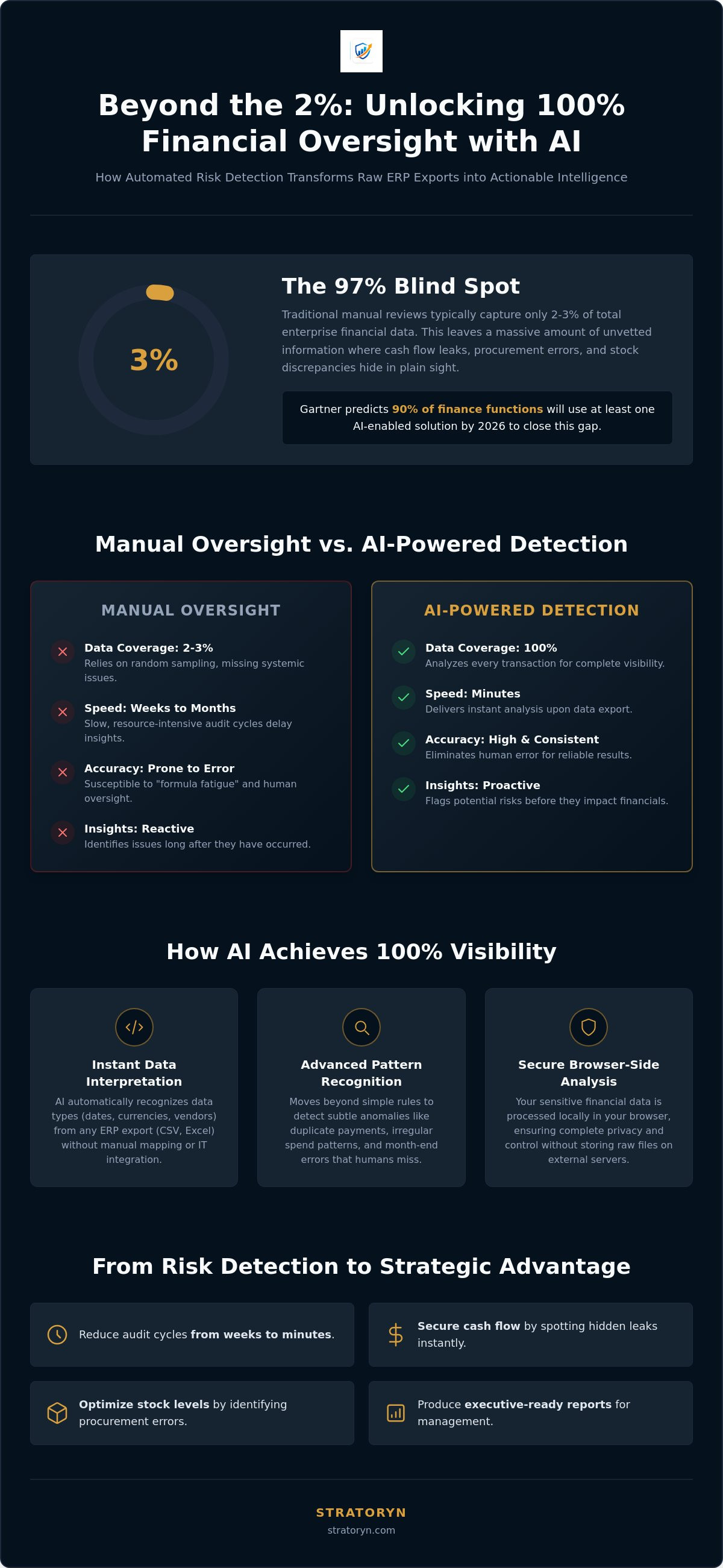
Gartner predicts that 90% of finance functions will use at least one AI-enabled technology solution by 2026. Despite this shift, manual data reviews typically capture only 2% to 3% of total enterprise information. This leaves a massive blind spot where cash flow leaks and stock discrepancies hide in plain sight within your ERP exports. You know that traditional oversight methods can't keep pace with modern data volumes, especially during high-stakes ERP migrations.
It's time to bridge the gap between raw data and actionable oversight. You can leverage automated financial risk detection to identify hidden vulnerabilities instantly without the need for complex IT integrations or permanent file storage. This article demonstrates how to use an AI Data Analyst to transform your CSV and Excel exports into clear, executive-ready reports. You'll learn to secure your accounts receivable, improve data integrity, and provide management with the clarity needed for confident decision-making in a fast-paced financial environment.
Key Takeaways
- Scale your oversight beyond the typical 3% manual review limit to capture 100% of your enterprise financial data.
- Identify vulnerabilities in your ERP exports instantly using AI pattern recognition that understands data types without the need for manual mapping.
- Reduce audit cycles from weeks to minutes by shifting from rigid, rule-based flags to contextual AI intelligence.
- Deploy automated financial risk detection to secure cash flow and optimize stock levels by spotting hidden leaks and procurement errors.
- Produce executive-ready reports that transform raw CSV data into professional insights for immediate management review.
Table of Contents
- Understanding Automated Financial Risk Detection in 2026
- How AI Identifies Hidden Vulnerabilities in ERP Exports
- Manual Review vs. Automated Detection: A Comparison Framework
- Critical Risk Categories for Modern Finance Teams
- Implementing Risk Detection with the Stratoryn Workspace
Understanding Automated Financial Risk Detection in 2026
Automated financial risk detection is the application of machine learning to scan financial records for anomalies, fraud, and operational inefficiencies. By 2026, the volume of enterprise data has officially outpaced human review capacity, creating a compliance crisis for finance teams still relying on manual oversight. Traditional methods are no longer sufficient to maintain integrity in a high-speed digital economy. The core objective of this technology is to transform raw ERP exports into actionable management intelligence, moving risk oversight from a back-office burden to a strategic operational utility.
The shift from reactive auditing to proactive risk management is a necessity. Organizations can't afford to wait for a quarterly audit to discover cash flow leaks or data quality issues. Instead, they need a continuous feedback loop that identifies vulnerabilities the moment data is exported. This proactive stance ensures that decision-makers have a clear, accurate view of their financial health at all times.
This clarity is particularly essential when dealing with high-value assets and property; for example, you can discover Orchestrate to understand how grant deeds impact your broader financial and legal standing.
The Evolution of Risk Identification
Risk identification has evolved from manual sampling to 100% data coverage. Historically, auditors looked at a tiny fraction of transactions, often missing systemic issues hidden in the noise. AI now moves beyond simple rule-based flags to sophisticated pattern recognition. This transformation redefines the traditional scope of financial risk management, evolving it into a real-time defensive layer for the business.
- Full Visibility: Moving from 3% sampling to 100% data analysis across all accounts.
- Pattern Recognition: Detecting subtle anomalies that static, logic-based rules often miss.
- Predictive Analytics: Forecasting potential liquidity threats and procurement risks before they manifest on the balance sheet.
Why Traditional Spreadsheets Fail
Spreadsheets remain the backbone of many finance departments, but they are ill-equipped for modern oversight. The "2% review" problem is a significant vulnerability; manual review typically misses 98% of potential risks because human analysts cannot process thousands of rows in real time. This leaves a massive amount of data unvetted and prone to error.
- The 2% Problem: Manual oversight is physically limited to a small fraction of enterprise data.
- Formula Fatigue: Human error in complex Excel-based financial modeling creates its own set of risks.
- Data Silos: Unlinked spreadsheets prevent a holistic view of risk across different departments.
Beyond these technical limitations, spreadsheets lack the contextual intelligence required to spot sophisticated fraud or deep-seated inefficiencies. Automated financial risk detection solves these challenges by providing a centralized, AI-driven analysis that works across all your exports without manual intervention or complex IT projects. It bridges the gap between raw data and the executive-ready insights needed to lead a modern organization.
How AI Identifies Hidden Vulnerabilities in ERP Exports
Many organizations believe that AI-powered risk management solutions require months of technical integration. This is no longer true in 2026. Modern AI models interpret raw CSV or Excel exports instantly by recognizing data types without manual mapping. Whether your export comes from SAP, Oracle, or NetSuite, the AI identifies dates, currencies, and vendor names automatically. For those looking to further optimize their Oracle environments, you can visit PS WebSolution to see how they lead in PeopleSoft process automation. This capability allows for automated financial risk detection without a single line of custom code.
Security remains a top priority when handling sensitive financial records. Stratoryn uses browser-side processing to ensure your data is analyzed locally, avoiding the risks associated with raw file storage on external servers. For a similarly secure approach to managing personal and client records, IronClad Family provides a specialized digital vault. Stratoryn functions as an AI Data Analyst for ERP exports, providing a secure workspace where you can transform raw data into polished reports in seconds. It allows you to maintain full control over your information while benefiting from high-level computational analysis.
Detecting Anomalies in Financial Data
Finding the "needle in the haystack" requires more than just looking for high-dollar transactions. AI uses pattern recognition to identify subtle irregularities that human reviewers often miss. For instance, it flags duplicate payments made to the same vendor under slightly different names or detects irregular spend patterns that deviate from historical norms. You can detect anomalies in financial data by looking for outliers in trial balances that signal month-end errors or manual overrides. These contextual insights prevent small errors from ballooning into significant financial losses.
Scrubbing ERP Exports for Data Quality
Data integrity is the foundation of reliable reporting. AI-driven automated financial risk detection excels at identifying gaps in your master data before they impact the bottom line. This is particularly critical during ERP migrations where "dirty data" can derail a multi-million dollar project. By scrubbing your exports, you ensure your new system starts with a clean slate.
- Identify Gaps: Spot missing tax IDs, incorrect vendor addresses, or incomplete customer profiles.
- Inventory Health: Detect stock problems and inventory aging issues directly from CSV data to optimize working capital.
- Audit Readiness: Ensure all ledger entries follow consistent naming conventions and formatting standards.
By focusing on the quality of your exports, you ensure that every decision is based on verified information. If you're ready to see how your data measures up, you can explore the ERP Intelligence Workspace today to identify hidden risks in minutes.
Manual Review vs. Automated Detection: A Comparison Framework
Manual review is a relic of slower business cycles. In 2026, waiting weeks for an audit report is a liability. While manual sampling might catch obvious errors, it lacks the scale to handle modern ERP exports. Automated financial risk detection compresses this timeline from weeks into minutes. It replaces tedious row-by-row inspection with a high-velocity scan that covers 100% of your enterprise data, ensuring no transaction goes unvetted.
The difference in depth is equally stark. Traditional methods rely on rule-based flags, simple logic that often triggers false positives or misses nuanced irregularities. Contextual AI intelligence looks at the relationship between data points. It understands that a vendor payment might be legitimate in one context but represents a fraud risk in another. This sophistication reduces the noise for finance teams, allowing them to focus on genuine threats rather than manual data cleaning.
Power BI vs. Automated Risk Detection
Many teams rely on Power BI for oversight, but visualization isn't the same as detection. A dashboard shows you that spending is up; it doesn't tell you that a specific invoice is a duplicate hidden under a misspelled vendor name. Standard BI platforms require significant IT setup and data modeling. An AI Data Analyst tool operates as a browser-based workspace, removing the need for complex integrations. You get results from your CSV exports immediately, bypassing the months-long queue for BI dashboard development.
The ROI of Automation
The financial benefits of automation extend beyond simple time savings. By implementing automated financial risk detection, you can significantly reduce the cost of month-end procedures. You can analyze trial balance ai to identify discrepancies before they reach the final report. This early intervention prevents capital loss by catching accounts receivable risks, such as uncollected debts or credit leaks, before they impact your cash flow. For organizations that want to maintain high data quality through professional support, Radius Regnskab offers expert bookkeeping services that complement these advanced analytical tools.
Moving from integrated BI platforms to no-integration tools is a defining trend for 2026. Browser-based workspaces eliminate the IT friction that often stalls digital transformation. Finance leaders no longer need to wait for technical teams to build custom connectors. They can simply upload a file and receive executive-ready reports. This speed to value is why streamlined, browser-side tools are winning over traditional enterprise software.
Critical Risk Categories for Modern Finance Teams
Operational management requires a granular focus on where capital actually sits. While high-level market risks are important—and often require tools like the SPX to SPY Converter for precise index-to-ETF mapping—modern finance teams face more immediate threats within their daily transaction cycles. Automated financial risk detection categorizes these vulnerabilities into four critical areas: cash flow, inventory, data integrity, and compliance. By isolating these risks at the transaction level, you can address inefficiencies before they impact your quarterly performance.
The goal is to move beyond generic oversight. You need to see exactly which vendor relationship is costing you more than it should or which accounts receivable line item is likely to default. Beyond data analysis, choosing efficient payment solutions like LyrxPay can help lower the direct costs of processing these transactions. This level of detail ensures that your financial defense is as sophisticated as the data you manage.
Automated Cash Flow Risk Assessment
Cash flow is the lifeblood of any operation, yet delays in collections often go unnoticed until they create a liquidity squeeze. AI identifies these risks by scanning accounts receivable exports for subtle shifts in payment behavior. It doesn't just flag overdue invoices; it predicts potential liquidity gaps by analyzing historical patterns. An automated cash flow risk assessment allows you to prioritize high-risk collections and manage working capital with precision. This shift from reactive monitoring to predictive intelligence ensures that your cash position remains stable even during volatile market cycles.
Inventory and Supply Chain Risks
Inventory management is often a blind spot in financial oversight. Hidden costs frequently hide in slow-moving stock or fragmented procurement processes. By analyzing vendor spend data, AI finds consolidation opportunities that manual reviews miss. You can detect stock-out risks or overstock situations directly from simple CSV exports, allowing for faster adjustments to procurement strategies.
- Vendor Consolidation: Identify multiple vendors supplying similar items to negotiate better volume discounts.
- Inventory Aging: Spot items that have been sitting in the ledger for too long, tying up valuable capital.
- Procurement Leaks: Detect unauthorized spend or "maverick" buying that bypasses established controls.
Data integrity gaps and compliance issues represent the final layer of operational risk. Duplicate records or inconsistent formatting can block ERP migrations and lead to costly reporting errors. Fraud detection also benefits from automated financial risk detection, as AI spots irregular transaction patterns without requiring constant human supervision. This comprehensive approach transforms your oversight from a checklist into a strategic advantage. If you want to secure your operations, you can start using the ERP Intelligence Workspace to scan your latest exports for these critical risks today.
Implementing Risk Detection with the Stratoryn Workspace
Implementing automated financial risk detection doesn't require a six-month IT project or a dedicated engineering team. The Stratoryn Workspace provides a friction-free workflow designed for immediate utility. You simply upload your CSV or Excel export, and the AI identifies the data structure without manual mapping. This streamlined approach allows finance teams to move from raw data to actionable oversight in minutes.
Security remains the foundation of the platform. By utilizing browser-side processing, Stratoryn ensures that your sensitive financial information is analyzed locally. This architecture eliminates the need for raw file storage on external servers, lowering the barrier to entry for security-conscious organizations. It's a modern solution that respects the high stakes of enterprise data management while offering a frictionless way to handle it.
Beyond daily oversight, the workspace functions as a powerful Data Quality Analysis tool. If you're planning an ERP migration, you can use the platform to identify integrity gaps and duplicate records before they move to the new system. This proactive scrubbing prevents costly errors and ensures a smoother transition between platforms, much like how SafeKeep allows individuals to organize their most important life documents and admin in one central hub. Using automated financial risk detection in this context ensures that your new ERP environment starts with clean, verified data.
From ERP Export to Executive Report
The transition from raw information to professional output is handled by the AI Data Analyst. This feature summarizes complex findings into Executive-Ready Reports designed for stakeholder clarity. Instead of presenting a massive spreadsheet of flags, the system provides contextual commentary and recommendations. To ensure these sensitive insights reach the right recipients safely, learn more about secure digital document delivery.
- Clarity: Reports are formatted for rapid decision-making, highlighting only the most critical risks.
- Customization: You can adjust risk thresholds to match your specific business requirements and risk appetite.
- Speed: Generate summaries in seconds that would normally take an analyst days to compile.
Getting Started with Early Access
Stratoryn is currently in its early-access phase, offering finance and operations professionals a first look at the future of oversight. Preparing for your first analysis is straightforward. You only need a standard export from your current ERP system, such as a trial balance, accounts receivable ledger, or vendor spend report.
The platform is built to value your time and professional requirements. By removing the complexity of traditional enterprise software, it allows you to focus on managing risk rather than managing tools. You can Join the Stratoryn Early Access Workspace today to begin transforming your ERP exports into strategic intelligence.
Securing Your Financial Future with Intelligent Oversight
The transition from manual sampling to comprehensive data coverage is no longer a luxury. In 2026, the speed of business requires a defensive layer that operates at the same pace as your transactions. By moving beyond rule-based flags to contextual AI intelligence, you can identify hidden cash leaks and inventory discrepancies before they impact your bottom line. Implementing automated financial risk detection transforms your oversight from a reactive chore into a strategic advantage.
Efficiency doesn't have to come at the cost of security. Browser-side processing ensures that your raw files are never stored on external servers, while the lack of complex IT integrations allows you to start analyzing data today. You've seen how easy it's to move from a CSV export to an executive-ready report. It's time to reclaim your time and focus on the high-level decisions that drive growth. You can Access the ERP Intelligence Workspace for Free to begin securing your operations with confidence. Your data is ready to tell a clearer story.
Frequently Asked Questions
What is automated financial risk detection and how does it work?
Automated financial risk detection is the application of machine learning to scan transactions for anomalies, fraud, and inefficiencies. It works by establishing a baseline of normal behavior and flagging any entries that deviate from that pattern. Unlike manual reviews that only cover a fraction of data, this technology analyzes 100% of your records. It transforms raw exports into actionable intelligence without requiring custom code or complex IT projects.
How does AI find anomalies in ERP data exports?
AI finds anomalies by recognizing data types and headers within your CSV exports automatically. It uses pattern recognition to identify irregularities such as duplicate payments, irregular vendor spend, or outliers in trial balances. By analyzing the context of each transaction rather than just following static rules, the system spots subtle risks that human reviewers often miss. This ensures a deeper level of oversight across all enterprise financial records.
Is it secure to upload financial CSV files to an AI tool?
Security is a primary concern when handling financial data. Stratoryn addresses this through browser-side processing, which means your data is analyzed locally within your web browser. Your raw files are never stored on external servers. This architecture provides the computational power of AI while maintaining the security of local processing. It eliminates the risks typically associated with third-party raw file storage and data breaches.
Can automated risk detection replace a traditional financial audit?
Automated detection is designed for continuous internal oversight rather than replacing a formal external audit. While it identifies 100% of data risks in real-time, traditional audits serve a different purpose involving regulatory compliance and external verification. To understand how professional firms help navigate these requirements, you can read more about the chartered accounting services at Stewart Accounting Services. However, using automated financial risk detection throughout the year makes your formal audits faster and more accurate by ensuring your data is clean and your internal controls are verified.
What types of ERP systems are compatible with Stratoryn?
Stratoryn is compatible with any ERP system that can generate a CSV or Excel export. This includes major platforms like SAP, NetSuite, Oracle, and Microsoft Dynamics. Because the tool doesn't require a direct API integration, you don't need to wait for IT approval or custom development. You simply upload your export from your existing system and begin the analysis immediately within the ERP Intelligence Workspace.
How does automated detection help with ERP migrations?
Automated detection serves as a critical Data Quality Analysis tool during ERP migrations. It identifies duplicate records, missing tax IDs, and inconsistent formatting before you move data into a new system. This proactive scrubbing ensures that your migration doesn't import existing errors. By cleaning your data at the source, you reduce the risk of system failures and reporting discrepancies in your new ERP environment.
Beyond data cleaning, teams can also utilize digital transaction simulation systems to ensure the new environment handles volume and logic correctly; you can learn more about these specialized testing tools.
What are the main benefits of browser-side data processing for finance?
Browser-side processing offers superior security and speed for finance professionals. By analyzing data locally, you maintain full control over your sensitive information without it ever leaving your environment as a stored file. This approach bypasses the need for complex cloud storage configurations and long upload times. It allows for immediate results while satisfying the strict data privacy requirements often found in high-stakes financial and operations departments.
How long does it take to generate an executive-ready management report?
Generating Executive-Ready Reports takes only a few seconds after your data is analyzed. The AI Data Analyst summarizes complex findings into clear, professional commentary for management review. This rapid turnaround allows you to move from a raw ERP export to a polished presentation almost instantly. It removes the manual labor of data cleaning and formatting, allowing you to focus on strategic decision-making and automated financial risk detection results.
Frequently asked questions
What is automated financial risk detection and how does it work?
Automated financial risk detection is the application of machine learning to scan transactions for anomalies, fraud, and inefficiencies. It works by establishing a baseline of normal behavior and flagging any entries that deviate from that pattern. Unlike manual reviews that only cover a fraction of data, this technology analyzes 100% of your records. It transforms raw exports into actionable intelligence without requiring custom code or complex IT projects.
How does AI find anomalies in ERP data exports?
AI finds anomalies by recognizing data types and headers within your CSV exports automatically. It uses pattern recognition to identify irregularities such as duplicate payments, irregular vendor spend, or outliers in trial balances. By analyzing the context of each transaction rather than just following static rules, the system spots subtle risks that human reviewers often miss. This ensures a deeper level of oversight across all enterprise financial records.
Is it secure to upload financial CSV files to an AI tool?
Security is a primary concern when handling financial data. Stratoryn addresses this through browser-side processing, which means your data is analyzed locally within your web browser. Your raw files are never stored on external servers. This architecture provides the computational power of AI while maintaining the security of local processing. It eliminates the risks typically associated with third-party raw file storage and data breaches.
Can automated risk detection replace a traditional financial audit?
Automated detection is designed for continuous internal oversight rather than replacing a formal external audit. While it identifies 100% of data risks in real-time, traditional audits serve a different purpose involving regulatory compliance and external verification. However, using automated financial risk detection throughout the year makes your formal audits faster and more accurate by ensuring your data is clean and your internal controls are verified.
What types of ERP systems are compatible with Stratoryn?
Stratoryn is compatible with any ERP system that can generate a CSV or Excel export. This includes major platforms like SAP, NetSuite, Oracle, and Microsoft Dynamics. Because the tool doesn't require a direct API integration, you don't need to wait for IT approval or custom development. You simply upload your export from your existing system and begin the analysis immediately within the ERP Intelligence Workspace.
How does automated detection help with ERP migrations?
Automated detection serves as a critical Data Quality Analysis tool during ERP migrations. It identifies duplicate records, missing tax IDs, and inconsistent formatting before you move data into a new system. This proactive scrubbing ensures that your migration doesn't import existing errors. By cleaning your data at the source, you reduce the risk of system failures and reporting discrepancies in your new ERP environment.
What are the main benefits of browser-side data processing for finance?
Browser-side processing offers superior security and speed for finance professionals. By analyzing data locally, you maintain full control over your sensitive information without it ever leaving your environment as a stored file. This approach bypasses the need for complex cloud storage configurations and long upload times. It allows for immediate results while satisfying the strict data privacy requirements often found in high-stakes financial and operations departments.
How long does it take to generate an executive-ready management report?
Generating Executive-Ready Reports takes only a few seconds after your data is analyzed. The AI Data Analyst summarizes complex findings into clear, professional commentary for management review. This rapid turnaround allows you to move from a raw ERP export to a polished presentation almost instantly. It removes the manual labor of data cleaning and formatting, allowing you to focus on strategic decision-making and automated financial risk detection results.
- automated financial risk detection
- AI in finance
- risk management
- ERP data analysis
- financial oversight
- audit automation
- cash flow
- FinTech
- data integrity
- financial risk management
- cash flow leaks