
AI Risk Detection in ERP Data: Identifying Hidden Business Threats in 2026

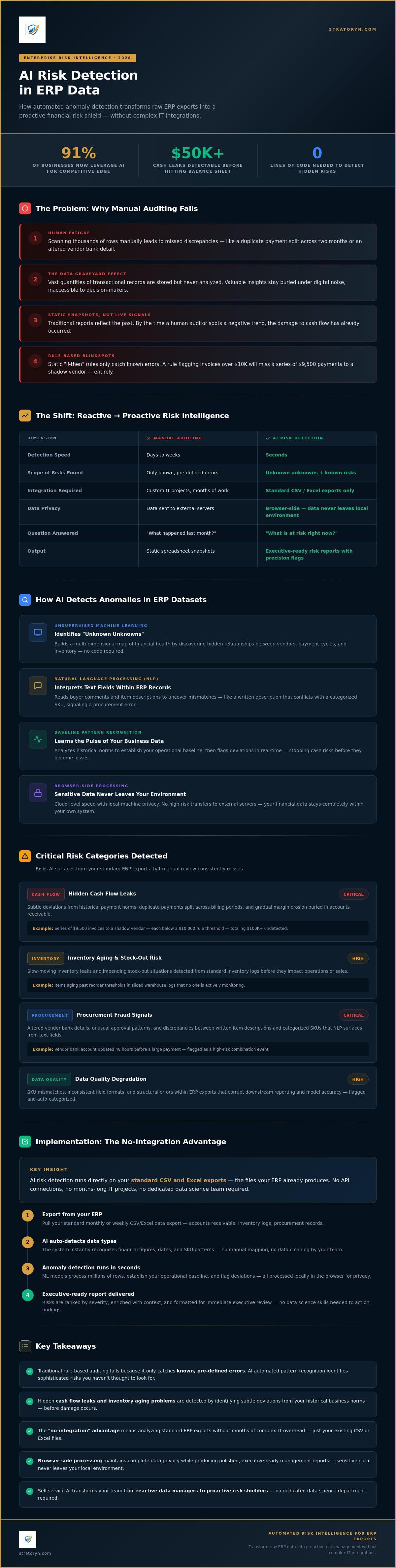
What if your standard monthly CSV export held the key to stopping a $50,000 cash leak before it ever hit your balance sheet? In 2026, the most dangerous business threats aren't external attacks; they're the silent anomalies buried deep within your existing accounts receivable and inventory logs. Implementing ai risk detection in erp data is no longer a luxury for the enterprise elite; it's a fundamental requirement for operational survival in a market where 91% of businesses now leverage AI to gain a competitive edge.
You're likely aware that manual data auditing is a slow, error-prone process that often misses critical stock-outs or hidden cash flow leaks until they've already caused damage. It's frustrating to wait months for complex IT integrations just to see the truth behind your own numbers. We agree that you shouldn't need a dedicated data science department to understand your operational risks or fix data quality issues.
This article demonstrates how to transform raw ERP exports into a proactive risk management shield instantly. You'll learn how to use an AI Data Analyst to convert simple Excel files into executive-ready reports that highlight threats with absolute precision. We'll show you a streamlined path to automated detection of financial anomalies, ensuring your workspace remains efficient, secure, and fully optimized.
Key Takeaways
- Understand why traditional rule-based auditing fails and how automated pattern recognition identifies sophisticated operational risks.
- Identify hidden cash flow leaks and inventory aging problems by detecting subtle deviations from historical business norms.
- Discover the "no-integration" advantage of using ai risk detection in erp data to analyze standard exports without complex IT overhead.
- Learn how browser-side processing maintains data privacy while transforming raw information into polished, executive-ready management reports.
- Move from reactive data management to a proactive risk shield by utilizing a self-service AI analyst for your enterprise datasets.
Table of Contents
- What is AI Risk Detection in ERP Data?
- How AI Detects Anomalies in Complex Enterprise Datasets
- Critical Risk Categories: From Cash Flow to Supply Chain
- Implementing AI Risk Detection Without Complex IT Projects
- Stratoryn: Automated Risk Intelligence for ERP Exports
What is AI Risk Detection in ERP Data?
AI risk detection is the automated process of identifying anomalies, patterns, and outliers within your core business systems. It goes beyond simple error checking. Instead, it uses machine learning to understand the "normal" rhythm of your operations and flags anything that breaks that cadence. In 2026, Enterprise resource planning (ERP) systems generate millions of data points daily; humans simply cannot keep up with the volume. Effective ai risk detection in erp data provides a digital safety net that catches sophisticated threats, such as subtle procurement fraud or slow-moving inventory leaks, before they escalate into financial crises.
Traditional auditing relies on static rules. If you don't tell the system to look for a specific error, it won't find it. This reactive approach is no longer sufficient. Modern risk intelligence is proactive. It acts as an AI Data Analyst that bridges the gap between raw, messy exports and decisive executive action. You move from asking "What happened last month?" to "What is at risk right now?" This transition ensures that management teams have the clarity they need to protect their bottom line without waiting for quarterly reviews.
This transition from a reactive to a proactive state is just as critical for personal leadership as it is for data systems; Salarah K Starre discusses how to move beyond reactive stress and survival mode to reclaim magnetic power.
The Limitations of Manual ERP Auditing
Manual auditing is a slow, high-friction process. Finance teams often find themselves drowning in massive Excel exports, leading to a significant visibility gap. When you're manually scanning thousands of rows, human fatigue is inevitable. Small discrepancies, like a slightly altered vendor bank detail or a duplicate payment split across two months, are easily missed. The 'Data Graveyard' effect occurs when vast quantities of transactional records are stored but never analyzed, rendering valuable business insights inaccessible and buried under digital noise. Traditional reports are static snapshots of a dynamic environment. By the time a human auditor spots a trend, the damage to cash flow has already occurred.
How AI Intelligence Workspace Changes the Game
An ERP Intelligence Workspace eliminates the manual grind. The software doesn't just store data; it interprets it. One of the most significant shifts is the use of automated data type detection. This allows the system to recognize financial figures, dates, and SKU patterns instantly without manual mapping. This speed reduces the cognitive load on your operations teams, allowing them to focus on strategy rather than data cleaning. By transitioning from a focus on historical record-keeping to identifying "what is at risk," businesses can secure their margins. It’s a move toward a frictionless, modern way of handling high-stakes data management.
Beyond ERP data, businesses can also check out Humae to bring this same level of AI-powered efficiency to their workforce management and HR processes.
How AI Detects Anomalies in Complex Enterprise Datasets
AI doesn't sleep. It doesn't get tired. It processes millions of rows of transactional data in seconds. This speed is essential for effective ai risk detection in erp data. By using unsupervised machine learning models, the system identifies "unknown unknowns." These are risks you haven't even thought to look for. While traditional systems only flag known errors, AI discovers hidden relationships between vendors, payment cycles, and inventory movements. It builds a multi-dimensional map of your financial health without requiring you to write a single line of code.
Unstructured data often hides the most significant threats. Natural language processing (NLP) allows the AI to interpret text fields within ERP records, such as buyer comments or item descriptions. This capability uncovers inconsistencies that a numeric-only scan would ignore. For instance; a mismatch between a written description and a categorized SKU can signal a procurement error. This level of semantic intelligence is also being applied to customer experiences by Ubestream Inc. who use similar AI processing to power contactless voice ordering systems. Security remains a top priority. Browser-side processing ensures that your sensitive financial data never leaves your local environment. This architecture provides the speed of the cloud with the privacy of a local machine. It removes the need for high-risk data transfers to external servers.
Pattern Recognition vs. Rule-Based Logic
Static "if-then" statements fail in 2026. Global supply chains are too complex for rigid logic. If a rule says to flag invoices over $10,000, it will miss a series of $9,500 payments sent to a shadow vendor. AI identifies these subtle trends by establishing a baseline for your specific operations. It learns the pulse of your business data by analyzing historical norms and flagging deviations as they occur. This allows you to stop cash risks before they manifest as losses. You gain a dynamic shield that evolves alongside your company's growth.
Data Quality as a Risk Foundation
Flawed data leads to flawed decisions. If your ERP exports contain missing fields, duplicates, or formatting errors, your risk analysis will be compromised. Automated data quality analysis identifies these structural weaknesses instantly. Using an erp data export audit tool ensures that your analysis is built on a foundation of integrity. When data is clean, executive reports become reliable. You can then make confident choices about resource allocation and procurement. Clean data is the prerequisite for any intelligent automation.
To see these patterns in your own exports, consider utilizing a dedicated ERP Intelligence Workspace to automate the heavy lifting.
Critical Risk Categories: From Cash Flow to Supply Chain
Business risk often hides in the mundane. While high-level compliance is a priority for major firms, the real erosion of profit happens through daily operational friction. Implementing ai risk detection in erp data allows you to move beyond basic error checking and into the territory of predictive intelligence. By categorizing threats into financial, operational, and strategic buckets, you create a comprehensive defense system. This approach ensures that no single anomaly, whether it's a duplicate payment or a stalled shipment, goes unnoticed. It's about maintaining a clear, persistent view of your entire value chain.
Compliance and strategic risks are frequently overlooked until an audit fails or a major vendor collapses. AI surfaces transactional errors that signal deeper systemic issues before they trigger a regulatory penalty. It also monitors shifts in customer behavior and vendor performance in real time. If a reliable supplier starts missing delivery windows by even 5%, the system flags it as a strategic risk. This early warning allows you to diversify your supply chain before a total bottleneck occurs. You're no longer reacting to a crisis; you're preventing one.
Identifying Hidden Cash Risks
Financial leaks are often the result of "death by a thousand cuts" rather than a single massive theft. AI analyzes trial balances and accounts receivable to identify subtle payment delays that indicate a customer's declining creditworthiness. It spots unusual discount patterns that might suggest unauthorized sales behavior or system misconfigurations. Unauthorized credit limit increases are flagged instantly, protecting your liquidity. For a deeper dive into these metrics, see our guide on ai financial analysis of erp data. This level of scrutiny ensures that your cash flow remains predictable and protected.
Operational and Stock Problem Detection
Operational risks directly impact your ability to serve customers. AI models predict stock-outs by analyzing procurement cycles against real-time demand shifts, helping you avoid lost sales. According to Quantumrun (May 2026), companies using AI-enabled ERP report a 20% average gain in forecasting accuracy. This precision allows you to detect slow-moving inventory and inventory aging early, freeing up working capital that would otherwise be trapped in a warehouse. Automated reporting surfaces these issues to management instantly, providing the data needed to adjust purchasing strategies on the fly. You gain a streamlined, responsive inventory system that supports growth rather than hindering it.
The precision required for ERP auditing is also being applied to specialized fields like athletics, where AiSportRecruiting uses AI to scan hundreds of verified college programs to match student-athletes with the right academic and athletic fit.
Implementing AI Risk Detection Without Complex IT Projects
Most enterprise software vendors claim that advanced intelligence requires a total system overhaul. They push for full migrations or expensive API connectors that take months to configure. This is a misconception that delays critical security oversight. The fastest path to insight is the "No-Integration" advantage. By using standard CSV or Excel exports, you bypass the IT bottleneck entirely. This approach allows you to deploy ai risk detection in erp data in minutes rather than quarters. You maintain control over your timeline without waiting for a developer to build custom report queries.
Speed to value is the primary metric for modern operations. Traditional projects often fail because the business environment changes before the software is fully integrated. In fact, Gartner (June 2026) projects that 40% of enterprise applications will include task-specific AI agents by the end of the year. You can stay ahead of this curve by utilizing tools that interpret the data you already have. This reduces the cognitive load on your finance team and eliminates the need for professional financial consulting for routine anomaly detection. You gain the power of an enterprise-grade data science department through a simple file upload; similarly, tech professionals looking to apply this efficiency to their own careers can check out QuickApply to automate their job search.
The 3-Step Process for Rapid Risk Analysis
Efficiency thrives on simplicity. A logical, linear workflow ensures that risk identification becomes a repeatable habit rather than a sporadic event. The process is straightforward:
- Step 1: Export clean transactional data from your existing system, whether you use SAP, NetSuite, or Microsoft Dynamics.
- Step 2: Upload the file to an AI Intelligence Workspace. The system performs automated type detection to categorize your fields instantly.
- Step 3: Review the generated Executive-Ready Reports and take immediate action on flagged anomalies.
Privacy and Security in AI Analysis
Security is the foundation of trust. Many organizations hesitate to use AI because they fear exposing sensitive financial data to unvetted third-party models. This concern is valid; "Shadow AI" is a primary security risk in 2026. To mitigate this, look for solutions that prioritize browser-side processing. This architecture ensures your data never leaves your local environment during analysis. There is no default raw file storage, which aligns with the strict requirements of the EU AI Act and NIST frameworks. You can read more about applying ai to erp data securely to ensure your compliance program remains robust. This method provides the clarity you need without compromising your data lineage.
Ready to identify hidden threats in your own datasets? Start your analysis today with the ERP Intelligence Workspace.
Stratoryn: Automated Risk Intelligence for ERP Exports
Stratoryn offers a streamlined solution to the growing complexity of enterprise information. The ERP Intelligence Workspace functions as a self-service AI Data Analyst, allowing finance and operations professionals to take direct control of their risk management. Unlike traditional tools designed exclusively for professional auditors, Stratoryn empowers business managers to perform high-level analysis independently. It provides immediate visibility into cash leaks and operational friction. This tool is specifically engineered for the regulatory climate of 2026, where audibility and data lineage are essential for compliance with the EU AI Act and NIST frameworks.
The platform focuses on three core pillars: cash risk detection, stock problem identification, and comprehensive Data Quality Analysis. By automating these audits, you remove the human error inherent in manual oversight. You don't need a data science degree to uncover why your accounts receivable is lagging or why your inventory levels are inconsistent. Stratoryn interprets the pulse of your business through your existing exports, providing a frictionless way to maintain a competitive edge. It turns the "Data Graveyard" into a source of strategic intelligence.
Transforming Exports into Executive Reports
Raw data visualization is often overwhelming for C-suite stakeholders. They don't need more charts; they need actionable insights. Stratoryn bridges this gap by generating Executive-Ready Reports that summarize complex findings into clear, professional outputs. These reports highlight exactly what is at risk and why, facilitating instant alignment across management teams. You can explore the full capabilities of this environment in our guide to the ERP Intelligence Workspace. This transition from raw information to polished intelligence ensures that decision-makers can act with total confidence.
Starting Your AI Journey Today
You can begin securing your operations without the typical hurdles of enterprise software procurement. There's no credit card required and no need for lengthy IT approval cycles to get started with early access. Preparing for your first analysis is simple. Just generate a standard CSV or Excel export from your current ERP system. Once you upload the file, the workspace handles the automated type detection and risk scanning instantly. It's a modern, secure approach to data management that respects your time and your privacy. Gaining real-time visibility through ai risk detection in erp data is the ultimate competitive advantage in a high-stakes economy. To further this advantage, Trainetics Academy provides the training necessary for teams to excel in an increasingly automated business environment.
Secure Your Financial Future with Proactive Intelligence
Protecting your business margins in 2026 requires moving beyond static reporting and manual audits. You've seen how ai risk detection in erp data identifies hidden cash leaks and stock problems that traditional methods simply miss. By focusing on the "no-integration" advantage, you can bypass the months of setup usually associated with enterprise software. You don't need a massive IT project to gain the clarity you deserve; you only need the right tool to interpret the data you already possess.
Stratoryn provides a frictionless way to transform raw CSV or Excel exports into actionable strategic intelligence. Browser-side processing ensures your sensitive data stays private and never leaves your local environment. You can generate executive-ready reports in seconds, allowing you to align your management team around verified facts rather than guesses. It's time to eliminate the "Data Graveyard" and replace it with a proactive shield that monitors your business health around the clock.
To further leverage this intelligence, Carter Strategies offers business strategy consulting and fractional CMO/CRO services to help mid-size companies translate operational data into sustainable growth.
Start detecting risks in your ERP exports for free with Stratoryn. Take the first step toward a more efficient, secure, and visible operation today.
Frequently Asked Questions
What is the difference between AI risk detection and traditional ERP reporting?
Traditional ERP reporting provides a historical snapshot based on pre-defined queries; it tells you what happened in the past. In contrast, ai risk detection in erp data uses unsupervised machine learning to identify anomalies and predictive patterns that rules-based systems miss. It shifts your focus from record-keeping to proactive threat mitigation by recognizing deviations from your business's unique historical norms.
Do I need to integrate my ERP system with an AI tool to detect risks?
You don't need a direct integration to gain high-level insights. Most modern intelligence workspaces analyze standard CSV or Excel exports. This "no-integration" model bypasses complex IT projects and allows you to start identifying risks immediately. It removes the friction of API configurations and allows you to maintain control over your core system architecture.
Can AI detect fraud in my accounts payable data exports?
Yes, AI excels at identifying sophisticated fraud patterns in accounts payable. It flags duplicate payments, unusual vendor bank account changes, and split invoices designed to bypass approval thresholds. By analyzing the relationships between transaction dates and amounts, the system surfaces anomalies that manual audits frequently overlook. This provides an essential layer of security for your cash flow.
Is it safe to upload sensitive financial data to an AI analysis platform?
Security depends on the platform's specific architecture. Leading solutions use browser-side processing, which means your sensitive financial data never leaves your local machine during the analysis. This approach eliminates the need for raw file storage on external servers. It ensures your compliance with high-stakes regulations like the EU AI Act, which takes full effect in August 2026.
What types of ERP systems are compatible with AI risk detection tools?
Any ERP system capable of generating a data export is compatible. Whether you use SAP, Oracle NetSuite, Microsoft Dynamics, or a legacy on-premise solution, the AI can interpret the resulting CSV or Excel files. The software uses automated type detection to map your data regardless of the source system's specific formatting. This makes it a universal solution for fragmented enterprise environments.
How long does it take to generate a risk report from an ERP export?
You can move from a raw export to an executive-ready report in minutes. Once you upload your file, the AI processes millions of data points almost instantly. This speed allows operations teams to address threats in real time rather than waiting for monthly or quarterly review cycles. It transforms raw information into actionable intelligence without the typical software lag.
What are the most common risks hidden in ERP data?
Common risks include hidden cash leaks in accounts receivable, inventory aging that traps working capital, and data quality errors that cause stock-outs. Using ai risk detection in erp data also surfaces subtle shifts in vendor performance and unauthorized credit limit increases. These issues often remain invisible in standard spreadsheets until they manifest as significant financial losses.
Can AI help with data cleansing before an ERP migration?
AI is a powerful tool for data cleansing during the pre-migration phase. It automatically identifies duplicate records, missing mandatory fields, and formatting inconsistencies across your legacy datasets. By working with a Microsoft Dynamics 365 Business Central partner Thailand to audit your exports, you ensure that you move only high-quality, verified information into your new system. This reduces the risk of a failed implementation and ensures your new ERP is effective from day one.
Frequently asked questions
What is the difference between AI risk detection and traditional ERP reporting?
Traditional ERP reporting provides a historical snapshot based on pre-defined queries; it tells you what happened in the past. In contrast, ai risk detection in erp data uses unsupervised machine learning to identify anomalies and predictive patterns that rules-based systems miss. It shifts your focus from record-keeping to proactive threat mitigation by recognizing deviations from your business's unique historical norms.
Do I need to integrate my ERP system with an AI tool to detect risks?
You don't need a direct integration to gain high-level insights. Most modern intelligence workspaces analyze standard CSV or Excel exports. This "no-integration" model bypasses complex IT projects and allows you to start identifying risks immediately. It removes the friction of API configurations and allows you to maintain control over your core system architecture.
Can AI detect fraud in my accounts payable data exports?
Yes, AI excels at identifying sophisticated fraud patterns in accounts payable. It flags duplicate payments, unusual vendor bank account changes, and split invoices designed to bypass approval thresholds. By analyzing the relationships between transaction dates and amounts, the system surfaces anomalies that manual audits frequently overlook. This provides an essential layer of security for your cash flow.
Is it safe to upload sensitive financial data to an AI analysis platform?
Security depends on the platform's specific architecture. Leading solutions use browser-side processing, which means your sensitive financial data never leaves your local machine during the analysis. This approach eliminates the need for raw file storage on external servers. It ensures your compliance with high-stakes regulations like the EU AI Act, which takes full effect in August 2026.
What types of ERP systems are compatible with AI risk detection tools?
Any ERP system capable of generating a data export is compatible. Whether you use SAP, Oracle NetSuite, Microsoft Dynamics, or a legacy on-premise solution, the AI can interpret the resulting CSV or Excel files. The software uses automated type detection to map your data regardless of the source system's specific formatting. This makes it a universal solution for fragmented enterprise environments.
How long does it take to generate a risk report from an ERP export?
You can move from a raw export to an executive-ready report in minutes. Once you upload your file, the AI processes millions of data points almost instantly. This speed allows operations teams to address threats in real time rather than waiting for monthly or quarterly review cycles. It transforms raw information into actionable intelligence without the typical software lag.
What are the most common risks hidden in ERP data?
Common risks include hidden cash leaks in accounts receivable, inventory aging that traps working capital, and data quality errors that cause stock-outs. Using ai risk detection in erp data also surfaces subtle shifts in vendor performance and unauthorized credit limit increases. These issues often remain invisible in standard spreadsheets until they manifest as significant financial losses.
Can AI help with data cleansing before an ERP migration?
AI is a powerful tool for data cleansing during the pre-migration phase. It automatically identifies duplicate records, missing mandatory fields, and formatting inconsistencies across your legacy datasets. Using an AI analyst to audit your exports ensures that you move only high-quality, verified information into your new system. This reduces the risk of a failed implementation and ensures your new ERP is effective from day one.
- ai risk detection in erp data
- AI
- ERP
- Risk Management
- Data Analysis
- Anomaly Detection
- Business Intelligence
- Financial Auditing
- Operational Risk
- erp data analysis
- financial anomaly detection
- operational risk management
- business threat detection
- ai for business intelligence
- inventory risk management