
AI Financial Analysis of ERP Data: A Strategic Guide for 2026

Why is your finance team still losing hours to manual Excel cleaning when your data already holds the answers to your most critical risks? Most legacy systems feel like digital filing cabinets rather than strategic assets. Implementing ai financial analysis of erp data allows you to reclaim your time and identify hidden risks in your AR and AP that currently go unnoticed. You likely feel the weight of these manual processes, but they are no longer a technical necessity for modern operations.
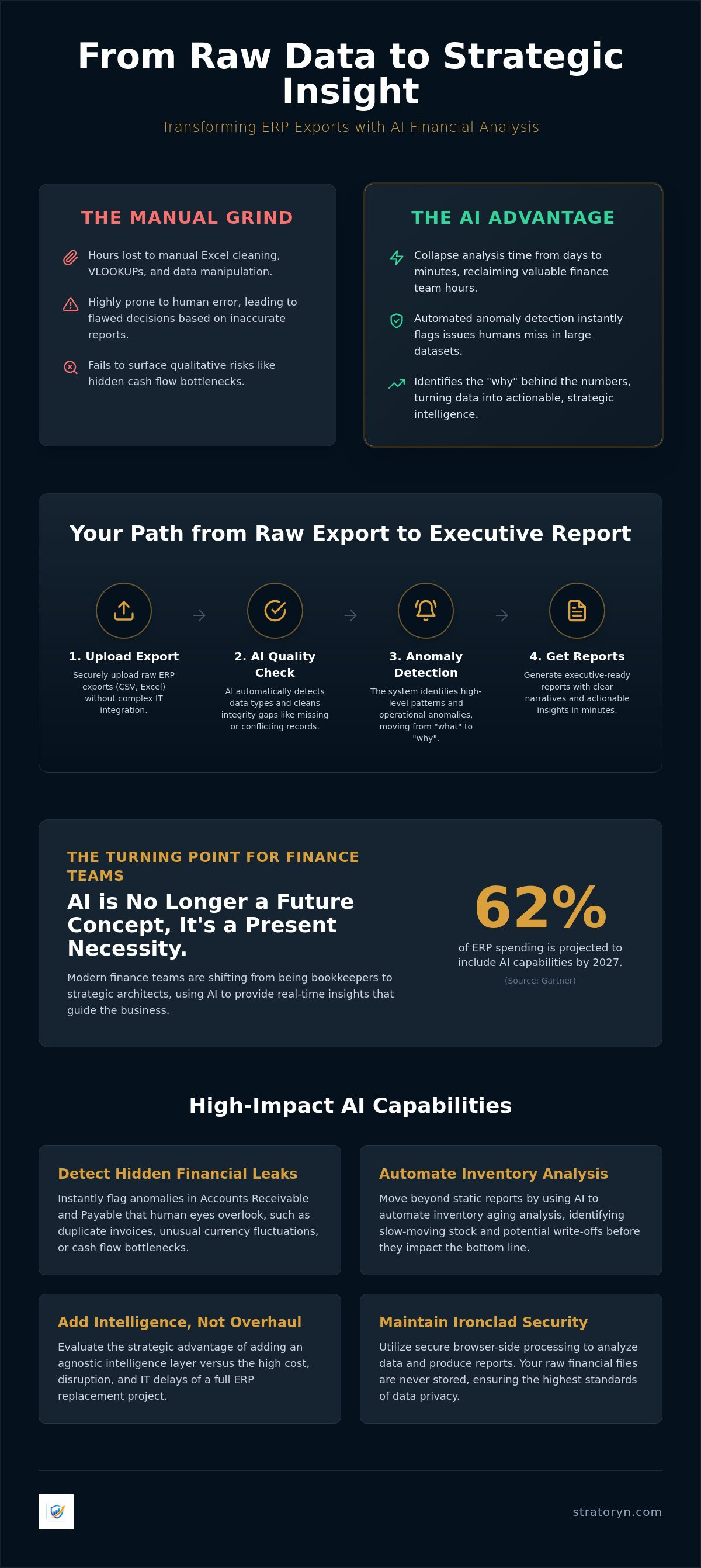
This guide explains how to transform stagnant exports into actionable intelligence without a massive IT overhaul or complex integrations. We will examine how an intelligent workspace automates data quality analysis and generates executive-ready reports. You'll learn to achieve clarity and speed, moving from raw files to strategic insights in a fraction of the traditional time. With 62% of ERP spending projected to include AI capabilities by 2027, this is your roadmap to modernizing your financial workflow today. We focus on practical utility and the speed of the outcome to ensure your value proposition is immediately apparent.
Key Takeaways
- Traditional BI tools won't surface qualitative risks like cash flow bottlenecks. AI-driven extraction identifies these patterns instantly.
- Modern ai financial analysis of erp data automates detection to find anomalies in large exports that human eyes typically overlook.
- Evaluate the strategic advantage of adding an intelligence layer rather than facing the high cost and disruption of a full ERP replacement.
- Target specific financial leaks by using AI to detect hidden risks in accounts receivable and automate inventory aging analysis.
- Maintain high security standards through browser-side processing that produces executive-ready reports without storing raw financial files.
Table of Contents
- The Evolution of AI Financial Analysis of ERP Data
- How AI Transforms Raw ERP Exports into Intelligence
- Embedded ERP AI vs. Agnostic Analysis Tools
- High-Impact Use Cases for AI in ERP Data
- Stratoryn: The Efficient Path to ERP Intelligence
The Evolution of AI Financial Analysis of ERP Data
Ai financial analysis of erp data is the automated extraction of high-level patterns and operational anomalies from Enterprise resource planning (ERP) systems. For decades, finance departments operated within a "vlookup" culture. This environment relied on manual data manipulation and static spreadsheets to find answers. It's a slow, grueling process. It's also prone to human error. Most importantly, it fails to capture the narrative behind the numbers. While your ERP is an excellent digital filing cabinet, it's a poor storyteller.
Traditional Business Intelligence (BI) tools often fail to surface qualitative risks. They can visualize that revenue is down, but they rarely explain why a specific cash flow bottleneck is forming in your accounts receivable. ERPs excel at data storage but lack the native intelligence to perform narrative analysis. AI changes this dynamic. By incorporating consumer data and cultural insights from Jembe.intelligence, it shifts the focus from simple data entry to proactive data intelligence. It turns raw information into a strategic asset that guides decision-making in real time.
Why 2026 is the Turning Point for Finance Teams
The maturation of generative AI has fundamentally altered the financial landscape in 2026. We've moved beyond simple chatbots to "agentic" AI systems that perform complex analysis autonomously. CFOs now face intense pressure to provide real-time strategic insights rather than historical post-mortems. According to Gartner, 62% of ERP application spending will include AI capabilities by 2027. This shift isn't just about efficiency. It's about survival. Modern finance teams use these tools to interpret structured financial data with a level of precision that was impossible just two years ago. They are moving from being bookkeepers to becoming strategic architects of the business.
Breaking the Dependency on Direct ERP Integrations
Many organizations fall into the "Integration Trap." They believe that AI requires a massive IT project and direct API connections to work. These bottlenecks can stall financial innovation for months. You don't need a direct integration to gain clarity. Modern AI can analyze raw data exports like CSV or Excel files directly within a secure workspace. This agnostic approach bypasses IT delays and allows finance professionals to act immediately. The Rise of AI Tools to Analyze ERP Exports in 2026 highlights how this method is becoming the standard for agile teams. It offers a frictionless way to transform stagnant exports into Executive-Ready Reports without the traditional technical hurdles.
How AI Transforms Raw ERP Exports into Intelligence
The transition from a raw ERP export to actionable intelligence used to take days of manual labor. Today, ai financial analysis of erp data collapses that timeline into minutes. The process begins with automated data type detection. Modern AI workspaces recognize currency, date formats, and account codes without manual mapping. This eliminates the tedious setup phase that traditionally stalls financial reporting. You upload a file and the system understands the structure immediately.
Once the data is mapped, the AI identifies anomalies that human eyes often miss in massive datasets. While a human might overlook a duplicate invoice or an unusual currency fluctuation in a 50,000-row spreadsheet, AI flags these instantly. This shift moves the finance team from descriptive analysis (what happened) to diagnostic analysis (why it happened). Understanding the Role Of AI In ERP Systems is essential for teams looking to boost efficiency and economic output. It's no longer just about seeing the numbers; it's about understanding the cause behind the trend.
Automated Data Quality and Integrity Checks
Data integrity is the foundation of any reliable financial report. AI identifies missing entries or conflicting records before they contaminate your final analysis. Utilizing robust Data Quality Analysis ensures that every insight is based on a clean dataset. We define "Data Integrity Gaps" as the primary silent killer of financial reports because they lead to flawed decisions based on incomplete information. By automating these checks, you ensure your outputs remain accurate and trustworthy. This process creates a frictionless path from raw data to Executive-Ready Reports.
Narrative Generation for Executive Management
Executives don't have time to decipher complex balance sheets. They need a clear, professional summary that highlights key takeaways. AI translates raw table data into professional management summaries that provide a strategic guide for stakeholders. This narrative generation explains the "so what" behind the data, allowing for immediate review and action. It replaces the traditional spreadsheet with a polished, actionable document. If you want to streamline your reporting, exploring an ERP Intelligence Workspace is the most efficient way to achieve these results.
The speed of this transformation is its greatest asset. You move from a raw file upload to a polished output in seconds. This allows finance professionals to focus on high-level strategy instead of data preparation. Modern ai financial analysis of erp data ensures your team stays ahead of the curve by delivering speed and clarity in a single package.
When you reclaim hours from manual data tasks, you can finally invest that time into personal development or practical life skills; for instance, if you are looking to master the roads in South West London or Surrey, you can visit Wimbledon Driving School to find professional instructors in your area.
Embedded ERP AI vs. Agnostic Analysis Tools
The choice between embedded ERP AI and agnostic analysis tools defines your operational speed for 2026. Major vendors like Oracle and SAP promote "All-in-One" ecosystems where AI is a native feature. This approach offers deep integration but forces you into a single ecosystem. If you use multiple systems or legacy versions, you're locked out of innovation until your next massive upgrade. Agnostic tools provide the flexibility to analyze data from NetSuite, SAP, or Microsoft Dynamics simultaneously. They create a unified view of your financial health without requiring a total system overhaul.
A common objection is the state of the data itself. CFOs often ask, "Is my data too messy for AI?" The answer is no. Modern AI thrives on complexity. It doesn't need a perfect database to start; it's designed to find patterns within the noise. Executing ai financial analysis of erp data through an agnostic layer allows you to bypass the "perfection trap." These tools clean and categorize information during the analysis process, turning fragmented exports into structured intelligence. You gain the benefits of advanced machine learning without the multi-year wait for a "clean" ERP migration.
The Problem with Native ERP Reporting
Native ERP report writers are notoriously rigid. They operate on fixed logic that hasn't changed in decades. Users on platforms like Reddit frequently cite these built-in tools as the weakest link in their tech stack. They're difficult to customize and often require specialized consulting hours just to change a single field. Applying AI to ERP Data externally offers more creative freedom. It allows you to query your data in plain English and generate Executive-Ready Reports that actually answer your specific business questions. You aren't limited by what your ERP vendor thinks you should see.
Speed to Value: Implementation Timelines
Traditional ERP migrations are high-stakes, disruptive events that can last 6 to 12 months. They often exceed budgets and exhaust internal teams. In contrast, an agnostic AI workspace delivers value in seconds. "No Integration" is a strategic advantage for agile finance teams. It means you can act today rather than waiting for next year's IT roadmap. Here is how the two approaches compare:
- Implementation Time: 6-12 months for native upgrades vs. under 60 seconds for file-based AI uploads.
- Total Cost: High licensing and consulting fees vs. a streamlined, utility-based SaaS model.
- User Friction: High disruption requiring extensive training vs. a frictionless, intuitive interface.
- Data Reach: Limited to a single system vs. the ability to analyze any ERP export instantly.
By choosing an agnostic layer, you prioritize speed and clarity. You empower your AI Data Analyst to work with your current data, regardless of its source or structure. This is the most efficient path to transforming raw information into professional, polished outputs.
High-Impact Use Cases for AI in ERP Data
The value of ai financial analysis of erp data lies in its ability to solve specific, high-stakes operational problems. While traditional reporting tells you the balance of your accounts, AI reveals the underlying health of your business. It transforms static spreadsheets into dynamic risk management tools. By focusing on high-impact areas like accounts receivable, inventory, and procurement, finance teams can uncover millions in trapped capital. This shift allows you to move from recording history to shaping the future of your organization. For enterprises seeking to extend this level of automation to their global partner networks, you can discover Computer Market Research and their specialized channel management tools.
Cash Flow and Accounts Receivable Optimization
Manual AR tracking is inherently reactive. You wait for a payment to be late before taking action. AI changes this by predicting payment delays based on historical ERP patterns. It analyzes customer behavior to flag accounts likely to miss deadlines before the invoice is even due. This provides critical "Cash Risk" alerts for treasury management, allowing for better liquidity planning. We define "Predictive AR" as a key driver for working capital because it enables proactive collections and more accurate cash forecasting. You don't have to wait for a crisis to understand your cash position.
Inventory and Supply Chain Risk Detection
Inventory is often a company's largest stagnant asset. AI correlates sales data with stock levels to find inefficiencies that manual audits miss. It identifies slow-moving stock and inventory aging problems automatically across thousands of SKUs. This allows you to identify "Stock Problems" before they impact the bottom line. By analyzing supply chain exports, AI spots procurement anomalies and vendor spend outliers that suggest overpayment or fraud. This visibility ensures that your procurement strategy aligns with actual consumption patterns. If you want to see these insights in action, you can explore our ERP Intelligence Workspace to start analyzing your exports today.
Automating the Month-End Close
The month-end close is traditionally a period of high stress and manual reconciliation. AI alleviates this by identifying trial balance discrepancies in real time. It compares ledger entries against historical norms to spot errors that would otherwise require hours of manual investigation. This automation reduces the "time to close," allowing your team to focus on strategic analysis rather than data validation. It ensures that your Executive-Ready Reports are based on verified, accurate information.
These use cases demonstrate that AI is not just a luxury; it's a necessity for modern finance. It provides the clarity needed to manage complex operations with precision. Whether you're detecting hidden risks or optimizing spend, the outcome is the same: a more resilient and profitable organization. By leveraging an AI Data Analyst, you ensure that no detail goes unnoticed in your financial landscape.
Stratoryn: The Efficient Path to ERP Intelligence
Stratoryn provides a focused tool for finance professionals who value time and clarity. The ERP Intelligence Workspace functions as an efficient, modern guide to your data. It eliminates the need for direct ERP integration, allowing you to bypass the IT bottlenecks described earlier in this guide. By focusing on practical utility, we transform raw information into polished, professional outputs in seconds. This is the fastest way to implement ai financial analysis of erp data without the risk or cost of a full system migration. You don't have to wait for your legacy system to catch up with 2026 standards.
Security and Data Privacy by Design
Data security is the primary concern for any finance team handling sensitive exports. We address this through local browser-side processing. Your financial data is analyzed within your own browser environment, which is a method superior to traditional cloud-first storage models. This architectural choice ensures that raw files aren't stored on our servers by default. You maintain absolute control over your information at all times. It's a calm, reassuring approach to a high-stakes technical hurdle. We understand that data privacy isn't just a feature; it's a requirement for enterprise-level trust. This methodology signals technological relevance while prioritizing the safety of your most sensitive assets.
Getting Started with AI Analysis Today
The "Upload and Analyze" workflow is built for speed and ease of use. You simply export your CSV or Excel files from your existing ERP and upload them to the workspace. Our AI Data Analyst then takes over. It functions as an authoritative expert that guides you through the file, identifying patterns and discrepancies that require attention. The system moves quickly from data identification to the presentation of a solution. It performs a rigorous Data Quality Analysis to ensure that every insight is grounded in clean, verified data.
The final output is a set of Executive-Ready Reports that translate complex trial balances or inventory logs into clear narratives. These reports are designed to minimize cognitive load for your leadership team. You can move from a stagnant spreadsheet to a strategic management summary in under a minute. This rhythmic delivery of insights ensures your team maintains momentum during the busy month-end close. We invite you to join the free early-access phase to experience these immediate results. Analyze your ERP data for free with Stratoryn and move from raw data to actionable insight today.
Future-Proof Your Financial Intelligence
Finance teams in 2026 cannot afford to remain trapped in manual spreadsheet cycles. We have explored how ai financial analysis of erp data shifts the burden from data cleaning to strategic decision-making. By leveraging agnostic tools, you bypass the friction of legacy systems and lengthy IT migrations. You've seen how identifying hidden cash risks and automating inventory aging analysis directly impacts your bottom line. The transition from raw data to actionable insight is no longer a multi-month project; it's a 60-second workflow.
The path to clarity is through intelligent automation that respects your security requirements. Stratoryn provides browser-side processing for maximum security and a strict no raw file storage policy. Our automated data type detection ensures instant analysis the moment you upload your export. It's time to move beyond descriptive reporting and start delivering the predictive insights your executive team requires. You have the data; now you have the tool to unlock its full potential. Access the Stratoryn ERP Intelligence Workspace for Free and begin your transformation today. Your strategic edge is waiting.
Frequently Asked Questions
What is the best AI for analyzing ERP data according to Reddit?
Reddit users generally favor agnostic tools that bypass the rigid limitations of native report writers. While some discuss embedded AI in platforms like NetSuite, many professionals prefer external workspaces that allow for plain English queries and faster results. Stratoryn is often highlighted as a streamlined solution for teams that want to avoid the "Integration Trap" and the long IT wait times associated with traditional system upgrades.
Can AI analyze financial data from Excel or CSV exports?
Yes, modern AI workspaces are specifically designed to interpret and analyze CSV and Excel files. This capability allows you to perform ai financial analysis of erp data without needing direct API access or complex IT configurations. The AI identifies data types and maps columns automatically. It transforms these flat files into structured intelligence, making it a frictionless choice for finance teams working with legacy systems or multiple data sources.
How does AI detect financial risks in ERP systems?
AI detects risks by identifying anomalies and patterns that deviate from historical norms within your exports. It scans thousands of ledger entries to spot duplicate invoices, unusual vendor spend, or emerging payment delays. Unlike traditional BI tools that only show historical figures, AI provides diagnostic analysis to explain why a specific risk is forming. This allows you to address issues like cash flow bottlenecks in accounts receivable before they impact your liquidity.
Do I need to integrate my ERP with an AI tool to get insights?
No, you don't need a direct integration to gain high-level strategic intelligence. You can simply export your data and upload it to an ai financial analysis of erp data workspace. This "no integration" approach is a strategic advantage for agile finance teams because it eliminates the months of setup and technical hurdles associated with traditional software implementations. You get immediate visibility into your financial health without waiting for an IT roadmap.
Is it safe to upload financial ERP data to an AI platform?
Safety depends on the platform's architecture, but modern solutions prioritize browser-side processing. Stratoryn analyzes your data locally within your browser environment rather than using cloud-first storage models. We maintain a strict no raw file storage policy to ensure your sensitive financial information remains under your absolute control. This approach provides a reassuring layer of security that lowers the barrier to entry for finance and operations professionals concerned about data privacy.
What types of reports can AI generate from ERP data?
AI generates Executive-Ready Reports that translate complex trial balances or inventory logs into professional management summaries. These include automated cash flow forecasts, inventory aging analysis, and procurement anomaly reports. The focus is on providing a strategic guide for stakeholders rather than just a collection of charts. This ensures that the value proposition of your data is immediately apparent to leadership, allowing for faster and more confident decision-making.
Does AI help with ERP data quality for migration?
Yes, AI is a powerful tool for Data Quality Analysis during critical migration projects. It identifies duplicate records, missing entries, and formatting inconsistencies that can derail a new system implementation. With support for systems like SAP ECC ending in 2027, many teams are using AI to clean their data before migrating to S/4HANA. This ensures your new system starts with high-integrity information, preventing the common "garbage in, garbage out" scenario.
Can AI identify hidden cash flow risks in accounts receivable?
AI identifies these risks by predicting payment delays based on historical customer behavior patterns found in your data. It flags accounts that are likely to miss deadlines before they actually go past due, allowing for proactive collections. This "Predictive AR" capability turns your accounts receivable export into a strategic asset for treasury management. You can secure your working capital and avoid unexpected liquidity crises by acting on these early warning signs immediately.
Frequently asked questions
Why 2026 is the Turning Point for Finance Teams
The maturation of generative AI has fundamentally altered the financial landscape in 2026. We've moved beyond simple chatbots to "agentic" AI systems that perform complex analysis autonomously. CFOs now face intense pressure to provide real-time strategic insights rather than historical post-mortems. According to Gartner, 62% of ERP application spending will include AI capabilities by 2027. This shift isn't just about efficiency. It's about survival. Modern finance teams use these tools to interpret structured financial data with a level of precision that was impossible just two years ago. They are moving from being bookkeepers to becoming strategic architects of the business.
Breaking the Dependency on Direct ERP Integrations
Many organizations fall into the "Integration Trap." They believe that AI requires a massive IT project and direct API connections to work. These bottlenecks can stall financial innovation for months. You don't need a direct integration to gain clarity. Modern AI can analyze raw data exports like CSV or Excel files directly within a secure workspace. This agnostic approach bypasses IT delays and allows finance professionals to act immediately. The Rise of AI Tools to Analyze ERP Exports in 2026 highlights how this method is becoming the standard for agile teams. It offers a frictionless way to transform stagnant exports into Executive-Ready Reports without the traditional technical hurdles. The transition from a raw ERP export to actionable intelligence used to take days of manual labor. Today, ai financial analysis of erp data collapses that timeline into minutes. The process begins with automated data type detection. Modern AI workspaces recognize currency, date formats, and account codes without manual mapping. This eliminates the tedious setup phase that traditionally stalls financial reporting. You upload a file and the system understands the structure immediately. Once the da
Automated Data Quality and Integrity Checks
Data integrity is the foundation of any reliable financial report. AI identifies missing entries or conflicting records before they contaminate your final analysis. Utilizing robust Data Quality Analysis ensures that every insight is based on a clean dataset. We define "Data Integrity Gaps" as the primary silent killer of financial reports because they lead to flawed decisions based on incomplete information. By automating these checks, you ensure your outputs remain accurate and trustworthy. This process creates a frictionless path from raw data to Executive-Ready Reports.
Narrative Generation for Executive Management
Executives don't have time to decipher complex balance sheets. They need a clear, professional summary that highlights key takeaways. AI translates raw table data into professional management summaries that provide a strategic guide for stakeholders. This narrative generation explains the "so what" behind the data, allowing for immediate review and action. It replaces the traditional spreadsheet with a polished, actionable document. If you want to streamline your reporting, exploring an ERP Intelligence Workspace is the most efficient way to achieve these results. The speed of this transformation is its greatest asset. You move from a raw file upload to a polished output in seconds. This allows finance professionals to focus on high-level strategy instead of data preparation. Modern ai financial analysis of erp data ensures your team stays ahead of the curve by delivering speed and clarity in a single package. The choice between embedded ERP AI and agnostic analysis tools defines your operational speed for 2026. Major vendors like Oracle and SAP promote "All-in-One" ecosystems where AI is a native feature. This approach offers deep integration but forces you into a single ecosyste
The Problem with Native ERP Reporting
Native ERP report writers are notoriously rigid. They operate on fixed logic that hasn't changed in decades. Users on platforms like Reddit frequently cite these built-in tools as the weakest link in their tech stack. They're difficult to customize and often require specialized consulting hours just to change a single field. Applying AI to ERP Data externally offers more creative freedom. It allows you to query your data in plain English and generate Executive-Ready Reports that actually answer your specific business questions. You aren't limited by what your ERP vendor thinks you should see.
Speed to Value: Implementation Timelines
Traditional ERP migrations are high-stakes, disruptive events that can last 6 to 12 months. They often exceed budgets and exhaust internal teams. In contrast, an agnostic AI workspace delivers value in seconds. "No Integration" is a strategic advantage for agile finance teams. It means you can act today rather than waiting for next year's IT roadmap. Here is how the two approaches compare: By choosing an agnostic layer, you prioritize speed and clarity. You empower your AI Data Analyst to work with your current data, regardless of its source or structure. This is the most efficient path to transforming raw information into professional, polished outputs. The value of ai financial analysis of erp data lies in its ability to solve specific, high-stakes operational problems. While traditional reporting tells you the balance of your accounts, AI reveals the underlying health of your business. It transforms static spreadsheets into dynamic risk management tools. By focusing on high-impact areas like accounts receivable, inventory, and procurement, finance teams can uncover millions in trapped capital. This shift allows you to move from recording history to shaping the future of your org
Cash Flow and Accounts Receivable Optimization
Manual AR tracking is inherently reactive. You wait for a payment to be late before taking action. AI changes this by predicting payment delays based on historical ERP patterns. It analyzes customer behavior to flag accounts likely to miss deadlines before the invoice is even due. This provides critical "Cash Risk" alerts for treasury management, allowing for better liquidity planning. We define "Predictive AR" as a key driver for working capital because it enables proactive collections and more accurate cash forecasting. You don't have to wait for a crisis to understand your cash position.
Inventory and Supply Chain Risk Detection
Inventory is often a company's largest stagnant asset. AI correlates sales data with stock levels to find inefficiencies that manual audits miss. It identifies slow-moving stock and inventory aging problems automatically across thousands of SKUs. This allows you to identify "Stock Problems" before they impact the bottom line. By analyzing supply chain exports, AI spots procurement anomalies and vendor spend outliers that suggest overpayment or fraud. This visibility ensures that your procurement strategy aligns with actual consumption patterns. If you want to see these insights in action, you can explore our ERP Intelligence Workspace to start analyzing your exports today.
Automating the Month-End Close
The month-end close is traditionally a period of high stress and manual reconciliation. AI alleviates this by identifying trial balance discrepancies in real time. It compares ledger entries against historical norms to spot errors that would otherwise require hours of manual investigation. This automation reduces the "time to close," allowing your team to focus on strategic analysis rather than data validation. It ensures that your Executive-Ready Reports are based on verified, accurate information. These use cases demonstrate that AI is not just a luxury; it's a necessity for modern finance. It provides the clarity needed to manage complex operations with precision. Whether you're detecting hidden risks or optimizing spend, the outcome is the same: a more resilient and profitable organization. By leveraging an AI Data Analyst, you ensure that no detail goes unnoticed in your financial landscape. Stratoryn provides a focused tool for finance professionals who value time and clarity. The ERP Intelligence Workspace functions as an efficient, modern guide to your data. It eliminates the need for direct ERP integration, allowing you to bypass the IT bottlenecks described earlier in th
Security and Data Privacy by Design
Data security is the primary concern for any finance team handling sensitive exports. We address this through local browser-side processing. Your financial data is analyzed within your own browser environment, which is a method superior to traditional cloud-first storage models. This architectural choice ensures that raw files aren't stored on our servers by default. You maintain absolute control over your information at all times. It's a calm, reassuring approach to a high-stakes technical hurdle. We understand that data privacy isn't just a feature; it's a requirement for enterprise-level trust. This methodology signals technological relevance while prioritizing the safety of your most sensitive assets.
Getting Started with AI Analysis Today
The "Upload and Analyze" workflow is built for speed and ease of use. You simply export your CSV or Excel files from your existing ERP and upload them to the workspace. Our AI Data Analyst then takes over. It functions as an authoritative expert that guides you through the file, identifying patterns and discrepancies that require attention. The system moves quickly from data identification to the presentation of a solution. It performs a rigorous Data Quality Analysis to ensure that every insight is grounded in clean, verified data. The final output is a set of Executive-Ready Reports that translate complex trial balances or inventory logs into clear narratives. These reports are designed to minimize cognitive load for your leadership team. You can move from a stagnant spreadsheet to a strategic management summary in under a minute. This rhythmic delivery of insights ensures your team maintains momentum during the busy month-end close. We invite you to join the free early-access phase to experience these immediate results. Analyze your ERP data for free with Stratoryn and move from raw data to actionable insight today. Finance teams in 2026 cannot afford to remain trapped in manual
What is the best AI for analyzing ERP data according to Reddit?
Reddit users generally favor agnostic tools that bypass the rigid limitations of native report writers. While some discuss embedded AI in platforms like NetSuite, many professionals prefer external workspaces that allow for plain English queries and faster results. Stratoryn is often highlighted as a streamlined solution for teams that want to avoid the "Integration Trap" and the long IT wait times associated with traditional system upgrades.
Can AI analyze financial data from Excel or CSV exports?
Yes, modern AI workspaces are specifically designed to interpret and analyze CSV and Excel files. This capability allows you to perform ai financial analysis of erp data without needing direct API access or complex IT configurations. The AI identifies data types and maps columns automatically. It transforms these flat files into structured intelligence, making it a frictionless choice for finance teams working with legacy systems or multiple data sources.
How does AI detect financial risks in ERP systems?
AI detects risks by identifying anomalies and patterns that deviate from historical norms within your exports. It scans thousands of ledger entries to spot duplicate invoices, unusual vendor spend, or emerging payment delays. Unlike traditional BI tools that only show historical figures, AI provides diagnostic analysis to explain why a specific risk is forming. This allows you to address issues like cash flow bottlenecks in accounts receivable before they impact your liquidity.
Do I need to integrate my ERP with an AI tool to get insights?
No, you don't need a direct integration to gain high-level strategic intelligence. You can simply export your data and upload it to an ai financial analysis of erp data workspace. This "no integration" approach is a strategic advantage for agile finance teams because it eliminates the months of setup and technical hurdles associated with traditional software implementations. You get immediate visibility into your financial health without waiting for an IT roadmap.
Is it safe to upload financial ERP data to an AI platform?
Safety depends on the platform's architecture, but modern solutions prioritize browser-side processing. Stratoryn analyzes your data locally within your browser environment rather than using cloud-first storage models. We maintain a strict no raw file storage policy to ensure your sensitive financial information remains under your absolute control. This approach provides a reassuring layer of security that lowers the barrier to entry for finance and operations professionals concerned about data privacy.
What types of reports can AI generate from ERP data?
AI generates Executive-Ready Reports that translate complex trial balances or inventory logs into professional management summaries. These include automated cash flow forecasts, inventory aging analysis, and procurement anomaly reports. The focus is on providing a strategic guide for stakeholders rather than just a collection of charts. This ensures that the value proposition of your data is immediately apparent to leadership, allowing for faster and more confident decision-making.
Does AI help with ERP data quality for migration?
Yes, AI is a powerful tool for Data Quality Analysis during critical migration projects. It identifies duplicate records, missing entries, and formatting inconsistencies that can derail a new system implementation. With support for systems like SAP ECC ending in 2027, many teams are using AI to clean their data before migrating to S/4HANA. This ensures your new system starts with high-integrity information, preventing the common "garbage in, garbage out" scenario.
Can AI identify hidden cash flow risks in accounts receivable?
AI identifies these risks by predicting payment delays based on historical customer behavior patterns found in your data. It flags accounts that are likely to miss deadlines before they actually go past due, allowing for proactive collections. This "Predictive AR" capability turns your accounts receivable export into a strategic asset for treasury management. You can secure your working capital and avoid unexpected liquidity crises by acting on these early warning signs immediately.
- ai financial analysis of erp data
- AI
- ERP
- Finance
- Automation
- Financial Analysis
- ERP Data
- Risk Management
- Accounts Receivable
- Business Intelligence
- erp data analysis
- ai in finance
- financial risk detection
- automated financial reporting
- erp automation
- accounts receivable analysis