
How to Analyze Trial Balance with AI for Faster Month-End Closing

Firms using autonomous agents save an average of three hours daily per accountant during the month-end close. You likely recognize the friction of the traditional cycle. The manual effort required to analyze trial balance ai exports often leads to human error and delayed reporting. It's a process that feels increasingly unsustainable in a high-speed business environment. Data privacy concerns only add another layer of complexity when you're handling sensitive financial ledgers.
You can reclaim your time and ensure total accuracy. This article demonstrates how to transform raw CSV exports into polished executive insights and risk reports using specialized automation. By leveraging an ERP Intelligence Workspace, you can reduce your closing time by 50% or more. We will explore how these systems identify misclassified accounts instantly and provide a secure, professional alternative to manual data entry. You'll learn to move beyond basic spreadsheets and adopt a streamlined, results-oriented strategy for financial data management. This guide provides the logical steps to transition from raw data to actionable insight without compromising security.
Key Takeaways
- Transition from manual tick-and-bash methods to algorithmic review for more reliable ledger integrity.
- Discover how to analyze trial balance ai systems to automate account mapping and detect period-over-period anomalies.
- Evaluate the security advantages of specialized ERP intelligence over general-purpose AI tools to prevent data leaks.
- Prepare raw CSV or Excel exports from major ERPs for zero-touch processing with simple data formatting steps.
- Generate professional reports that transform messy ledger data into clear visibility for cash and stock risks.
Table of Contents
- The Evolution of Financial Auditing: Why Analyze Trial Balance with AI?
- How AI Automates Trial Balance Classification and Risk Detection
- General LLMs vs. Specialized ERP Intelligence: Choosing Your Strategy
- Preparing Your ERP Exports for Automated AI Review
- Accelerate Your Close with the Stratoryn ERP Intelligence Workspace
The Evolution of Financial Auditing: Why Analyze Trial Balance with AI?
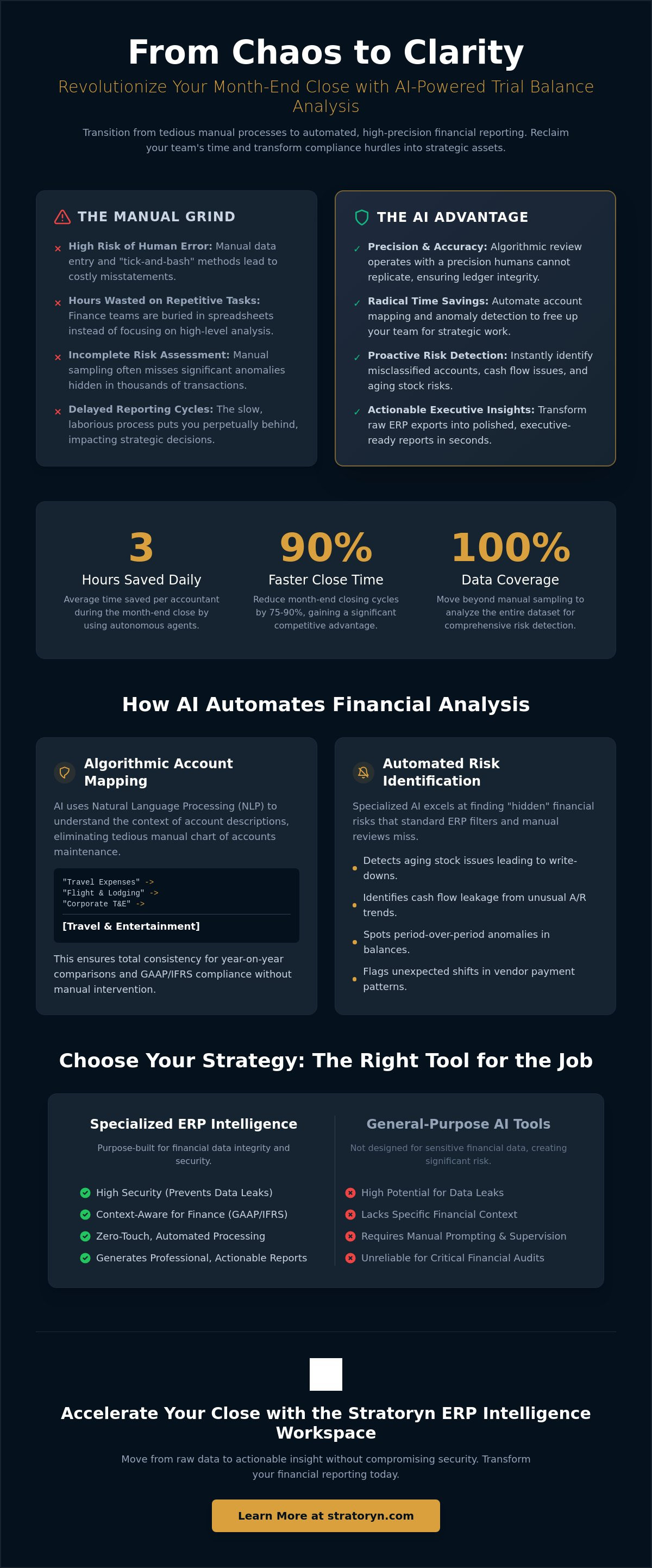
Financial auditing has reached a critical pivot point. Traditional methods relied on manual "tick-and-bash" techniques to verify a trial balance. Today, the standard has shifted to the automated verification of ledger integrity. When you analyze trial balance ai systems, you aren't just categorizing accounts; you're deploying an algorithmic review that operates with a precision humans cannot replicate. By 2026, financial analysis has moved from descriptive reporting to prescriptive strategy. Speed is no longer a luxury. For modern CFOs, reducing month-end close time by 75-90% is a distinct competitive advantage that drives market confidence and operational agility. It's about turning a compliance hurdle into a strategic asset.
The Limitations of Manual Reconciliation
Manual reconciliation carries a high cost. Human error in large-scale ERP exports can lead to material misstatements that are expensive to rectify. During intense 12-hour closing shifts, data fatigue becomes a physical reality for finance teams. This exhaustion directly impacts accuracy. Manual sampling is another weakness; it often misses significant tail-end risks because it only examines a small fraction of the total dataset. Relying on human eyes to spot anomalies across thousands of rows is a recipe for oversight. Organizations that continue to use these legacy methods find themselves buried in spreadsheets while their competitors move forward with clear, real-time data. It's a question of whether you want your team focused on data entry or high-level analysis.
Bridging the Gap Between Raw Data and Executive Insights
Excel formulas have reached their limit. They can't easily detect subtle patterns or misclassifications across thousands of disparate accounts. AI identifies these connections instantly. It bridges the gap by ensuring GAAP and IFRS compliance through automated mapping that aligns raw data with complex regulatory requirements. This capability shifts the conversation from "what happened" to "where is the risk." You can analyze trial balance ai outputs to gain immediate visibility into cash flow issues or stock discrepancies. The result is a transformation of raw information into polished, executive-ready reports. This process doesn't just save time. It provides a level of certainty that manual processes simply can't offer. You move from reactive data processing to proactive financial management in seconds. It's a streamlined path to total ledger transparency.
How AI Automates Trial Balance Classification and Risk Detection
Automation in the finance department has evolved beyond simple macros. Modern algorithms now interpret financial data with contextual awareness. When you analyze trial balance ai capabilities, the most immediate benefit is the transition from manual ledger mapping to intelligent account grouping. AI doesn't just read labels; it understands the underlying nature of transactions. This level of sophistication is why AI can be used in the audit's planning phase to pinpoint high-risk areas before the closing process even begins. By identifying anomalies in debit and credit balances across multiple periods, these systems flag inconsistencies that a human reviewer might overlook after hours of manual work. You gain a proactive defense against reporting errors.
Algorithmic Account Mapping
AI eliminates the tedious nature of chart of accounts (COA) maintenance. It uses natural language processing to understand the context within account descriptions. For example, it recognizes that "Travel Expenses" and "Flight & Lodging" should be grouped under the same parent category, even if they lack identical naming conventions. This ensures total consistency for year-on-year comparisons. You spend less time on manual mapping and more time on strategic review. This automated consistency is a core feature of the ERP Intelligence Workspace, which simplifies the transition from raw data to structured financial statements. It creates a reliable foundation for every report you generate.
Automated Financial Risk Identification
Specialized AI excels at finding "hidden" risks that standard ERP filters miss. It monitors inventory movements to detect aging stock issues that could lead to future write-downs. It also identifies cash flow leakage by spotting unusual trends in accounts receivable or unexpected shifts in vendor payment patterns. These are not just data points; they are early warning signs. AI highlights these data quality issues directly within the ledger before they reach your final executive summaries. You can address a credit risk or a stock problem in real-time rather than discovering it weeks after the close. This visibility transforms the trial balance from a static document into a dynamic risk management tool.
The final output of this automated process is the generation of variance analysis reports. AI compares current figures against historical benchmarks or budgets without requiring a single manual calculation. It explains the "why" behind the numbers by correlating data points across different ledger sections. This shift allows your team to focus exclusively on resolving discrepancies rather than finding them. You achieve a faster, more accurate close that provides leadership with immediate, actionable clarity.
General LLMs vs. Specialized ERP Intelligence: Choosing Your Strategy
Finance leaders often face a choice between general-purpose Large Language Models (LLMs) and specialized ERP intelligence. While general AI tools have gained popularity, they often fall short in high-stakes financial environments. To effectively analyze trial balance ai outputs, you need a system that understands the rigid structure of a general ledger natively. General models are designed for broad conversation; they aren't built to maintain the mathematical integrity required for a month-end close. Research indicates that specialized automation is critical for improving the quality and efficiency of financial statement audits. Choosing the wrong strategy can lead to inconsistent results and significant security vulnerabilities.
The Problem with Manual Prompting
Copy-pasting sensitive data into a chat interface is not a scalable solution. It creates a prompt-heavy workflow that relies on your ability to engineer the perfect question every time. This variability makes it nearly impossible to maintain consistency across different periods or teams. You also risk creating technical debt if your team relies on custom Python scripts to bridge the gap between a general AI and your raw ERP exports. A specialized tool avoids these hurdles by automating the entire analysis pipeline without manual intervention. It delivers a zero-touch experience that values your time.
Security and Browser-Side Processing
Privacy is the most significant concern when using public AI models. Sending your company's full trial balance to a public cloud can lead to catastrophic data leaks. When you analyze trial balance ai solutions, the distinction between a chatbot and a dedicated intelligence workspace becomes clear. Specialized platforms prioritize browser-side processing. This approach ensures your raw data never leaves your local environment, acting as the gold standard for financial privacy.
- Specialized tools do not store raw CSV or Excel files by default.
- Deterministic algorithms eliminate the hallucination risk common in general LLMs.
- Browser-based analysis maintains professional confidentiality while providing rapid insights.
- Native ERP understanding ensures that account groupings and risk detections are grounded in actual accounting principles.
General AI is an experiment; specialized ERP intelligence is a financial strategy. By using tools built specifically for data quality analysis, you ensure that your month-end closing is both fast and secure. You don't have to choose between automation and safety. A professional workspace provides the streamlined, confident solution your operations require.
Preparing Your ERP Exports for Automated AI Review
Moving from a raw ledger export to a finished report shouldn't take days. The transition to automation requires a simple, repeatable process that removes manual intervention. When you analyze trial balance ai capabilities, you'll find that modern systems are designed to ingest messy data without the need for extensive pre-cleaning. You don't need to spend hours formatting cells or fixing alignment. Instead, follow a logical sequence to move your data from the ERP into an intelligence layer that produces immediate results.
- Step 1: Export your trial balance as a CSV or Excel file directly from your ERP, such as SAP, NetSuite, or Microsoft Dynamics.
- Step 2: Ensure your headers are present. While modern AI detects data types automatically, clear labels help maintain an audit trail.
- Step 3: Verify that your export includes three essential pillars: account codes, account descriptions, and period balances.
- Step 4: Upload the file to a specialized workspace. This triggers an instant scan for data quality gaps and ledger inconsistencies.
- Step 5: Review the automatically generated report. You'll receive a list of prioritized action items and risk detections in seconds.
Common ERP Export Formats
Most enterprise systems offer various export options, but CSV remains the superior choice for AI processing. Formatted Excel files often contain hidden artifacts or merged cells that can slow down legacy tools. A flat CSV file provides the cleanest path for an analyze trial balance ai workflow. Whether you're pulling data from NetSuite or Microsoft Dynamics, the goal is to maintain the integrity of the raw numbers. The system handles the heavy lifting of interpretation, so you don't have to. You can start your transformation by accessing the ERP Intelligence Workspace to automate your first export review today.
Data Quality Checkpoints
Does your current process catch duplicate records before they skew your final figures? Automated review acts as a diagnostic tool for your entire financial operation. It identifies missing account mappings and inconsistent ledger entries that typically go unnoticed until the audit phase. This is particularly valuable during ERP migrations or chart of accounts restructuring. By using Data Quality Analysis, you ensure that every executive report is built on a foundation of verified, accurate data. You move beyond simple reporting and into a state of continuous ledger health monitoring. This proactive approach eliminates the "rework" that often plagues the final days of the month-end close.
Accelerate Your Close with the Stratoryn ERP Intelligence Workspace
Stratoryn provides a specialized environment to analyze trial balance ai exports without the security risks associated with public cloud models. Our ERP Intelligence Workspace functions as a secure, browser-based layer that sits on top of your existing ledger data. It eliminates the need for manual mapping by identifying cash risks and stock problems automatically. You move from a raw export to a comprehensive overview in minutes. This speed allows finance teams to focus on resolution rather than discovery. It turns a reactive compliance task into a proactive financial strategy that secures your data while accelerating your results.
Transforming Raw Data into Executive Reports
Messy CSV files are a standard byproduct of large-scale ERP systems. Stratoryn converts these exports into polished Executive-Ready Reports that are immediately suitable for management presentations. For lean finance teams, the AI Data Analyst functions as an extra set of expert eyes. It performs deep Data Quality Analysis to ensure no anomaly goes unnoticed. This includes spotting slow-moving inventory or unexpected cash outflows that standard filters often miss. This automation significantly reduces the physical and mental stress typically associated with the month-end close. Controllers can finally trust their data without the 12-hour manual review sessions. You gain the clarity you need to make informed decisions faster than ever before.
Security remains our primary directive. Unlike general AI tools that require you to upload data to a public cloud, Stratoryn prioritizes browser-side processing. This means your raw financial files stay within your local environment. When you analyze trial balance ai trends with our workspace, you get the benefits of automation without the liability of data leaks. We don't store your raw files by default; we simply process them to extract the intelligence you require. It's a professional, streamlined solution for a high-stakes environment where confidentiality is non-negotiable. You maintain total control over your information while leveraging the power of modern algorithmic review.
Getting Started with Early Access
You don't need a complex integration or a team of consultants to begin. Stratoryn offers a frictionless path to modern financial intelligence. The platform is designed for immediate utility, allowing you to upload your export and receive insights instantly. The signup process is straightforward and tailored for busy finance professionals who value their time. We are currently offering a free early-access phase for those who want to reclaim their month-end cycles. There are no long implementation cycles or technical hurdles to overcome. Start your AI-powered trial balance analysis today at Stratoryn and transform your month-end closing into a streamlined, strategic process. Experience the confidence of a zero-touch, high-precision close.
Transform Your Month-End Close into a Strategic Advantage
The transition from manual reconciliation to automated ledger integrity is a fundamental shift in financial management. You've seen how specialized algorithms outpace manual sampling by identifying hidden risks in stock and cash flow instantly. Choosing a deterministic tool over a general-purpose model ensures that your results are accurate and your data remains private. When you analyze trial balance ai capabilities, the goal is always clear: total visibility with zero friction. You've learned that modern closing cycles don't require technical debt or manual data mapping.
Stratoryn provides the authoritative solution your finance team requires. Our workspace prioritizes browser-side processing for maximum security, ensuring no raw file storage remains on our servers by default. You can move from a raw CSV export to automated executive-ready reporting in minutes. This approach eliminates data fatigue and allows you to focus on high-level advisory roles. Analyze your ERP exports for free with Stratoryn to experience a faster, more reliable month-end close. It's time to replace cumbersome legacy processes with intelligent automation that respects your time and your data's confidentiality. Reclaim your closing cycle today.
Frequently Asked Questions
Is it safe to analyze my trial balance with AI?
Safety is guaranteed through browser-side processing. This ensures your financial data never leaves your local environment or touches public AI training sets. Professional workspaces use this method to lower the barrier for security-conscious firms. You can safely analyze trial balance ai exports by choosing platforms that avoid permanent raw file storage. It's a secure, modern way to handle sensitive ledger information without risking a data leak.
Does AI replace the need for a month-end audit by a CPA?
AI does not replace a CPA but serves as a powerful preparation tool. It automates the "tick-and-bash" work, allowing auditors to focus on judgment-intensive tasks. By cleaning and validating data beforehand, you reduce the time and cost of the external audit. This technology provides a cleaner ledger, which simplifies the verification process for your accounting partners. It's about augmentation, not replacement.
Which ERP systems are compatible with AI analysis tools?
Compatibility is determined by export capability rather than direct integration. Any system capable of generating a CSV or Excel report, such as SAP, NetSuite, or Sage Intacct, works seamlessly. You simply export the raw ledger and upload it to the workspace. This flexibility allows you to analyze trial balance ai trends across different business units regardless of the underlying software. It ensures a consistent review process for diverse ERP environments.
How does AI detect anomalies in a trial balance that Excel misses?
AI identifies multi-dimensional patterns that static Excel formulas often miss. While Excel relies on specific rules you define, algorithms recognize subtle shifts in account behavior and period-over-period variances automatically. This includes detecting misclassified transactions or unusual debit and credit balances that don't fit historical norms. You get a deeper level of insight without the need to build and maintain complex spreadsheet macros. It's a faster path to clarity.
What is the difference between general AI and specialized ERP intelligence?
General AI models prioritize conversational fluency, while specialized ERP intelligence focuses on mathematical precision. General tools are prone to hallucinations and lack the context of GAAP or IFRS mapping. Specialized platforms use deterministic logic to ensure every calculation is accurate and repeatable. You need a tool that understands the specific architecture of a general ledger to produce reliable executive insights. It's the difference between an experiment and a financial strategy.
Can AI help with ERP data migration quality?
AI is an essential tool for maintaining high standards during ERP data migrations. It acts as a diagnostic layer to identify missing account mappings and duplicate records before they enter the new system. By performing a Data Quality Analysis on your legacy data, you prevent garbage-in, garbage-out scenarios. This ensures your new ERP environment starts with a verified and clean trial balance. It's a proactive measure for migration success.
Do I need to be a data scientist to use AI for financial analysis?
You don't need a technical background to leverage these tools. The AI Data Analyst is built for finance professionals who need results without learning to code. The interface handles the complex data processing behind the scenes, presenting you with clear action items and risk reports. It's a frictionless experience that prioritizes your professional requirements over technical complexity. You focus on the strategy while the machine handles the data.
What happens to my raw data after the AI analysis is complete?
Your raw data is processed locally and is not stored permanently by default. Most professional workspaces use browser-side analysis to maintain total confidentiality. Once the analysis is complete and you've generated your Executive-Ready Reports, the raw file is discarded. This approach aligns with strict enterprise security standards and ensures your sensitive financial information remains under your exclusive control. It's a secure, ephemeral process designed for privacy.
Frequently asked questions
The Limitations of Manual Reconciliation
Manual reconciliation carries a high cost. Human error in large-scale ERP exports can lead to material misstatements that are expensive to rectify. During intense 12-hour closing shifts, data fatigue becomes a physical reality for finance teams. This exhaustion directly impacts accuracy. Manual sampling is another weakness; it often misses significant tail-end risks because it only examines a small fraction of the total dataset. Relying on human eyes to spot anomalies across thousands of rows is a recipe for oversight. Organizations that continue to use these legacy methods find themselves buried in spreadsheets while their competitors move forward with clear, real-time data. It's a question of whether you want your team focused on data entry or high-level analysis.
Bridging the Gap Between Raw Data and Executive Insights
Excel formulas have reached their limit. They can't easily detect subtle patterns or misclassifications across thousands of disparate accounts. AI identifies these connections instantly. It bridges the gap by ensuring GAAP and IFRS compliance through automated mapping that aligns raw data with complex regulatory requirements. This capability shifts the conversation from "what happened" to "where is the risk." You can analyze trial balance ai outputs to gain immediate visibility into cash flow issues or stock discrepancies. The result is a transformation of raw information into polished, executive-ready reports. This process doesn't just save time. It provides a level of certainty that manual processes simply can't offer. You move from reactive data processing to proactive financial management in seconds. It's a streamlined path to total ledger transparency. Automation in the finance department has evolved beyond simple macros. Modern algorithms now interpret financial data with contextual awareness. When you analyze trial balance ai capabilities, the most immediate benefit is the transition from manual ledger mapping to intelligent account grouping. AI doesn't just read labels; it
Algorithmic Account Mapping
AI eliminates the tedious nature of chart of accounts (COA) maintenance. It uses natural language processing to understand the context within account descriptions. For example, it recognizes that "Travel Expenses" and "Flight & Lodging" should be grouped under the same parent category, even if they lack identical naming conventions. This ensures total consistency for year-on-year comparisons. You spend less time on manual mapping and more time on strategic review. This automated consistency is a core feature of the ERP Intelligence Workspace, which simplifies the transition from raw data to structured financial statements. It creates a reliable foundation for every report you generate.
Automated Financial Risk Identification
Specialized AI excels at finding "hidden" risks that standard ERP filters miss. It monitors inventory movements to detect aging stock issues that could lead to future write-downs. It also identifies cash flow leakage by spotting unusual trends in accounts receivable or unexpected shifts in vendor payment patterns. These are not just data points; they are early warning signs. AI highlights these data quality issues directly within the ledger before they reach your final executive summaries. You can address a credit risk or a stock problem in real-time rather than discovering it weeks after the close. This visibility transforms the trial balance from a static document into a dynamic risk management tool. The final output of this automated process is the generation of variance analysis reports. AI compares current figures against historical benchmarks or budgets without requiring a single manual calculation. It explains the "why" behind the numbers by correlating data points across different ledger sections. This shift allows your team to focus exclusively on resolving discrepancies rather than finding them. You achieve a faster, more accurate close that provides leadership with immed
The Problem with Manual Prompting
Copy-pasting sensitive data into a chat interface is not a scalable solution. It creates a prompt-heavy workflow that relies on your ability to engineer the perfect question every time. This variability makes it nearly impossible to maintain consistency across different periods or teams. You also risk creating technical debt if your team relies on custom Python scripts to bridge the gap between a general AI and your raw ERP exports. A specialized tool avoids these hurdles by automating the entire analysis pipeline without manual intervention. It delivers a zero-touch experience that values your time.
Security and Browser-Side Processing
Privacy is the most significant concern when using public AI models. Sending your company's full trial balance to a public cloud can lead to catastrophic data leaks. When you analyze trial balance ai solutions, the distinction between a chatbot and a dedicated intelligence workspace becomes clear. Specialized platforms prioritize browser-side processing. This approach ensures your raw data never leaves your local environment, acting as the gold standard for financial privacy. General AI is an experiment; specialized ERP intelligence is a financial strategy. By using tools built specifically for data quality analysis, you ensure that your month-end closing is both fast and secure. You don't have to choose between automation and safety. A professional workspace provides the streamlined, confident solution your operations require. Moving from a raw ledger export to a finished report shouldn't take days. The transition to automation requires a simple, repeatable process that removes manual intervention. When you analyze trial balance ai capabilities, you'll find that modern systems are designed to ingest messy data without the need for extensive pre-cleaning. You don't need to spend ho
Common ERP Export Formats
Most enterprise systems offer various export options, but CSV remains the superior choice for AI processing. Formatted Excel files often contain hidden artifacts or merged cells that can slow down legacy tools. A flat CSV file provides the cleanest path for an analyze trial balance ai workflow. Whether you're pulling data from NetSuite or Microsoft Dynamics, the goal is to maintain the integrity of the raw numbers. The system handles the heavy lifting of interpretation, so you don't have to. You can start your transformation by accessing the ERP Intelligence Workspace to automate your first export review today.
Data Quality Checkpoints
Does your current process catch duplicate records before they skew your final figures? Automated review acts as a diagnostic tool for your entire financial operation. It identifies missing account mappings and inconsistent ledger entries that typically go unnoticed until the audit phase. This is particularly valuable during ERP migrations or chart of accounts restructuring. By using Data Quality Analysis, you ensure that every executive report is built on a foundation of verified, accurate data. You move beyond simple reporting and into a state of continuous ledger health monitoring. This proactive approach eliminates the "rework" that often plagues the final days of the month-end close. Stratoryn provides a specialized environment to analyze trial balance ai exports without the security risks associated with public cloud models. Our ERP Intelligence Workspace functions as a secure, browser-based layer that sits on top of your existing ledger data. It eliminates the need for manual mapping by identifying cash risks and stock problems automatically. You move from a raw export to a comprehensive overview in minutes. This speed allows finance teams to focus on resolution rather than d
Transforming Raw Data into Executive Reports
Messy CSV files are a standard byproduct of large-scale ERP systems. Stratoryn converts these exports into polished Executive-Ready Reports that are immediately suitable for management presentations. For lean finance teams, the AI Data Analyst functions as an extra set of expert eyes. It performs deep Data Quality Analysis to ensure no anomaly goes unnoticed. This includes spotting slow-moving inventory or unexpected cash outflows that standard filters often miss. This automation significantly reduces the physical and mental stress typically associated with the month-end close. Controllers can finally trust their data without the 12-hour manual review sessions. You gain the clarity you need to make informed decisions faster than ever before. Security remains our primary directive. Unlike general AI tools that require you to upload data to a public cloud, Stratoryn prioritizes browser-side processing. This means your raw financial files stay within your local environment. When you analyze trial balance ai trends with our workspace, you get the benefits of automation without the liability of data leaks. We don't store your raw files by default; we simply process them to extract the i
Getting Started with Early Access
You don't need a complex integration or a team of consultants to begin. Stratoryn offers a frictionless path to modern financial intelligence. The platform is designed for immediate utility, allowing you to upload your export and receive insights instantly. The signup process is straightforward and tailored for busy finance professionals who value their time. We are currently offering a free early-access phase for those who want to reclaim their month-end cycles. There are no long implementation cycles or technical hurdles to overcome. Start your AI-powered trial balance analysis today at Stratoryn and transform your month-end closing into a streamlined, strategic process. Experience the confidence of a zero-touch, high-precision close. The transition from manual reconciliation to automated ledger integrity is a fundamental shift in financial management. You've seen how specialized algorithms outpace manual sampling by identifying hidden risks in stock and cash flow instantly. Choosing a deterministic tool over a general-purpose model ensures that your results are accurate and your data remains private. When you analyze trial balance ai capabilities, the goal is always clear: total
Is it safe to analyze my trial balance with AI?
Safety is guaranteed through browser-side processing. This ensures your financial data never leaves your local environment or touches public AI training sets. Professional workspaces use this method to lower the barrier for security-conscious firms. You can safely analyze trial balance ai exports by choosing platforms that avoid permanent raw file storage. It's a secure, modern way to handle sensitive ledger information without risking a data leak.
Does AI replace the need for a month-end audit by a CPA?
AI does not replace a CPA but serves as a powerful preparation tool. It automates the "tick-and-bash" work, allowing auditors to focus on judgment-intensive tasks. By cleaning and validating data beforehand, you reduce the time and cost of the external audit. This technology provides a cleaner ledger, which simplifies the verification process for your accounting partners. It's about augmentation, not replacement.
Which ERP systems are compatible with AI analysis tools?
Compatibility is determined by export capability rather than direct integration. Any system capable of generating a CSV or Excel report, such as SAP, NetSuite, or Sage Intacct, works seamlessly. You simply export the raw ledger and upload it to the workspace. This flexibility allows you to analyze trial balance ai trends across different business units regardless of the underlying software. It ensures a consistent review process for diverse ERP environments.
How does AI detect anomalies in a trial balance that Excel misses?
AI identifies multi-dimensional patterns that static Excel formulas often miss. While Excel relies on specific rules you define, algorithms recognize subtle shifts in account behavior and period-over-period variances automatically. This includes detecting misclassified transactions or unusual debit and credit balances that don't fit historical norms. You get a deeper level of insight without the need to build and maintain complex spreadsheet macros. It's a faster path to clarity.
What is the difference between general AI and specialized ERP intelligence?
General AI models prioritize conversational fluency, while specialized ERP intelligence focuses on mathematical precision. General tools are prone to hallucinations and lack the context of GAAP or IFRS mapping. Specialized platforms use deterministic logic to ensure every calculation is accurate and repeatable. You need a tool that understands the specific architecture of a general ledger to produce reliable executive insights. It's the difference between an experiment and a financial strategy.
Can AI help with ERP data migration quality?
AI is an essential tool for maintaining high standards during ERP data migrations. It acts as a diagnostic layer to identify missing account mappings and duplicate records before they enter the new system. By performing a Data Quality Analysis on your legacy data, you prevent garbage-in, garbage-out scenarios. This ensures your new ERP environment starts with a verified and clean trial balance. It's a proactive measure for migration success.
Do I need to be a data scientist to use AI for financial analysis?
You don't need a technical background to leverage these tools. The AI Data Analyst is built for finance professionals who need results without learning to code. The interface handles the complex data processing behind the scenes, presenting you with clear action items and risk reports. It's a frictionless experience that prioritizes your professional requirements over technical complexity. You focus on the strategy while the machine handles the data.
What happens to my raw data after the AI analysis is complete?
Your raw data is processed locally and is not stored permanently by default. Most professional workspaces use browser-side analysis to maintain total confidentiality. Once the analysis is complete and you've generated your Executive-Ready Reports, the raw file is discarded. This approach aligns with strict enterprise security standards and ensures your sensitive financial information remains under your exclusive control. It's a secure, ephemeral process designed for privacy.
- analyze trial balance ai
- AI in Accounting
- Trial Balance
- Month-End Close
- Financial Automation
- ERP
- Accounting Technology
- Data Security
- Reporting
- month-end close automation
- accounting ai
- erp intelligence
- financial data analysis
- automated financial reporting
- ledger integrity