
Automated Cash Flow Risk Assessment: A Guide to AI-Driven Financial Intelligence

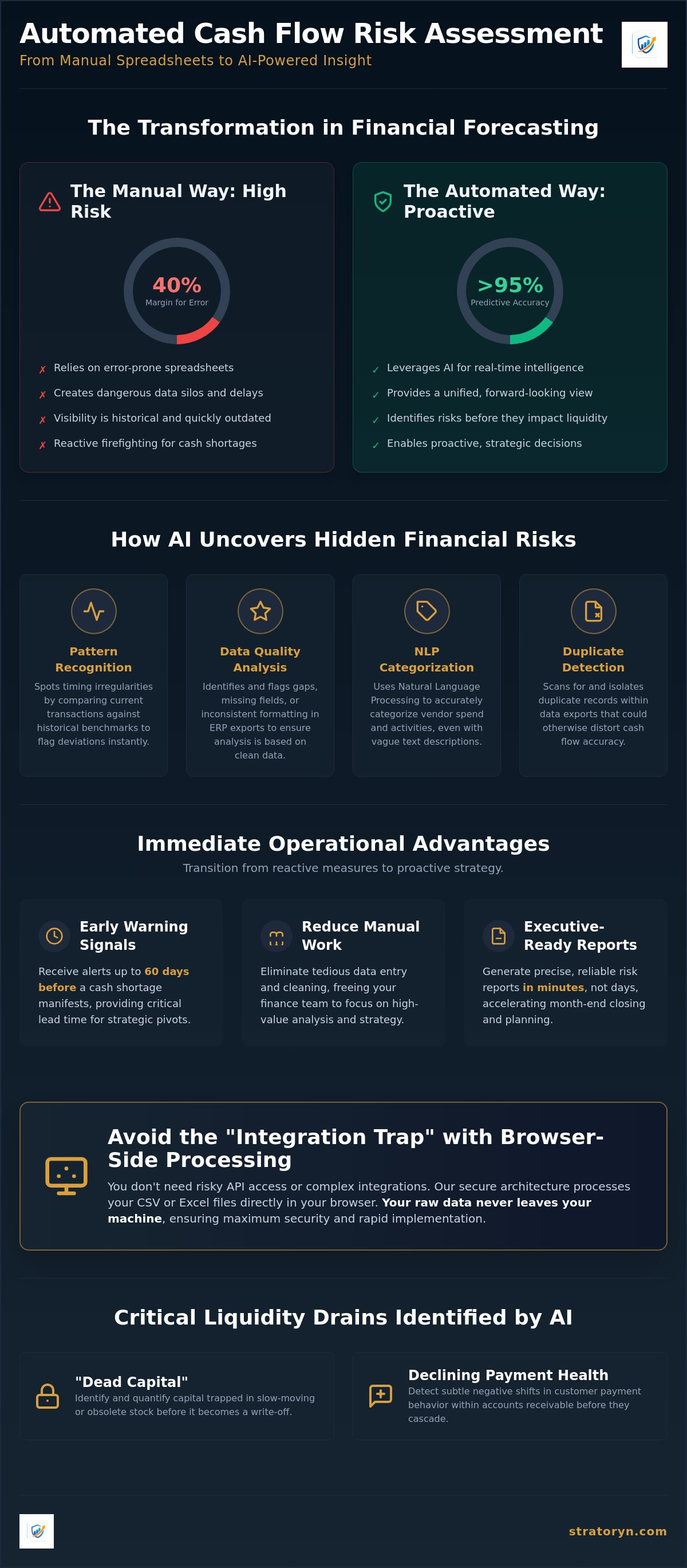
Manual cash flow forecasting typically achieves only 60% accuracy, leaving a massive 40% margin for error that can jeopardize your company's liquidity. Relying on spreadsheets means you are constantly fighting against data silos and manual entry mistakes. You know the frustration of spending hours cleaning ERP exports only to find that the resulting visibility is already outdated. It is a cumbersome process that slows down your month-end closing and leaves you blind to emerging cash shortages. Managing high-stakes data shouldn't feel like a manual chore.
Implementing an automated cash flow risk assessment strategy changes this dynamic entirely. By leveraging AI-driven financial intelligence, you can transition from reactive firefighting to proactive scaling. This guide outlines how to move beyond the limitations of manual workflows to protect your capital and generate executive-ready reports with precision. We will examine the shift from raw data to actionable insight, showing you how to identify early warning signals and secure your financial future with streamlined, modern tools. It is time to replace your spreadsheets with a solution that values your time and professional requirements.
Key Takeaways
- Shift from historical reporting to predictive intelligence by implementing automated cash flow risk assessment to identify liquidity threats in real-time.
- Learn how AI-driven pattern recognition spots timing irregularities and data gaps in ERP exports before they skew your financial results.
- Identify specific liquidity drains, such as "dead capital" trapped in slow-moving stock and declining payment health within your accounts receivable.
- Avoid the "Integration Trap" by using browser-side processing that analyzes CSV or Excel files without requiring direct API access or raw file storage.
- Move from raw data to executive-ready risk reports in minutes, significantly accelerating your month-end closing and strategic planning.
Table of Contents
- What is Automated Cash Flow Risk Assessment?
- How AI Identifies Hidden Financial Risks in ERP Exports
- Critical Cash Flow Risk Categories to Automate
- Overcoming the Barriers to Automated Financial Intelligence
- Implementing Rapid Risk Detection with Stratoryn
What is Automated Cash Flow Risk Assessment?
Business moves faster in 2026 than ever before. Traditional monthly reviews are no longer sufficient to catch the rapid shifts in customer payment behavior or supply chain costs. Waiting thirty days to see a cash dip is a recipe for insolvency. Automation provides a core difference by replacing manual audits with continuous anomaly detection. It quantifies Cash Flow at Risk (CFaR) by evaluating market variables and internal data points simultaneously. This ensures you have a clear view of your actual liquidity, not just a static balance sheet.
The Evolution of Financial Risk Detection
Manual spreadsheets are the primary source of financial inaccuracy. They are prone to human error, and the time required to update them creates a dangerous visibility gap. Legacy ERP systems were designed to solve this, yet they often provide rigid structures that miss nuanced risks. These systems are excellent at recording history but poor at predicting the future. AI-powered analysis bridges this gap. It excels at finding patterns in messy data exports that traditional software ignores. It turns fragmented information into a cohesive narrative of risk and opportunity.
Key Benefits of Automating Cash Visibility
Transitioning to an automated model provides immediate operational advantages. You receive early warning signals often 60 days before a cash shortage manifests. This lead time is the difference between a controlled strategic pivot and a desperate scramble for high-interest financing. Automation also strips away the tedious manual work that exhausts finance teams. By reducing operational overhead, your staff can focus on high-value analysis rather than data entry. Most importantly, you achieve higher precision in detecting anomalies in financial data. This accuracy builds confidence in your executive-ready reports and ensures your scaling efforts are backed by hard evidence.
How AI Identifies Hidden Financial Risks in ERP Exports
AI identifies risks by examining the heartbeat of your financial data. While a human might miss a subtle delay in a recurring payment, pattern recognition algorithms spot these irregularities instantly. It compares current transaction timing against historical benchmarks to flag deviations before they impact your bank balance. This process creates a robust framework for evaluating risk's effects on value, ensuring that every data point contributes to a larger picture of financial health. It moves beyond simple observation into active protection.
Data quality is another critical layer that manual reviews often neglect. ERP exports frequently contain gaps, missing fields, or inconsistent formatting that can skew traditional analysis. Automated cash flow risk assessment tools perform automated data quality analysis to identify these holes. They use Natural Language Processing (NLP) to categorize vendor spend accurately, even when descriptions are vague or inconsistent. This ensures your risk reports are built on a foundation of clean, verified information rather than fragmented assumptions.
From Raw Data to Risk Intelligence
The ERP Intelligence Workspace simplifies the ingestion of complex files. You don't need direct API integrations to get started. Instead, you upload your CSV or Excel exports directly into a secure environment. Browser-side processing has become the new standard for financial security. It ensures that your raw files never leave your machine; only the insights are processed. This architecture eliminates the risk of raw file storage while allowing the AI to detect duplicate records that could otherwise threaten your cash accuracy.
The "AI Data Analyst" Advantage
Positioning an AI Data Analyst within your workflow scales your human review capabilities without increasing headcount. It identifies hidden costs, such as small but frequent service fee increases, that traditional filters often overlook. This level of scrutiny is particularly valuable during the closing cycle. You can significantly speed up the analyze trial balance ai process, turning a multi-day task into a matter of minutes. If you want to see how this works in practice, you can explore the workspace today.
Critical Cash Flow Risk Categories to Automate
Effective automated cash flow risk assessment requires a focused approach on the specific categories that drain liquidity. Accounts Receivable is often the most significant area of concern. AI doesn't just track who owes you money; it identifies customers with declining payment health by spotting subtle shifts in their transaction behavior. If a reliable client begins to stretch payment terms by even a few days, the system flags this as a potential trend. This early detection allows you to intervene before a minor delay turns into a major bad debt expense.
Inventory aging is another critical category where capital often becomes trapped. Automation identifies "dead capital" by highlighting stock that moves slower than historical averages or industry benchmarks. When cash is tied up in stagnant inventory, it isn't available for growth or debt reduction. By automating this analysis, you can adjust procurement cycles in real-time, ensuring your warehouse reflects actual market demand rather than outdated forecasts. This precision directly protects your cash position.
Operational vs. Financial Risks
Automating the Risk Scoring Process
Once risks are identified, they must be quantified to drive action. Automating the risk scoring process involves assigning probability weights to various data signals. This prevents "alarm fatigue" by ensuring that only the most significant threats reach the executive level. A "Red-Amber-Green" (RAG) visibility dashboard simplifies this complex data into an actionable format:
- Red: High-probability threats with a significant impact on liquidity. These require immediate executive intervention.
- Amber: Emerging risks or moderate fluctuations. These should be monitored closely by department heads.
- Green: Low-risk operations that meet or exceed performance benchmarks. These indicate stable cash flow.
This tiered approach ensures that your team focuses its energy where it matters most. It transforms a sea of raw data into a clear, prioritized roadmap for protecting your company's financial future.
Overcoming the Barriers to Automated Financial Intelligence
Many finance leaders avoid new technology because they fear the "Integration Trap." They assume that implementing automated cash flow risk assessment requires a six-month IT project and complex API connections. This assumption is a significant barrier to progress. Modern intelligence tools bypass this hurdle by analyzing data exports directly. You don't need a direct line into your ERP to gain deep insights. By using CSV or Excel files, you maintain control over your systems while gaining the speed of AI-driven analysis. It is a streamlined approach that prioritizes immediate utility.
Security concerns often stall innovation in the finance department. The fear of data leaks or unauthorized access is valid. However, browser-side analysis solves this problem by ensuring that raw files are never stored on external servers. Your data stays within your controlled environment, and only the resulting insights are processed. This architecture lowers the barrier to entry, allowing you to scale your intelligence without compromising your security posture. It creates a sense of quiet authority by handling technical hurdles before they become business risks.
Traditional Software vs. Modern AI Tools
The difference between legacy systems and modern AI tools is found in the speed of outcome. Traditional software implementations often take months and require heavy involvement from IT teams. In contrast, modern AI-driven workspaces can be operational in minutes. Legacy systems typically involve high capital expenditure and rigid structures. Modern SaaS solutions offer a flexible cost structure and are designed for finance users, not just technical specialists. This shift empowers your team to own the data process from start to finish without waiting for technical support.
Building Internal Trust in AI Outputs
Trust is built through transparency. To gain stakeholder buy-in, you must be able to verify AI findings with clear data lineage. Executive-ready reporting is essential here. It translates complex algorithmic outputs into clear, actionable narratives that boards and CEOs can understand. Many organizations start with a "Free Access" phase to prove the value of the insights before committing to a full rollout. This allows you to demonstrate immediate ROI without a massive upfront investment. If you are ready to remove the IT bottleneck, you can start your ERP Intelligence Workspace today.
Finally, the "Garbage In, Garbage Out" problem is solved through automated data cleansing. You don't need perfect data to start your automated cash flow risk assessment journey. The AI identifies and flags inconsistencies, missing fields, or corrupted entries in your ERP exports. It cleans the data as it analyzes it, ensuring that your final reports are accurate and reliable. This proactive approach turns technical data into executive-ready management reports that drive confident decision-making across the entire organization.
Implementing Rapid Risk Detection with Stratoryn
Stratoryn provides a direct path to financial intelligence without the complexity of traditional software. The process begins with your existing data. You simply export your standard CSV or Excel files from any major ERP, such as SAP or NetSuite. There is no need for custom scripts or technical middleware. Once you have your files, you upload them to the ERP Intelligence Workspace. This environment is built for total privacy. Because processing happens browser-side, Stratoryn ensures no raw file storage occurs on external servers. Your sensitive financial data remains under your control.
The AI Data Analyst immediately begins its work. It performs a comprehensive automated cash flow risk assessment by scanning for liquidity threats, hidden opportunities, and data gaps. This isn't just a visualization tool; it is a diagnostic engine. It identifies where your data is incomplete and where your cash is at risk. Within minutes, you move from raw, fragmented information to a suite of Executive-Ready Reports. These outputs are polished, professional, and ready for immediate presentation to your leadership team.
Step-by-Step: From Export to Executive Insight
Moving from raw data to actionable insight follows a logical, three-step sequence. First, the AI Data Analyst adapts to your specific ERP format, recognizing the unique structure of your exports. Second, you can customize risk thresholds to match your specific business needs. This ensures the signals you receive are relevant to your industry and scale. Finally, you share the generated reports with decision-makers. This rapid cycle allows you to drive immediate action, turning potential threats into managed outcomes before they impact your balance sheet.
Why Stratoryn is the Efficient Choice for 2026
The financial landscape of 2026 demands speed and security. Stratoryn is the efficient choice because it requires no IT integration. You can start your first automated cash flow risk assessment today, not six months from now. The focus remains strictly on visibility and action. By removing the technical hurdles of traditional data management, Stratoryn functions as a bold innovator for finance professionals. It is a secure, results-oriented workspace that values your time. You gain the clarity of AI-driven intelligence through a frictionless, contemporary interface designed for the high stakes of modern business.
Securing Your Financial Future with Intelligent Automation
Transitioning from manual spreadsheets to automated cash flow risk assessment is a strategic requirement for any scaling business. You have seen how AI identifies hidden patterns in transaction data to provide early warning signals for liquidity shortages. By focusing on critical risk categories like inventory aging and accounts receivable health, you can protect your capital and accelerate your month-end closing process with confidence.
Access the ERP Intelligence Workspace for Free and start transforming your raw ERP exports into actionable financial intelligence today. You have the data; now you have the tool to master it.
Frequently Asked Questions
How does automated cash flow risk assessment differ from traditional forecasting?
Traditional forecasting is reactive and manual; automated assessment is proactive and real-time. While traditional methods rely on historical averages and static spreadsheets, an automated cash flow risk assessment uses AI to scan thousands of data points for anomalies. It provides predictive intelligence rather than just reporting history. This shift allows you to spot liquidity threats before they manifest in your bank balance, giving you more time to react.
Do I need to integrate my ERP system to use automated risk detection?
No, direct ERP integration is not required to gain financial intelligence. You simply export your data as a CSV or Excel file and upload it to the workspace. This approach eliminates the IT bottleneck and allows you to start analyzing risks immediately. It bypasses the "Integration Trap" by focusing on the data you already have rather than building complex, permanent API connections that require months of setup.
Is my financial data secure when using an AI data analysis tool?
Security is maintained through browser-side processing, which keeps your raw files on your local machine. Unlike traditional cloud tools, the raw data is never stored on external servers. Only the insights and patterns are processed, ensuring maximum data privacy. This architecture meets the high security standards required by finance professionals while providing the speed of modern AI analysis without the risk of raw file storage.
What types of ERP exports are supported for automated analysis?
The system supports standard CSV and Excel exports from any major ERP, including SAP, NetSuite, and Microsoft Dynamics. The AI is designed to recognize and adapt to various data structures without custom configuration. This flexibility ensures that you can move from a raw export to an automated cash flow risk assessment regardless of the specific software your organization uses for record-keeping or financial management.
Can AI really identify risks that a human accountant might miss?
Yes, AI identifies subtle pattern shifts that are often invisible to the human eye during manual reviews. For example, it can spot a customer whose payment timing has slowed by only a few days over several months, indicating a long-term liquidity decline. It processes volumes of data that would be impossible for a human to audit manually, ensuring that no outlier or anomaly goes unnoticed during your risk review.
How long does it take to generate an executive-ready risk report?
You can generate a polished, professional report in just a few minutes. Once you upload your ERP export, the AI Data Analyst processes the information instantly. It cleans the data, identifies risks, and formats the findings into a narrative that is ready for management review. This rapid turnaround significantly accelerates your month-end closing and strategic planning cycles by removing the need for manual data cleaning.
What are the most common cash flow risks identified by AI?
The most common risks include declining customer payment health, inventory aging, and vendor spend anomalies. AI also frequently flags data quality issues, such as duplicate records or missing entries, which can skew your financial visibility. By identifying these "dead capital" traps and timing irregularities early, the system provides the early warning signals necessary to protect your company's liquidity and scale with confidence.
Frequently asked questions
The Evolution of Financial Risk Detection
Manual spreadsheets are the primary source of financial inaccuracy. They are prone to human error, and the time required to update them creates a dangerous visibility gap. Legacy ERP systems were designed to solve this, yet they often provide rigid structures that miss nuanced risks. These systems are excellent at recording history but poor at predicting the future. AI-powered analysis bridges this gap. It excels at finding patterns in messy data exports that traditional software ignores. It turns fragmented information into a cohesive narrative of risk and opportunity.
Key Benefits of Automating Cash Visibility
Transitioning to an automated model provides immediate operational advantages. You receive early warning signals often 60 days before a cash shortage manifests. This lead time is the difference between a controlled strategic pivot and a desperate scramble for high-interest financing. Automation also strips away the tedious manual work that exhausts finance teams. By reducing operational overhead, your staff can focus on high-value analysis rather than data entry. Most importantly, you achieve higher precision in detecting anomalies in financial data. This accuracy builds confidence in your executive-ready reports and ensures your scaling efforts are backed by hard evidence. AI identifies risks by examining the heartbeat of your financial data. While a human might miss a subtle delay in a recurring payment, pattern recognition algorithms spot these irregularities instantly. It compares current transaction timing against historical benchmarks to flag deviations before they impact your bank balance. This process creates a robust framework for evaluating risk's effects on value, ensuring that every data point contributes to a larger picture of financial health. It moves beyond simple o
From Raw Data to Risk Intelligence
The ERP Intelligence Workspace simplifies the ingestion of complex files. You don't need direct API integrations to get started. Instead, you upload your CSV or Excel exports directly into a secure environment. Browser-side processing has become the new standard for financial security. It ensures that your raw files never leave your machine; only the insights are processed. This architecture eliminates the risk of raw file storage while allowing the AI to detect duplicate records that could otherwise threaten your cash accuracy.
The "AI Data Analyst" Advantage
Positioning an AI Data Analyst within your workflow scales your human review capabilities without increasing headcount. It identifies hidden costs, such as small but frequent service fee increases, that traditional filters often overlook. This level of scrutiny is particularly valuable during the closing cycle. You can significantly speed up the analyze trial balance ai process, turning a multi-day task into a matter of minutes. If you want to see how this works in practice, you can explore the workspace today. AI also cross-references your Accounts Receivable against historical payment speeds. It doesn't just look at the due date; it looks at the customer's actual behavior. If a client who usually pays in 15 days suddenly takes 25, the system flags it as a liquidity risk. This proactive stance ensures your automated cash flow risk assessment remains dynamic and reliable. You gain a clear view of the future by analyzing the subtle shifts in the present. Effective automated cash flow risk assessment requires a focused approach on the specific categories that drain liquidity. Accounts Receivable is often the most significant area of concern. AI doesn't just track who owes you money;
Operational vs. Financial Risks
Distinguishing between different risk types helps finance teams prioritize their response. Operational risks often involve supply chain disruptions that appear as delayed purchase orders or unfulfilled contracts. Financial risks are more structural, including currency fluctuations or the impact of rising interest rates on corporate debt. Strategic risks involve over-concentration, such as relying too heavily on a single vendor or customer. Identifying these distinctions ensures that your mitigation strategies are targeted and effective.
Automating the Risk Scoring Process
Once risks are identified, they must be quantified to drive action. Automating the risk scoring process involves assigning probability weights to various data signals. This prevents "alarm fatigue" by ensuring that only the most significant threats reach the executive level. A "Red-Amber-Green" (RAG) visibility dashboard simplifies this complex data into an actionable format: This tiered approach ensures that your team focuses its energy where it matters most. It transforms a sea of raw data into a clear, prioritized roadmap for protecting your company's financial future. Many finance leaders avoid new technology because they fear the "Integration Trap." They assume that implementing automated cash flow risk assessment requires a six-month IT project and complex API connections. This assumption is a significant barrier to progress. Modern intelligence tools bypass this hurdle by analyzing data exports directly. You don't need a direct line into your ERP to gain deep insights. By using CSV or Excel files, you maintain control over your systems while gaining the speed of AI-driven analysis. It is a streamlined approach that prioritizes immediate utility. Security concerns often stall
Traditional Software vs. Modern AI Tools
The difference between legacy systems and modern AI tools is found in the speed of outcome. Traditional software implementations often take months and require heavy involvement from IT teams. In contrast, modern AI-driven workspaces can be operational in minutes. Legacy systems typically involve high capital expenditure and rigid structures. Modern SaaS solutions offer a flexible cost structure and are designed for finance users, not just technical specialists. This shift empowers your team to own the data process from start to finish without waiting for technical support.
Building Internal Trust in AI Outputs
Trust is built through transparency. To gain stakeholder buy-in, you must be able to verify AI findings with clear data lineage. Executive-ready reporting is essential here. It translates complex algorithmic outputs into clear, actionable narratives that boards and CEOs can understand. Many organizations start with a "Free Access" phase to prove the value of the insights before committing to a full rollout. This allows you to demonstrate immediate ROI without a massive upfront investment. If you are ready to remove the IT bottleneck, you can start your ERP Intelligence Workspace today. Finally, the "Garbage In, Garbage Out" problem is solved through automated data cleansing. You don't need perfect data to start your automated cash flow risk assessment journey. The AI identifies and flags inconsistencies, missing fields, or corrupted entries in your ERP exports. It cleans the data as it analyzes it, ensuring that your final reports are accurate and reliable. This proactive approach turns technical data into executive-ready management reports that drive confident decision-making across the entire organization. Stratoryn provides a direct path to financial intelligence without the com
Step-by-Step: From Export to Executive Insight
Moving from raw data to actionable insight follows a logical, three-step sequence. First, the AI Data Analyst adapts to your specific ERP format, recognizing the unique structure of your exports. Second, you can customize risk thresholds to match your specific business needs. This ensures the signals you receive are relevant to your industry and scale. Finally, you share the generated reports with decision-makers. This rapid cycle allows you to drive immediate action, turning potential threats into managed outcomes before they impact your balance sheet.
Why Stratoryn is the Efficient Choice for 2026
The financial landscape of 2026 demands speed and security. Stratoryn is the efficient choice because it requires no IT integration. You can start your first automated cash flow risk assessment today, not six months from now. The focus remains strictly on visibility and action. By removing the technical hurdles of traditional data management, Stratoryn functions as a bold innovator for finance professionals. It is a secure, results-oriented workspace that values your time. You gain the clarity of AI-driven intelligence through a frictionless, contemporary interface designed for the high stakes of modern business. Transitioning from manual spreadsheets to automated cash flow risk assessment is a strategic requirement for any scaling business. You have seen how AI identifies hidden patterns in transaction data to provide early warning signals for liquidity shortages. By focusing on critical risk categories like inventory aging and accounts receivable health, you can protect your capital and accelerate your month-end closing process with confidence. Stratoryn eliminates the traditional barriers to financial intelligence. You don't need complex IT integrations or months of implementati
How does automated cash flow risk assessment differ from traditional forecasting?
Traditional forecasting is reactive and manual; automated assessment is proactive and real-time. While traditional methods rely on historical averages and static spreadsheets, an automated cash flow risk assessment uses AI to scan thousands of data points for anomalies. It provides predictive intelligence rather than just reporting history. This shift allows you to spot liquidity threats before they manifest in your bank balance, giving you more time to react.
Do I need to integrate my ERP system to use automated risk detection?
No, direct ERP integration is not required to gain financial intelligence. You simply export your data as a CSV or Excel file and upload it to the workspace. This approach eliminates the IT bottleneck and allows you to start analyzing risks immediately. It bypasses the "Integration Trap" by focusing on the data you already have rather than building complex, permanent API connections that require months of setup.
Is my financial data secure when using an AI data analysis tool?
Security is maintained through browser-side processing, which keeps your raw files on your local machine. Unlike traditional cloud tools, the raw data is never stored on external servers. Only the insights and patterns are processed, ensuring maximum data privacy. This architecture meets the high security standards required by finance professionals while providing the speed of modern AI analysis without the risk of raw file storage.
What types of ERP exports are supported for automated analysis?
The system supports standard CSV and Excel exports from any major ERP, including SAP, NetSuite, and Microsoft Dynamics. The AI is designed to recognize and adapt to various data structures without custom configuration. This flexibility ensures that you can move from a raw export to an automated cash flow risk assessment regardless of the specific software your organization uses for record-keeping or financial management.
Can AI really identify risks that a human accountant might miss?
Yes, AI identifies subtle pattern shifts that are often invisible to the human eye during manual reviews. For example, it can spot a customer whose payment timing has slowed by only a few days over several months, indicating a long-term liquidity decline. It processes volumes of data that would be impossible for a human to audit manually, ensuring that no outlier or anomaly goes unnoticed during your risk review.
How long does it take to generate an executive-ready risk report?
You can generate a polished, professional report in just a few minutes. Once you upload your ERP export, the AI Data Analyst processes the information instantly. It cleans the data, identifies risks, and formats the findings into a narrative that is ready for management review. This rapid turnaround significantly accelerates your month-end closing and strategic planning cycles by removing the need for manual data cleaning.
What are the most common cash flow risks identified by AI?
The most common risks include declining customer payment health, inventory aging, and vendor spend anomalies. AI also frequently flags data quality issues, such as duplicate records or missing entries, which can skew your financial visibility. By identifying these "dead capital" traps and timing irregularities early, the system provides the early warning signals necessary to protect your company's liquidity and scale with confidence.
- automated cash flow risk assessment
- automated cash flow
- risk assessment
- AI in finance
- liquidity management
- cash flow forecasting
- financial intelligence
- fintech
- ERP data
- AI-driven financial intelligence
- liquidity risk management
- predictive cash flow analysis
- ERP data analysis