
AI for AR Risk Management: 2026 Modern Finance Strategy

47% of B2B invoices in 2026 are paid late, yet nearly half of those delays stem from simple oversight rather than a lack of funds. For finance leaders, the primary danger is that these risks remain invisible until the cash fails to arrive. Relying on manual Excel tracking is slow and error-prone. It creates a reactive cycle that threatens your liquidity. Implementing AI for accounts receivable risk management allows you to move past these manual bottlenecks and gain immediate visibility into your ledger.
You shouldn't have to wait for complex IT integrations to secure your cash flow. This guide explains how to leverage AI to identify hidden risks and automate executive-ready AR reporting using the ERP data exports you already generate. We will explore how to reduce DSO through proactive detection and improve data integrity without the typical technical hurdles. It is time to transform your raw financial information into a polished, professional output that drives 2026 strategy.
Key Takeaways
- Shift from reactive collections to proactive risk detection. Learn why intelligence-first strategies outperform simple workflow automation for maintaining liquidity.
- Leverage existing CSV and Excel exports to surface hidden cash risks. This method bypasses IT bottlenecks and eliminates the need for complex ERP integrations.
- Implement AI for accounts receivable risk management to identify high-risk customer clusters automatically. Targeted intervention prevents bad debt before it impacts the balance sheet.
- Transform raw financial data into executive-ready reports with surgical precision. Automated data quality analysis ensures your leadership receives accurate, actionable insights.
Table of Contents
- Beyond Late Payments: The 2026 Landscape of Accounts Receivable Risk
- How AI Interrogates ERP Exports to Surface Hidden Cash Risks
- Data Intelligence vs. Workflow Automation: Choosing Your AR Strategy
- Implementing an AI-Driven AR Risk Management Framework
- Stratoryn: Instant AR Risk Analysis Without the IT Bottleneck
Beyond Late Payments: The 2026 Landscape of Accounts Receivable Risk
Modern finance requires more than just knowing who owes you money. It requires knowing who might stop paying before they actually do. Traditional finance strategies often focus on reactive collections, where the team only acts once an invoice is already past due. AI for accounts receivable risk management shifts this paradigm. It is an intelligence-first approach that uses predictive modeling to identify threats within your ledger months before they impact your cash flow.
There is a critical distinction between "Data Intelligence" and "Workflow Automation." Sending more automated emails to a client who is functionally bankrupt is a waste of resources. Intelligence is the engine that tells you who to email and why. While automation focuses on the speed of a task, data intelligence focuses on the accuracy of the target. Effective risk management in 2026 is driven by this foresight, allowing finance leaders to protect liquidity with surgical precision.
The Limitations of Traditional AR Tracking
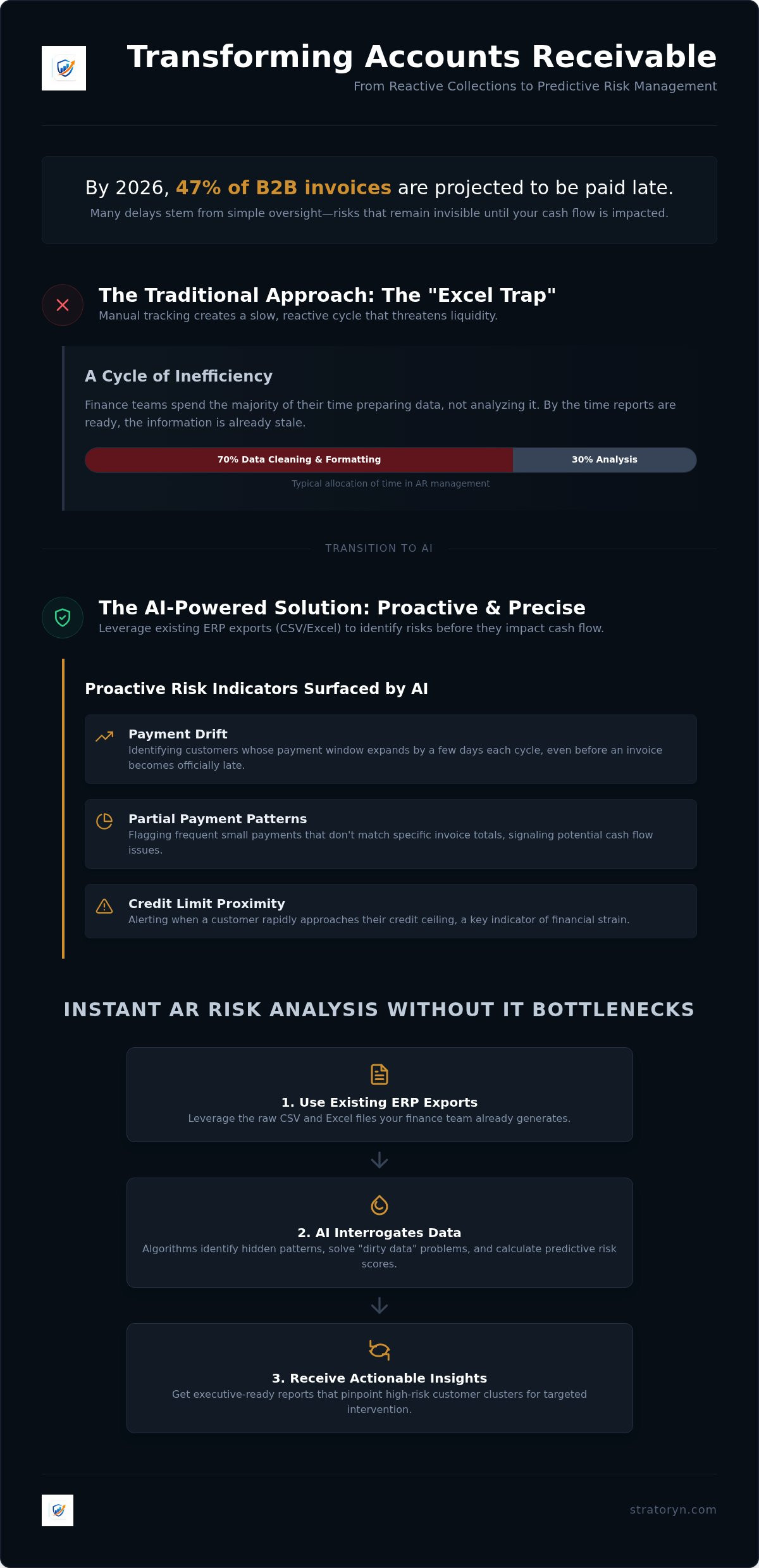
Many finance teams are currently caught in the "Excel Trap." They spend 70% of their time cleaning raw data exports and only 30% analyzing them. By the time a spreadsheet is formatted and ready for review, the data is already stale. Standard ERP aging reports are inherently historical; they show you what happened yesterday. They fail to surface the "drift" in payment behavior that signals a looming default. In a large-scale enterprise portfolio, manual oversight cannot catch these subtle patterns. The result is a persistent delay between a risk event and its appearance on a manager's desk, which often leads to preventable bad debt.
Proactive Risk Indicators Surfaced by AI
AI doesn't just look at dates. It interrogates raw CSV and Excel exports to correlate disparate data points that human analysts might miss. It identifies anomalies that suggest a shift in a customer's financial health. Common indicators surfaced by AI include:
- Payment Drift: A customer who consistently paid in 30 days begins paying in 35, then 38, even if they aren't technically "late" yet.
- Partial Payment Patterns: Frequent small payments that don't match specific invoice totals.
- Credit Limit Proximity: Rapidly approaching a credit ceiling without a corresponding increase in order volume.
- Regional Economic Signals: Correlating local economic downturns with specific customer clusters in your export.
Predictive risk scoring is a dynamic numerical value assigned to each debtor, calculated by AI to forecast the probability of default before a payment is missed. This score allows teams to prioritize high-stakes accounts and secure cash before the 47% of invoices that are typically paid late in 2026 become a permanent loss.
How AI Interrogates ERP Exports to Surface Hidden Cash Risks
You don't need a direct API connection to leverage high-level intelligence. Modern AI for accounts receivable risk management operates directly on the data exports your finance team already generates. By analyzing raw CSV and Excel files, machine learning algorithms identify high-risk customer clusters without the need for a months-long IT project. Natural language processing (NLP) even interprets internal invoice notes and payment terms to find hidden friction points. This level of automated financial risk detection ensures that your oversight scales alongside your business growth.
Pattern Recognition in Accounts Receivable Data
Machine learning detects "slow-pay" trends before they ever trigger a standard aging alert. It monitors the variance between promised and actual payment dates with microscopic precision. If a client's payment window expands by even a few days across multiple cycles, the system flags it as a liquidity threat. It also isolates disputed invoices that are quietly stalling cash flow. By cross-referencing customer behavior across different product lines, AI reveals if a client is deprioritizing your invoices. These patterns are often invisible in a standard spreadsheet but become obvious once processed through an intelligence workspace.
Solving the "Dirty Data" Problem
Raw ERP exports are frequently riddled with duplicate records and inconsistent naming. One customer might appear as "Acme Corp" and "Acme Corporation" in different entries. AI identifies these duplicates automatically. It consolidates the risk profile into a single, accurate view. This capability is essential when using an erp migration data quality tool to maintain integrity during system transitions. It ensures that your risk assessments aren't diluted by fragmented data entries.
Stratoryn detects data gaps that would typically break a standard BI dashboard. If a column is missing a date or a currency code is malformed, the system flags the error rather than producing a flawed report. This ensures that your executive-ready reports are built on clean, verified information. You can upload your latest export to see how quickly raw data transforms into actionable risk intelligence. This process removes the technical hurdles that often prevent finance teams from adopting modern AI for accounts receivable risk management.
Data Intelligence vs. Workflow Automation: Choosing Your AR Strategy
Many software providers focus on "Automated Agents" designed to send collection emails faster. While efficiency is helpful, speed is a liability when you are targeting the wrong risks. Workflow automation solves the "how" of collections, but data intelligence addresses the "who" and "why." AI for accounts receivable risk management is most effective when it functions as an intelligence workspace rather than a simple auto-dialer. It ensures your team spends time on the accounts that actually threaten your liquidity. Sending a perfectly timed email to a client who cannot pay is an exercise in futility.
Choosing an intelligence-first strategy allows you to avoid the "Integration Tax." This is the hidden cost of time, labor, and budget required to connect AI tools directly to an ERP. Many enterprise projects stall for months while waiting for IT approval or custom API development. A streamlined approach uses browser-side analysis to bypass these delays entirely. You get actionable results in minutes, not quarters. This speed allows you to react to market shifts in real-time, protecting your cash flow against the 4.75% interest rates currently applied to late federal payments in 2026.
The Barrier of Direct ERP Integration
IT departments prioritize system stability and security above all else. They often block third-party API access to prevent potential vulnerabilities or performance lags in core financial systems. Additionally, permanent raw file storage in cloud-based AR tools creates a significant security risk for sensitive customer information. If a vendor's cloud is breached, your entire ledger is exposed. Browser-based processing eliminates these concerns. By analyzing data locally in your browser, your raw exports never stay on a third-party server. This "no-integration" model allows finance teams to deploy advanced AI for accounts receivable risk management without waiting for a technical green light or compromising data privacy.
Moving from Task-Based to Insight-Based AR
A task-based approach focuses on the repetitive action of sending a reminder. An insight-based approach uses AI to suggest restructuring a credit limit or changing payment terms before a customer defaults. This shift transforms the AR Manager from a "chaser" who follows up on late payments into a "data strategist" who prevents them. When you leverage ai for data quality management, you ensure that every strategic decision is based on verified, clean information. This directly impacts the bottom line by preventing bad debt and optimizing working capital. You aren't just doing the work faster; you are making better financial decisions. High-performing firms in 2026 use this intelligence to achieve DSO rates as low as 35 days, far outperforming those stuck in manual, task-heavy workflows.
Implementing an AI-Driven AR Risk Management Framework
A successful transition to intelligence-led finance requires a repeatable framework. You don't need a massive IT project to begin. Follow these five steps to integrate AI for accounts receivable risk management into your monthly operations with surgical precision.
- Step 1: Standardize. Ensure your ERP exports use consistent column mapping. AI requires uniform headers and date formats to perform accurate interrogation across different reporting periods.
- Step 2: Profile. Use automated data profiling to identify high-risk clusters. This process surfaces anomalies in your raw CSV files that traditional aging reports often ignore.
- Step 3: Validate. Cross-check AI-generated risk scores against your historical aging trends. Validating these findings builds internal trust in the predictive model.
- Step 4: Translate. Move from raw data to Executive-Ready Reports. These summaries should highlight actionable cash risks and data quality gaps for leadership.
- Step 5: Audit. Establish a monthly "Risk Audit" cadence. Use your latest AI exports to track how your risk profile evolves over time, ensuring your strategy remains proactive.
Identifying High-Risk Clusters
Traditional methods segment portfolios by balance size. This is a strategic mistake. A small balance with a high probability of default often signals systemic issues within a specific customer segment. AI generates "risk heat maps" directly from your CSV data. These maps allow you to visualize exactly where the risk of total loss is highest. You can then prioritize your collection efforts based on the severity of the threat rather than the dollar amount of the invoice. This ensures your team addresses the most volatile accounts first, protecting your overall liquidity.
Generating Executive-Ready Reports
In 2026, CFOs are moving away from simple DSO metrics. They prioritize Risk-Adjusted DSO, which accounts for the probability of non-payment across the entire ledger. A high-quality ERP Intelligence Workspace automates the creation of these management summaries. It transforms raw exports into polished outputs that highlight liquidity threats and data integrity issues. These reports provide the clarity needed for high-stakes financial decisions without the manual labor of spreadsheet formatting. You can generate your first executive report in minutes by uploading your latest data export. This shift from manual tracking to automated intelligence allows your team to function as data strategists rather than administrative chasers.
Stratoryn: Instant AR Risk Analysis Without the IT Bottleneck
Stratoryn eliminates the friction traditionally associated with enterprise financial software. It provides immediate access to AI for accounts receivable risk management through a simple file upload. There is no waiting for API keys, custom development, or lengthy security audits. Analysis begins the second you provide a CSV or Excel export. This approach bypasses the IT bottleneck that often stalls digital transformation projects, allowing finance teams to act while the data is still relevant.
The AI Data Analyst feature functions as an on-demand expert for your department. It doesn't just present numbers; it interprets them. It identifies the underlying causes of shifting payment behaviors and suggests specific corrective actions. This allows your team to move from raw data to actionable insight without the burden of manual calculation. By focusing on the "No Integration" value proposition, Stratoryn ensures that your transition to an intelligence-led strategy happens in minutes, not months.
Security and Privacy by Design
Browser-side processing is the core of the Stratoryn security model. Your sensitive financial data remains on your local machine during the analysis. We don't practice raw file storage, which is the gold standard for data security in 2026. This architecture naturally simplifies compliance with GDPR and SOC2 requirements because your most sensitive ledger information is never stored on a third-party server. It removes the primary barrier to entry for risk-averse finance leaders who need advanced intelligence without compromising their data privacy protocols.
Accelerating the Month-End Close
Speed is the ultimate metric for a successful month-end close. Automated risk detection removes the need for manual reconciliations and line-by-line aging reviews. By utilizing automated erp reporting software, you can generate Executive-Ready Reports in seconds. This efficiency allows your team to focus on resolving high-risk disputes rather than formatting spreadsheets. You gain a clear, real-time view of your liquidity position, ensuring that your 2026 finance strategy is built on a foundation of verified data integrity.
Stop waiting for IT to clear your backlog. You can analyze your first AR export for free on Stratoryn and see the immediate impact of AI for accounts receivable risk management on your DSO. It is time to transform your raw exports into a strategic advantage.
Securing Your Cash Flow with Data Intelligence
The shift toward intelligence-led finance is no longer optional. You have seen how reactive collections and manual Excel tracking create invisible risks that threaten your liquidity. By adopting AI for accounts receivable risk management, you move from chasing payments to predicting them with surgical precision. This transition doesn't require a complex IT project or months of system integration. It starts with the data you already have in your raw ERP exports.
Stratoryn provides the clarity you need with zero integration required. Our browser-side processing ensures your data privacy while generating executive-ready reports in seconds. You can identify high-risk clusters and data quality gaps immediately. This efficiency allows your team to focus on strategic cash management rather than administrative cleanup. It is time to transform your raw financial exports into a polished, professional advantage.
Start your free AR risk analysis with Stratoryn and secure your cash flow today. Taking control of your ledger has never been faster or more secure. You are ready to lead your finance team into a more predictable and automated future.
Frequently Asked Questions
How does AI identify risk in accounts receivable data?
AI uses predictive modeling and pattern recognition to detect subtle shifts in payment behavior. It analyzes historical trends in your CSV exports to flag "drift," such as a customer moving from 30-day to 35-day payment cycles. This foresight allows you to catch potential defaults before they appear on a standard aging report. It identifies anomalies that human analysts often miss.
Do I need to integrate my ERP with an AI tool to manage AR risk?
No, direct integration is not required for modern risk analysis. You can leverage AI for accounts receivable risk management by uploading raw CSV or Excel exports from your existing ERP. This "no-integration" approach bypasses IT bottlenecks. It allows you to start identifying cash flow threats immediately without compromising system stability or waiting for API approvals.
Is it safe to upload my accounts receivable CSV to an AI platform?
Safety depends on the platform's architecture. Stratoryn uses browser-side processing, which means your raw financial data never leaves your machine or stays on a third-party server. This "no raw file storage" model is the gold standard for data privacy in 2026. It ensures compliance with GDPR and SOC2 while protecting sensitive ledger information from external breaches.
Can AI help reduce my Days Sales Outstanding (DSO)?
Yes, companies using AI-driven technology can see DSO reductions of 20% to 40% according to 2026 industry benchmarks. By identifying high-risk accounts early, your team can prioritize collection efforts where they are most needed. Proactive risk detection prevents invoices from becoming severely past due. This directly accelerates cash flow and improves your firm's overall liquidity position.
What is the difference between AR automation and AR intelligence?
AR automation focuses on speeding up repetitive tasks, such as sending reminder emails. AR intelligence uses an ERP Intelligence Workspace to analyze the underlying data and tell you who to email and why. Automation handles the "how," but intelligence provides the strategic "who." This ensures you don't waste resources on low-risk accounts while ignoring high-risk threats.
How long does it take to see results from an AI AR risk management tool?
Results are often visible within minutes of your first data upload. Because there is no lengthy implementation phase, the AI Data Analyst can surface hidden risks and data quality gaps as soon as the CSV is processed. You can move from raw exports to an executive-ready report in a single session. This speed is essential for maintaining an agile 2026 finance strategy.
Can AI handle messy or inconsistent data from older ERP systems?
Yes, modern AI tools include automated Data Quality Analysis to resolve "dirty data" issues. The system identifies duplicate records, inconsistent naming conventions, and missing fields that typically break traditional BI tools. It cleans and standardizes the information during the analysis phase. This ensures your risk scores remain accurate regardless of your ERP's age or data entry habits.
What kind of reports can AI generate for my finance leadership team?
AI generates Executive-Ready Reports that focus on high-level strategic metrics like Risk-Adjusted DSO. These summaries highlight specific liquidity threats and data integrity gaps rather than just listing overdue balances. They provide CFOs with a clear, actionable view of the ledger's health. This allows for faster decision-making and more accurate cash flow forecasting during the month-end close.
Frequently asked questions
How does AI identify risk in accounts receivable data?
AI uses predictive modeling and pattern recognition to detect subtle shifts in payment behavior. It analyzes historical trends in your CSV exports to flag "drift," such as a customer moving from 30-day to 35-day payment cycles. This foresight allows you to catch potential defaults before they appear on a standard aging report. It identifies anomalies that human analysts often miss.
Do I need to integrate my ERP with an AI tool to manage AR risk?
No, direct integration is not required for modern risk analysis. You can leverage AI for accounts receivable risk management by uploading raw CSV or Excel exports from your existing ERP. This "no-integration" approach bypasses IT bottlenecks. It allows you to start identifying cash flow threats immediately without compromising system stability or waiting for API approvals.
Is it safe to upload my accounts receivable CSV to an AI platform?
Safety depends on the platform's architecture. Stratoryn uses browser-side processing, which means your raw financial data never leaves your machine or stays on a third-party server. This "no raw file storage" model is the gold standard for data privacy in 2026. It ensures compliance with GDPR and SOC2 while protecting sensitive ledger information from external breaches.
Can AI help reduce my Days Sales Outstanding (DSO)?
Yes, companies using AI-driven technology can see DSO reductions of 20% to 40% according to 2026 industry benchmarks. By identifying high-risk accounts early, your team can prioritize collection efforts where they are most needed. Proactive risk detection prevents invoices from becoming severely past due. This directly accelerates cash flow and improves your firm's overall liquidity position.
What is the difference between AR automation and AR intelligence?
AR automation focuses on speeding up repetitive tasks, such as sending reminder emails. AR intelligence uses an ERP Intelligence Workspace to analyze the underlying data and tell you who to email and why. Automation handles the "how," but intelligence provides the strategic "who." This ensures you don't waste resources on low-risk accounts while ignoring high-risk threats.
How long does it take to see results from an AI AR risk management tool?
Results are often visible within minutes of your first data upload. Because there is no lengthy implementation phase, the AI Data Analyst can surface hidden risks and data quality gaps as soon as the CSV is processed. You can move from raw exports to an executive-ready report in a single session. This speed is essential for maintaining an agile 2026 finance strategy.
Can AI handle messy or inconsistent data from older ERP systems?
Yes, modern AI tools include automated Data Quality Analysis to resolve "dirty data" issues. The system identifies duplicate records, inconsistent naming conventions, and missing fields that typically break traditional BI tools. It cleans and standardizes the information during the analysis phase. This ensures your risk scores remain accurate regardless of your ERP's age or data entry habits.
What kind of reports can AI generate for my finance leadership team?
AI generates Executive-Ready Reports that focus on high-level strategic metrics like Risk-Adjusted DSO. These summaries highlight specific liquidity threats and data integrity gaps rather than just listing overdue balances. They provide CFOs with a clear, actionable view of the ledger's health. This allows for faster decision-making and more accurate cash flow forecasting during the month-end close.
- AI for accounts receivable risk management
- AI
- Accounts Receivable
- Risk Management
- FinTech
- Cash Flow
- DSO
- B2B Payments
- Financial Strategy
- AR risk management
- AI in finance
- reduce DSO
- cash flow management
- proactive collections
- B2B payments