
Inventory Stock Problem Detection AI: Surfacing Hidden Risks in ERP Data

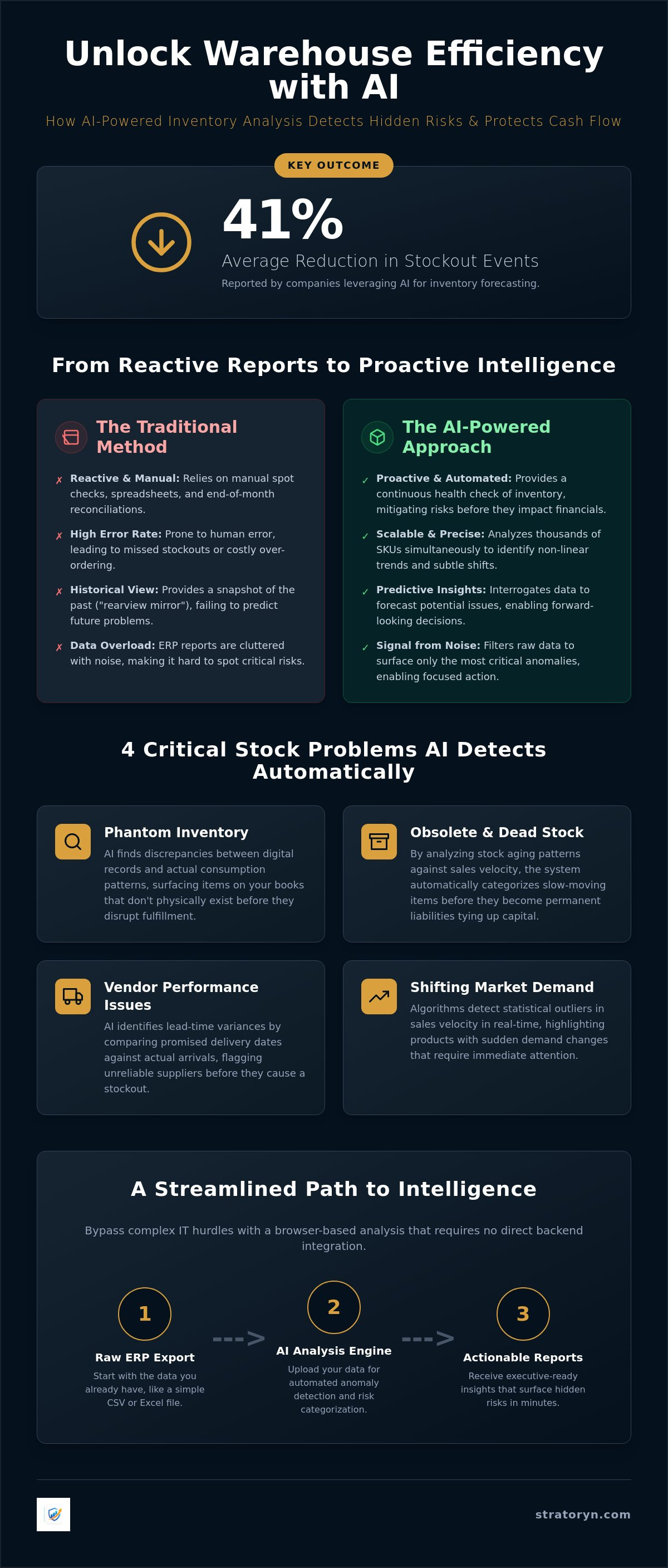
Companies leveraging AI for forecasting now report an average reduction of 41 percent in stockout events, yet many operations still rely on manual spreadsheets to manage warehouse risks. You likely know the frustration of staring at cluttered ERP reports while capital remains trapped in slow-moving stock. This guide promises to show you how inventory stock problem detection ai identifies imbalances and cash-flow risks directly from your existing ERP exports. We will explore how to automate anomaly detection and generate executive-ready reports that surface hidden risks in minutes.
You don't need a massive software overhaul or complex integrations to gain this level of clarity. This article outlines a streamlined path to transform raw data into a professional tool for warehouse efficiency and financial precision. This approach ensures your stock levels remain optimized for the 2026 market while minimizing the cognitive load on your operations team. By focusing on practical utility and the speed of the outcome, you can move from raw information to polished, actionable insights without the typical technical hurdles.
Key Takeaways
- Understand why traditional ERP reports often fail to highlight stock anomalies until they affect your bottom line.
- Discover how inventory stock problem detection ai uses statistical deviations to surface "phantom inventory" hidden in your data exports.
- Identify the four critical categories of stock risks that AI categorizes automatically to streamline operations and finance workflows.
- Learn how to bypass complex IT hurdles by using browser-based analysis that requires no direct backend integration.
- See how to transform cluttered data tables into executive-ready reports that enable faster decisions and protect warehouse cash flow.
Table of Contents
- The Evolution of Inventory Stock Problem Detection
- How AI Identifies Hidden Inventory Risks in ERP Data
- 4 Critical Stock Problems AI Detects Automatically
- Overcoming the Implementation Barrier: AI Without Integration
- Transforming ERP Exports into Actionable Stock Intelligence
The Evolution of Inventory Stock Problem Detection
Inventory management has transitioned from a back-office recording task to a strategic front-line defense. For decades, Inventory control relied on manual spot checks and end-of-month reconciliations. These reactive methods are no longer sufficient. Traditional ERP systems serve as excellent databases, but they often fail to highlight anomalies until the financial impact is already visible on the balance sheet. Modern inventory stock problem detection ai changes this dynamic by shifting the focus from historical reporting to proactive risk mitigation.
AI identifies subtle shifts in stock movement that traditional spreadsheet formulas simply cannot see. While a standard report might show a high stock level, it won't necessarily flag the specific aging pattern suggesting that stock is becoming obsolete. AI bridges the gap between raw data exports and executive decision-making. It transforms static CSV files into a dynamic roadmap for cash flow protection. This technology doesn't just store data; it interrogates it, surfacing hidden risks that remain buried in standard rows and columns. Standard ERP reports are often cluttered with noise, presenting rows of data without context. An AI-driven approach filters this noise to surface only the most critical risks, allowing finance and operations professionals to maintain a lean warehouse without sacrificing service levels.
Why Manual Stock Audits Fail in 2026
Spreadsheets can't keep up with the complexity of modern supply chains. Human error in manual Excel analysis frequently leads to missed stockouts or costly over-ordering. As SKU counts grow, the sheer volume of data exceeds the capacity for human review. Static reports are also ill-equipped to handle the volatility of 2026 global markets. They provide a snapshot of the past, whereas operations teams need a lens into the future. Relying on manual audits means you're always looking in the rearview mirror while trying to drive forward. This delay creates a blind spot where capital remains tied up in slow-moving stock that should have been cleared months ago.
The Role of AI in Modern Inventory Intelligence
Machine learning models excel at identifying non-linear trends in stock aging and demand shifts. Instead of waiting for a quarterly audit, inventory stock problem detection ai provides a continuous health check of your entire inventory position. This automation allows your operations team to stop hunting for problems and start resolving them. Key advantages include:
- Instant identification of phantom inventory that doesn't match physical reality.
- Automated categorization of slow-moving items before they become liabilities.
- Scaling human intelligence across thousands of SKUs simultaneously without increasing headcount.
By using an AI Data Analyst to scale human intelligence, businesses can identify cash-flow risks in the warehouse before they escalate. This process moves the needle from asking what happened to deciding what we should do now. It creates a sense of quiet authority for managers who can finally trust their data.
How AI Identifies Hidden Inventory Risks in ERP Data
AI doesn't simply store your data; it interrogates it. While traditional systems provide a passive record of what is on the shelf, inventory stock problem detection ai scans ERP exports for statistical deviations that human analysts often overlook. These algorithms look for discrepancies between your digital records and actual consumption patterns. By analyzing thousands of rows in seconds, the system surfaces "phantom inventory"—items that appear on your books but don't exist in reality—before they disrupt your fulfillment cycle. This level of automated analysis is essential for maintaining a lean warehouse without increasing administrative overhead.
Modern pattern recognition also extends to vendor performance. AI automatically identifies lead-time variances by comparing promised delivery dates against actual arrival timestamps in your ERP data. If a specific supplier consistently misses windows, the system flags the risk before it leads to a stockout. This proactive approach allows operations teams to adjust safety stock levels dynamically rather than relying on outdated annual estimates. Research into how AI technology detects stock problems shows that machine learning excels at finding these non-linear relationships that simple spreadsheet formulas miss.
Anomaly Detection and Pattern Recognition
Algorithms identify outliers in sales velocity that signal shifting market demand in real-time. This automated detection highlights "dead stock" months before it becomes a significant cash risk, allowing you to liquidate or reposition assets early. By analyzing historical consumption rates and seasonal trends, AI predicts future stockouts with high precision, ensuring you order exactly what you need. This transformation of raw data into actionable insight ensures that your capital remains productive rather than being tied up in stagnant inventory.
Ensuring Data Integrity for Accurate Detection
The success of any AI model depends on the quality of the underlying information. Many businesses struggle with detection because their base data is fragmented or inaccurate. AI acts as a sophisticated filter, identifying duplicate SKU entries or incorrect unit-of-measure data in your CSV exports that would otherwise skew your results. You must improve ERP data integrity to ensure that your risk scores reflect reality. Unlike rigid ERP modules, a flexible inventory stock problem detection ai solution highlights these quality gaps during the analysis phase. If you want to see how this works with your own data, using an ERP Intelligence Workspace can clarify your current stock position in minutes.
Finally, risk scoring prioritizes these issues for you. Instead of a list of 500 "problems," the system generates a weighted report. It ranks risks based on their potential impact on cash flow and customer service. This ensures that executive attention remains focused on high-stakes anomalies rather than minor data noise. It's a faster, more reliable way to manage a warehouse in a volatile economy.
4 Critical Stock Problems AI Detects Automatically
Standard ERP reports often drown operations managers in rows of data without providing a clear path to action. Effective inventory stock problem detection ai solves this by filtering noise and categorizing risks into four actionable buckets. Each detected anomaly links directly to a financial impact. This ensures that finance and operations teams prioritize the most significant cash risks first. By using an AI Data Analyst, you can transform a cluttered warehouse report into a strategic roadmap for efficiency.
Executive reports should highlight these four areas to maintain a lean supply chain. This structured approach moves beyond simple counting. It focuses on the velocity and health of your capital. When your system identifies these problems automatically, your team stops searching for errors and starts executing solutions. This transition is vital for scaling human intelligence without increasing administrative headcount.
1. Slow-Moving and Obsolete Inventory (SLOB)
AI calculates the "burn rate" of every SKU by comparing current stock levels against real-time consumption data. This identifies capital traps that standard reports miss. By analyzing aging trends directly from your CSV exports, the system flags items reaching their end-of-life cycle. Automated alerts allow you to liquidate or reposition these assets before they become a total loss. This proactive detection prevents the slow accumulation of "dead stock" that often hides in the back of a warehouse for years.
2. Imminent Stockouts and Supply Gaps
Predictive analysis provides an early warning system for high-priority items. The AI compares your current stock position against historical consumption and fluctuating lead times to predict gaps before they occur. This reduces the need for expensive emergency re-orders and prevents the lost sales associated with empty shelves. It's a faster, more reliable way to manage demand volatility than manual spreadsheet tracking. You gain the clarity needed to adjust orders while there's still time to react.
3. Lead-Time and Vendor Variance
The system tracks the delta between promised delivery dates and actual arrival timestamps. This surfaces which vendors consistently contribute to stock instability. By linking performance to automated procurement data analysis, you can hold suppliers accountable with hard data. This level of visibility ensures that your safety stock levels reflect actual vendor behavior rather than optimistic estimates. It turns procurement into a data-driven advantage.
4. Excessive Capital and Over-Ordering
Over-ordering is often a symptom of poor data visibility. AI identifies SKUs where you have excessive safety stock that isn't justified by demand patterns. This surfaces immediate opportunities to reduce orders and free up cash flow. By detecting these imbalances automatically, you can maintain a leaner inventory position without risking service levels. This ensures that every dollar in the warehouse is working toward your bottom line.
Overcoming the Implementation Barrier: AI Without Integration
Many organizations stall their AI initiatives because they fear the technical debt of a six-month integration project. This perception is a significant hurdle that often prevents operations teams from modernizing. You don't need to modify your core infrastructure to gain advanced insights. It's possible to deploy inventory stock problem detection ai without changing a single line of your ERP's backend code. By focusing on the data you already export, you bypass the IT bottleneck and start surfacing risks in hours rather than quarters.
Whether you utilize SAP, NetSuite, or a legacy on-premise system, the universal common denominator is the data export. Analyzing raw ERP exports ensures compatibility across any software ecosystem. This approach positions the AI as a flexible layer that sits on top of your existing processes. It functions as an AI Data Analyst that interrogates your CSV files to find patterns that standard reports ignore. This streamlined method prioritizes immediate utility and the speed of the outcome, creating a sense of quiet authority for the user who needs answers now.
Why CSV Exports are the Secret to Rapid AI Adoption
Every ERP system can generate a CSV or Excel export. This simple fact eliminates the need for expensive API development or complex database permissions that typically require months of IT oversight. Operations teams can perform rapid testing of AI models on specific data subsets for immediate insights. This allows you to validate the accuracy of the detection on a single warehouse or product category before scaling. It's a low-risk, high-reward strategy that proves ROI without a massive upfront investment in software architecture.
Maintaining Data Privacy in AI Analysis
Security is a non-negotiable requirement when handling sensitive financial and stock data. The industry is seeing a shift toward browser-side processing to enhance privacy and meet strict compliance standards. This technology ensures that your raw files are processed locally within your browser rather than being stored on external servers. The rise of AI tools to analyze ERP exports is changing the landscape of data security by removing the need for raw file storage. It offers a reassuring way to adopt innovation while keeping your proprietary data under your direct control.
If you are looking for a way to identify warehouse risks without an IT overhaul, the ERP Intelligence Workspace provides a secure, integration-free solution. This browser-based approach allows you to transform raw information into polished, professional outputs with total confidence in your data integrity. You can finally stop waiting for IT approval and start protecting your cash flow today.
Transforming ERP Exports into Actionable Stock Intelligence
Detection is only the first step. For a supply chain manager, knowing a problem exists is secondary to knowing how to fix it. Effective inventory stock problem detection ai bridges this gap by focusing on the "Why" and the "So What" of your warehouse data. Instead of presenting a raw list of anomalies, it interprets the financial weight of every stock imbalance. This ensures your team focuses on high-impact decisions that protect the bottom line rather than getting lost in minor data fluctuations. It's about moving from raw information to polished, professional outputs that drive business strategy.
A streamlined workflow moves from a simple file upload to a comprehensive risk report in minutes. This speed is critical for maintaining an agile warehouse. You shouldn't wait for a monthly review to catch a stockout or identify a capital trap. By automating the transformation of complex data tables into actionable intelligence, you reclaim the time previously spent on manual Excel analysis. This creates a logical business process where your existing ERP data becomes a strategic asset. You gain a sense of quiet authority when your decisions are backed by automated, precise risk assessments.
Generating Executive-Ready Management Reports
Executive leadership doesn't need to see thousands of rows of SKU data. They need to see the five key risks threatening warehouse cash flow. AI-powered Executive-Ready Reports summarize these complexities into clear, high-level insights. This includes providing automated commentary on inventory health that you can take directly into board meetings. Visualizing the cash-at-risk from overstocked or obsolete items turns abstract data into a concrete financial argument for change. This level of clarity ensures that every stakeholder understands the stakes without needing a technical background in data processing.
Next Steps: Implementing an AI Data Analyst
Transitioning to an AI-driven model doesn't require a total system overhaul. You can start by identifying low-hanging fruit with a single data export. Follow these steps to begin:
- Upload a standard CSV export to identify high-value items with declining sales velocity.
- Perform a regular Data Quality Analysis to audit your ERP data for duplicate entries or incorrect units of measure.
- Scale your intelligence by using an AI Data Analyst to monitor lead-time variances across your entire vendor list.
Leverage the ERP Intelligence Workspace to gain instant visibility into your stock position. This frictionless approach allows you to scale human intelligence across your entire supply chain without increasing administrative headcount. You can finally stop managing by intuition and start managing by insight. This is the most efficient way to handle the high stakes of modern data management while maintaining a lean, responsive warehouse.
Secure Your Warehouse Cash Flow with AI
Take control of your warehouse efficiency today. Finance and operations professionals can now access free early access to start surfacing hidden risks immediately. Analyze your ERP exports for stock risks with the Stratoryn Workspace. Your data is ready to work for you; it's time to unlock its full potential.
Frequently Asked Questions
How does AI detect stock problems that my ERP misses?
AI identifies risks by applying advanced statistical models to your historical data patterns. While your ERP serves as a record-keeping database, it often lacks the analytical layer to flag non-linear trends like subtle stock aging or phantom inventory. AI interrogates every SKU simultaneously to find deviations that standard spreadsheet formulas miss. This process transforms raw data into a proactive defense, ensuring that your management decisions are based on current risks rather than historical snapshots.
Can I use AI to analyze inventory data from Excel or CSV files?
Yes, you can analyze data directly from standard Excel or CSV exports. This approach eliminates the need for complex API integrations or backend database access. By using an AI Data Analyst to process these files, you gain immediate visibility into warehouse risks regardless of your current software infrastructure. It's the most efficient way to scale human intelligence and identify cash-flow traps without a heavy IT burden or lengthy implementation cycles.
Is it safe to upload sensitive inventory data to an AI tool?
Security is maintained through browser-side processing. This technology ensures that your raw files are analyzed locally on your machine rather than being stored on external servers. This method protects sensitive financial and stock information while meeting strict compliance standards. You maintain total control over your proprietary data while leveraging the power of inventory stock problem detection ai to surface hidden risks without compromising your internal security protocols.
How much time does it take to implement inventory stock problem detection AI?
Implementation takes minutes rather than months. Since the system analyzes existing ERP exports, there is no technical integration or software deployment required. You simply upload your CSV or Excel file to the workspace and receive actionable insights immediately. This rapid turnaround allows operations teams to identify low-hanging fruit and resolve critical stock imbalances within the same business day, moving directly from raw data to decision-making.
What is the difference between demand forecasting and stock problem detection?
Demand forecasting predicts future sales volume, whereas inventory stock problem detection ai identifies current anomalies and health risks in your stock position. Forecasting tells you what you might need; detection tells you what is currently wrong, such as obsolete items or vendor lead-time variances. Both are essential for a lean supply chain, but detection is the primary tool for protecting immediate cash flow and surfacing warehouse inefficiencies that are already costing you money.
Does inventory AI work with older ERP systems that don’t have built-in AI?
Inventory AI works with any system capable of generating a data export. Legacy ERPs often lack modern analytical tools, but their raw data remains a valuable asset. By exporting your stock tables to a dedicated intelligence workspace, you can apply modern machine learning to older records. This allows you to modernize your operations and gain executive-ready reports without the cost, time, or risk associated with a full system migration.
Frequently asked questions
Why Manual Stock Audits Fail in 2026
Spreadsheets can't keep up with the complexity of modern supply chains. Human error in manual Excel analysis frequently leads to missed stockouts or costly over-ordering. As SKU counts grow, the sheer volume of data exceeds the capacity for human review. Static reports are also ill-equipped to handle the volatility of 2026 global markets. They provide a snapshot of the past, whereas operations teams need a lens into the future. Relying on manual audits means you're always looking in the rearview mirror while trying to drive forward. This delay creates a blind spot where capital remains tied up in slow-moving stock that should have been cleared months ago.
The Role of AI in Modern Inventory Intelligence
Machine learning models excel at identifying non-linear trends in stock aging and demand shifts. Instead of waiting for a quarterly audit, inventory stock problem detection ai provides a continuous health check of your entire inventory position. This automation allows your operations team to stop hunting for problems and start resolving them. Key advantages include: By using an AI Data Analyst to scale human intelligence, businesses can identify cash-flow risks in the warehouse before they escalate. This process moves the needle from asking what happened to deciding what we should do now. It creates a sense of quiet authority for managers who can finally trust their data. AI doesn't simply store your data; it interrogates it. While traditional systems provide a passive record of what is on the shelf, inventory stock problem detection ai scans ERP exports for statistical deviations that human analysts often overlook. These algorithms look for discrepancies between your digital records and actual consumption patterns. By analyzing thousands of rows in seconds, the system surfaces "phantom inventory"—items that appear on your books but don't exist in reality—before they disrupt your f
Anomaly Detection and Pattern Recognition
Algorithms identify outliers in sales velocity that signal shifting market demand in real-time. This automated detection highlights "dead stock" months before it becomes a significant cash risk, allowing you to liquidate or reposition assets early. By analyzing historical consumption rates and seasonal trends, AI predicts future stockouts with high precision, ensuring you order exactly what you need. This transformation of raw data into actionable insight ensures that your capital remains productive rather than being tied up in stagnant inventory.
Ensuring Data Integrity for Accurate Detection
The success of any AI model depends on the quality of the underlying information. Many businesses struggle with detection because their base data is fragmented or inaccurate. AI acts as a sophisticated filter, identifying duplicate SKU entries or incorrect unit-of-measure data in your CSV exports that would otherwise skew your results. You must improve ERP data integrity to ensure that your risk scores reflect reality. Unlike rigid ERP modules, a flexible inventory stock problem detection ai solution highlights these quality gaps during the analysis phase. If you want to see how this works with your own data, using an ERP Intelligence Workspace can clarify your current stock position in minutes. Finally, risk scoring prioritizes these issues for you. Instead of a list of 500 "problems," the system generates a weighted report. It ranks risks based on their potential impact on cash flow and customer service. This ensures that executive attention remains focused on high-stakes anomalies rather than minor data noise. It's a faster, more reliable way to manage a warehouse in a volatile economy. Standard ERP reports often drown operations managers in rows of data without providing a clea
1. Slow-Moving and Obsolete Inventory (SLOB)
AI calculates the "burn rate" of every SKU by comparing current stock levels against real-time consumption data. This identifies capital traps that standard reports miss. By analyzing aging trends directly from your CSV exports, the system flags items reaching their end-of-life cycle. Automated alerts allow you to liquidate or reposition these assets before they become a total loss. This proactive detection prevents the slow accumulation of "dead stock" that often hides in the back of a warehouse for years.
2. Imminent Stockouts and Supply Gaps
Predictive analysis provides an early warning system for high-priority items. The AI compares your current stock position against historical consumption and fluctuating lead times to predict gaps before they occur. This reduces the need for expensive emergency re-orders and prevents the lost sales associated with empty shelves. It's a faster, more reliable way to manage demand volatility than manual spreadsheet tracking. You gain the clarity needed to adjust orders while there's still time to react.
3. Lead-Time and Vendor Variance
The system tracks the delta between promised delivery dates and actual arrival timestamps. This surfaces which vendors consistently contribute to stock instability. By linking performance to automated procurement data analysis, you can hold suppliers accountable with hard data. This level of visibility ensures that your safety stock levels reflect actual vendor behavior rather than optimistic estimates. It turns procurement into a data-driven advantage.
4. Excessive Capital and Over-Ordering
Over-ordering is often a symptom of poor data visibility. AI identifies SKUs where you have excessive safety stock that isn't justified by demand patterns. This surfaces immediate opportunities to reduce orders and free up cash flow. By detecting these imbalances automatically, you can maintain a leaner inventory position without risking service levels. This ensures that every dollar in the warehouse is working toward your bottom line. Many organizations stall their AI initiatives because they fear the technical debt of a six-month integration project. This perception is a significant hurdle that often prevents operations teams from modernizing. You don't need to modify your core infrastructure to gain advanced insights. It's possible to deploy inventory stock problem detection ai without changing a single line of your ERP's backend code. By focusing on the data you already export, you bypass the IT bottleneck and start surfacing risks in hours rather than quarters. Whether you utilize SAP, NetSuite, or a legacy on-premise system, the universal common denominator is the data export. Analyzing raw ERP exports ensures compatibility across any software ecosystem. This approach positio
Why CSV Exports are the Secret to Rapid AI Adoption
Every ERP system can generate a CSV or Excel export. This simple fact eliminates the need for expensive API development or complex database permissions that typically require months of IT oversight. Operations teams can perform rapid testing of AI models on specific data subsets for immediate insights. This allows you to validate the accuracy of the detection on a single warehouse or product category before scaling. It's a low-risk, high-reward strategy that proves ROI without a massive upfront investment in software architecture.
Maintaining Data Privacy in AI Analysis
Security is a non-negotiable requirement when handling sensitive financial and stock data. The industry is seeing a shift toward browser-side processing to enhance privacy and meet strict compliance standards. This technology ensures that your raw files are processed locally within your browser rather than being stored on external servers. The rise of AI tools to analyze ERP exports is changing the landscape of data security by removing the need for raw file storage. It offers a reassuring way to adopt innovation while keeping your proprietary data under your direct control. If you are looking for a way to identify warehouse risks without an IT overhaul, the ERP Intelligence Workspace provides a secure, integration-free solution. This browser-based approach allows you to transform raw information into polished, professional outputs with total confidence in your data integrity. You can finally stop waiting for IT approval and start protecting your cash flow today. Detection is only the first step. For a supply chain manager, knowing a problem exists is secondary to knowing how to fix it. Effective inventory stock problem detection ai bridges this gap by focusing on the "Why" and the
Generating Executive-Ready Management Reports
Executive leadership doesn't need to see thousands of rows of SKU data. They need to see the five key risks threatening warehouse cash flow. AI-powered Executive-Ready Reports summarize these complexities into clear, high-level insights. This includes providing automated commentary on inventory health that you can take directly into board meetings. Visualizing the cash-at-risk from overstocked or obsolete items turns abstract data into a concrete financial argument for change. This level of clarity ensures that every stakeholder understands the stakes without needing a technical background in data processing.
Next Steps: Implementing an AI Data Analyst
Transitioning to an AI-driven model doesn't require a total system overhaul. You can start by identifying low-hanging fruit with a single data export. Follow these steps to begin: Leverage the ERP Intelligence Workspace to gain instant visibility into your stock position. This frictionless approach allows you to scale human intelligence across your entire supply chain without increasing administrative headcount. You can finally stop managing by intuition and start managing by insight. This is the most efficient way to handle the high stakes of modern data management while maintaining a lean, responsive warehouse. The transition from reactive manual audits to proactive risk management is now a necessity for maintaining a lean supply chain. You've seen how identifying anomalies directly from your data exports bypasses the traditional IT bottleneck. By focusing on the velocity of your capital rather than just the volume of your stock, you can eliminate "phantom inventory" and reduce the risk of costly stockouts. This shift transforms your warehouse from a cost center into a strategic asset. Modern inventory stock problem detection ai provides the clarity needed to make high-stakes dec
How does AI detect stock problems that my ERP misses?
AI identifies risks by applying advanced statistical models to your historical data patterns. While your ERP serves as a record-keeping database, it often lacks the analytical layer to flag non-linear trends like subtle stock aging or phantom inventory. AI interrogates every SKU simultaneously to find deviations that standard spreadsheet formulas miss. This process transforms raw data into a proactive defense, ensuring that your management decisions are based on current risks rather than historical snapshots.
Can I use AI to analyze inventory data from Excel or CSV files?
Yes, you can analyze data directly from standard Excel or CSV exports. This approach eliminates the need for complex API integrations or backend database access. By using an AI Data Analyst to process these files, you gain immediate visibility into warehouse risks regardless of your current software infrastructure. It's the most efficient way to scale human intelligence and identify cash-flow traps without a heavy IT burden or lengthy implementation cycles.
Is it safe to upload sensitive inventory data to an AI tool?
Security is maintained through browser-side processing. This technology ensures that your raw files are analyzed locally on your machine rather than being stored on external servers. This method protects sensitive financial and stock information while meeting strict compliance standards. You maintain total control over your proprietary data while leveraging the power of inventory stock problem detection ai to surface hidden risks without compromising your internal security protocols.
How much time does it take to implement inventory stock problem detection AI?
Implementation takes minutes rather than months. Since the system analyzes existing ERP exports, there is no technical integration or software deployment required. You simply upload your CSV or Excel file to the workspace and receive actionable insights immediately. This rapid turnaround allows operations teams to identify low-hanging fruit and resolve critical stock imbalances within the same business day, moving directly from raw data to decision-making.
What is the difference between demand forecasting and stock problem detection?
Demand forecasting predicts future sales volume, whereas inventory stock problem detection ai identifies current anomalies and health risks in your stock position. Forecasting tells you what you might need; detection tells you what is currently wrong, such as obsolete items or vendor lead-time variances. Both are essential for a lean supply chain, but detection is the primary tool for protecting immediate cash flow and surfacing warehouse inefficiencies that are already costing you money.
Does inventory AI work with older ERP systems that don’t have built-in AI?
Inventory AI works with any system capable of generating a data export. Legacy ERPs often lack modern analytical tools, but their raw data remains a valuable asset. By exporting your stock tables to a dedicated intelligence workspace, you can apply modern machine learning to older records. This allows you to modernize your operations and gain executive-ready reports without the cost, time, or risk associated with a full system migration.
- inventory stock problem detection ai
- Inventory Management
- AI
- ERP
- Supply Chain
- Anomaly Detection
- Warehouse Operations
- Risk Management
- Data Analysis
- inventory management ai
- stock anomaly detection
- erp data analysis
- warehouse risk management
- supply chain ai
- inventory optimization