
How to Implement Automated Procurement Data Analysis in 2026

If 86% of organizations plan to scale AI in their procurement processes by the end of 2026, why are most managers still spending Friday afternoons cleaning up messy CSV exports from SAP or Oracle? Implementing automated procurement data analysis shouldn't require a total system overhaul, yet many teams remain stuck in manual reporting cycles that hide critical vendor risks. You likely feel the pressure to modernize but want to avoid the friction of a six-month IT integration project. It is a valid concern; your professional time is better spent on strategy than formatting spreadsheets.
You can transform raw ERP exports into actionable procurement insights using AI-driven automation without the traditional technical hurdles. This guide explains how to generate executive-ready reports that identify cash risks and stock problems instantly. We will explore how to maintain high-level data security while ensuring your team has real-time visibility into every dollar spent. You will see exactly how to bridge the gap between raw information and polished, professional outputs to drive immediate business value.
Key Takeaways
- Shift from manual data entry to "data intelligence" by using AI to process procurement exports automatically.
- Implement automated procurement data analysis as an analytical layer over your current ERP to avoid complex IT integration projects.
- Detect hidden vendor risks and inventory stock problems instantly through automated anomaly detection in your spend data.
- Generate executive-ready reports from raw CSV or Excel files in minutes to provide immediate visibility to stakeholders.
- Maintain high security standards with browser-side processing that analyzes data without the need for raw file storage in the cloud.
Table of Contents
- What is Automated Procurement Data Analysis?
- How AI Transforms Procurement Exports into Insights
- Vendor Spend and Risk Detection: What Automation Reveals
- How to Implement Automated Procurement Analysis in 4 Steps
- Stratoryn: Instant Procurement Intelligence Without IT Integration
What is Automated Procurement Data Analysis?
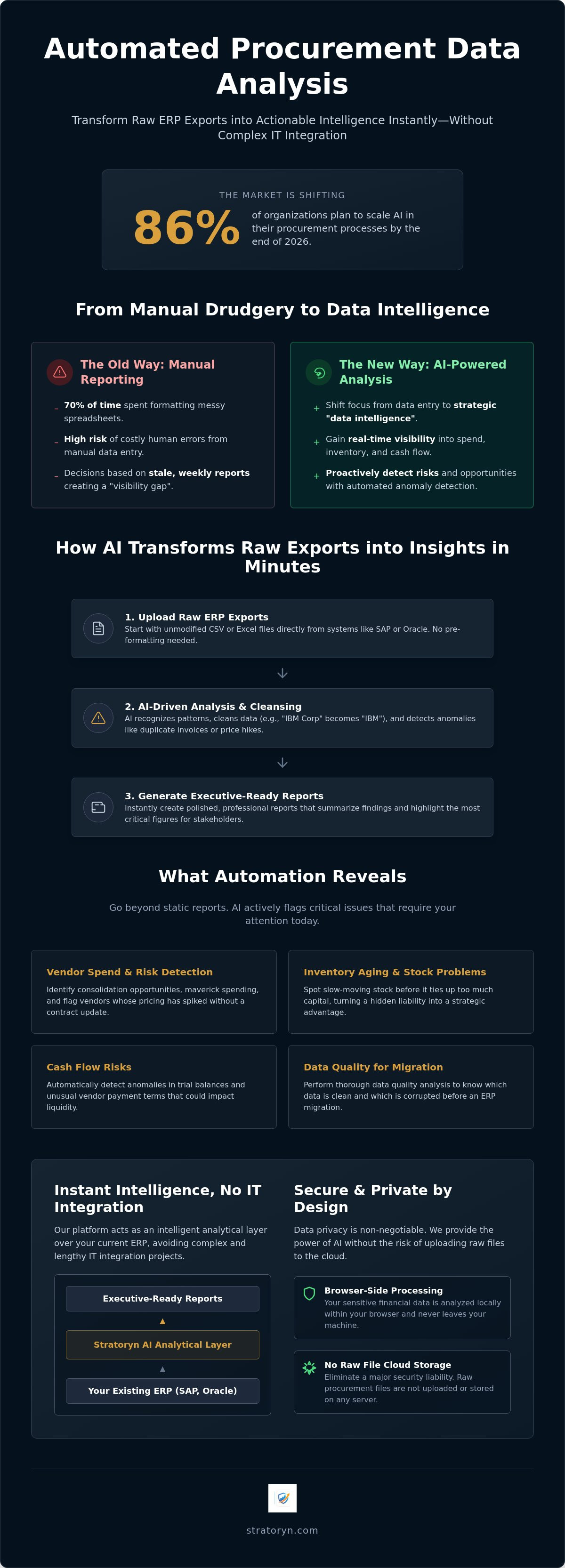
Automated procurement data analysis is the use of AI and machine learning to process raw procurement exports without manual intervention. It eliminates the need for finance teams to spend hours scrubbing CSV or Excel files. Instead of a person identifying patterns, an intelligent software layer does the heavy lifting. In 2026, the industry has shifted decisively from "data entry" to "data intelligence." This means professionals no longer focus on getting data into a system; they focus on the strategic insights that come out of it.
Modern automation builds upon foundational spend analysis techniques to provide a real-time view of where capital is flowing. By applying automated procurement data analysis, businesses can move faster than their competitors. Speed is the ultimate advantage in a volatile market. When you automate the analytical layer, you gain immediate visibility into critical operational metrics:
- Vendor spend: Identifying consolidation opportunities and maverick spending.
- Inventory aging: Spotting stock problems before they tie up too much capital.
- Cash flow risks: Detecting anomalies in trial balances and vendor payment terms.
The Problem with Manual Procurement Reporting
Manual data cleanup is the primary bottleneck for modern finance teams. When your staff spends 70% of their time formatting spreadsheets, they only have 30% left for actual analysis. This leads to a "visibility gap" where decisions are based on stale, weekly reports rather than live data. Human error is another high cost. A single misplaced decimal in a spreadsheet-based procurement report can lead to massive overpayments or missed vendor risks. It's a fragile way to manage millions in spend.
Automation vs. Traditional ERP Reporting
Standard ERP reports often fail because they are designed for record-keeping, not decision-making. Systems like SAP or Oracle are excellent at processing transactions, but their built-in reporting is often static and rigid. They struggle with inconsistent data formats across different business units. Automated procurement data analysis solves this by acting as an intelligent workspace. It doesn't just visualize data; it detects risks. While a traditional report might show you a list of vendors, an AI-driven system flags the one vendor whose pricing has spiked 15% without a contract update. It handles the "messy" reality of ERP exports, ensuring that inconsistent naming conventions don't hide critical insights.
How AI Transforms Procurement Exports into Insights
AI changes the relationship between a finance professional and their data. Instead of spending hours mapping columns, automated procurement data analysis uses pattern recognition to identify vendor names, transaction dates, and line-item amounts instantly. It understands that "IBM Corp" and "IBM" refer to the same entity. This intelligence eliminates the drudgery of manual data cleaning. Once the data is structured, the system scans for anomalies. It flags duplicate invoices, unexpected price hikes, or deviations in vendor spend that signal hidden risks. You can gain this level of clarity using an ERP Intelligence Workspace to process your exports in minutes.
Opportunity detection is equally vital. AI identifies slow-moving stock that ties up capital and highlights cash risks in your trial balance. It acts as a proactive monitor. You aren't just looking at what happened last month; you're seeing what needs attention today. This level of insight is achieved through browser-side processing. By analyzing files locally within your browser, your sensitive financial data remains private. You get the power of AI without the risk of uploading raw files to a central cloud server.
From Raw CSV to Executive-Ready Reports
Management doesn't want to see a 50,000-row spreadsheet. They want to see the bottom line. AI summarizes complex procurement data into Executive-Ready Reports that highlight the most critical figures. It also performs a thorough Data Quality Analysis. This is essential for migration readiness. If you're moving from an old ERP to a new one, you need to know which data is clean and which is corrupted. This automation allows one analyst to oversee the volume of work that previously required five people. It scales human intelligence by removing the repetitive tasks of manual reporting.
Security and Data Privacy in Automated Analysis
In 2026, data privacy is a non-negotiable requirement. Traditional tools often require you to store raw files in the cloud, creating a significant security liability. Stratoryn changes this dynamic. The "no raw file storage" approach is a critical security feature. It ensures that your underlying financial records never leave your control. Browser-based tools provide the speed of modern software with the security of local processing. This makes maintaining compliance during ERP data audits much simpler. You can demonstrate rigorous oversight without exposing your entire dataset to external threats.
Vendor Spend and Risk Detection: What Automation Reveals
Automated procurement data analysis reveals what manual reviews consistently miss. It's not just about paying bills on time. It's about uncovering hidden cash risks in your accounts receivable and procurement streams. For example, you might have significant capital locked in slow-moving inventory that traditional, static reports fail to flag until it's too late. By analyzing vendor spend data with high precision, you gain the leverage needed to negotiate better contract terms. This visibility is especially critical when improving ERP data integrity before a major system migration. Clean, validated data is the only foundation for a successful digital transition.
Traditional reporting often leaves a gap between a transaction and an insight. Automated procurement data analysis closes this gap by acting as a continuous monitor. It doesn't wait for a human to ask the right question. It proactively searches for anomalies that suggest operational friction or financial leakage. This creates a culture of accountability and precision that manual spreadsheets simply cannot support. You move from a reactive posture to a proactive strategy. The speed of the outcome is what matters most to finance leaders who need to make decisions based on today's reality, not last month's records.
Analyzing Vendor Spend Data with AI
Detecting Operational and Financial Risks
AI identifies unusual payment patterns that suggest either internal fraud or simple clerical errors. Duplicate invoices are a persistent drain on corporate resources that automation catches before the payment run. Beyond the accounts payable ledger, it monitors inventory aging. You can export a standard CSV from your ERP and instantly see which items have been sitting for 90, 120, or 180 days. Using AI tools to analyze ERP exports significantly accelerates the close-of-month process. It transforms a week of manual reconciliation and data cleaning into a few minutes of automated, high-confidence review. This speed allows your finance team to focus on the future rather than correcting the past.
How to Implement Automated Procurement Analysis in 4 Steps
Modern procurement leaders don't have months to wait for IT-led integrations. You need insights now to manage vendor risks and optimize spend. Implementing automated procurement data analysis is a straightforward process that bypasses traditional technical hurdles. It focuses on the analytical layer rather than the underlying infrastructure. By following a methodical four-step sequence, you can move from a cluttered ERP export to a polished executive summary in under an hour. This speed allows your team to react to market shifts in real-time.
- Step 1: Export your procurement data from your current ERP, such as SAP, NetSuite, or Oracle.
- Step 2: Upload the CSV or Excel file to an AI-powered intelligence workspace.
- Step 3: Review the automated risk flags and data quality highlights generated by the system.
- Step 4: Generate and share Executive-Ready Reports with your key stakeholders.
Step 1: Preparing Your ERP Export
Success begins with the raw data. You don't need a perfect system; you just need a clean export. Focus on essential fields: Vendor Name, Invoice Date, GL Account, and Transaction Amount. Large datasets often crash standard spreadsheet software, but modern automation handles millions of rows without lag. Ensure consistency by pulling data from the same timeframe across different departments. This prevents the "visibility gap" discussed earlier in this guide. If your data is messy, don't worry. The system is designed to handle unstandardized ERP outputs.
Step 2: Leveraging AI for Rapid Analysis
Once your file is ready, the AI Data Analyst takes over. It identifies hidden patterns that manual reviews consistently miss. The system performs a comprehensive Data Quality Analysis to find duplicate records, missing entries, or inconsistent naming conventions. It validates these findings against your specific business rules to ensure accuracy. You aren't just looking at numbers; you're looking at validated intelligence. This step transforms raw information into a structured format ready for decision-making. It scales your team's capability, allowing one analyst to perform the work of five manual reporters. Start your transformation today at stratoryn.com.
After the AI completes its initial pass, you move to the review phase. The workspace highlights anomalies like price spikes or unusual vendor payment patterns. You can verify these flags instantly. Finally, the system compiles these insights into a professional format. These reports are designed for the C-suite, focusing on high-level impact and clear calls to action. You maintain full control over the narrative while the automation handles the heavy lifting of data processing. This is the future of procurement: fast, secure, and entirely results-oriented.
Stratoryn: Instant Procurement Intelligence Without IT Integration
Stratoryn provides a streamlined alternative to the heavy, integration-dependent suites that dominate the market. While competitors often require a multi-month deployment project, our ERP Intelligence Workspace delivers results in minutes. This zero-integration approach allows agile teams to bypass IT bottlenecks and focus immediately on strategic decision-making. By performing automated procurement data analysis directly in your browser, you maintain total control over your financial records. There's no need for complex API connections or professional consulting to see exactly where your capital is going.
The future of secure financial analysis lies in local processing. Stratoryn uses browser-side intelligence to analyze your ERP exports without ever storing your raw files in the cloud. You get the speed of modern AI with the security of an offline tool. This methodology ensures that your sensitive vendor spend and inventory data remains within your organization's perimeter. You can generate Executive-Ready Reports that are boardroom-ready immediately after the analysis concludes. It's a frictionless way to handle the high stakes of data management.
Why Stratoryn is Different
- No raw file storage: Your underlying CSV or Excel files are never kept on our servers, ensuring your data stays under your control.
- Automated detection: The system identifies risks, opportunities, and data quality issues that manual audits consistently miss.
- Data Quality Analysis: Every upload undergoes a rigorous check to ensure your reports are based on clean, validated information.
We're currently offering free early-access to the AI Data Analyst workspace. This allows finance and operations professionals to reclaim their time and improve their reporting accuracy without any upfront financial commitment. It's a focused tool designed for those who value efficiency and professional clarity.
Get Started with Automated Analysis Today
Joining the early-access phase is a simple, direct process. You can upload your first ERP export today and see the transformation from raw data to actionable insight instantly. This tool handles messy, unstandardized data and turns it into professional management reports that drive real business value. If you're tired of the "visibility gap" caused by manual reporting, it's time to adopt a more contemporary model. Scaling your procurement intelligence shouldn't be a burden on your IT department. Start using automated procurement data analysis to secure your supply chain and optimize your vendor spend at stratoryn.com.
Secure Your Procurement Strategy for 2026
Stratoryn offers a zero-integration solution that prioritizes both speed and security. Our browser-side processing ensures your sensitive financial records never leave your control, while our automated risk detection highlights immediate opportunities for cost savings. You can generate professional, executive-ready reports in minutes rather than days. Start analyzing your procurement data for free with Stratoryn and transform your raw ERP exports into actionable intelligence today. You have the tools to eliminate data friction and lead your organization with total confidence. The path to clearer insights is direct and immediate.
Frequently Asked Questions
How can I automate my procurement data analysis without IT support?
You can automate your analysis by using an ERP Intelligence Workspace that operates independently of your core infrastructure. Instead of requesting custom reports or API integrations from IT, you simply export your data as a CSV or Excel file. The AI-driven platform processes these files locally in your browser. This approach allows finance managers to gain insights in minutes without waiting for technical tickets to be resolved.
Is automated procurement analysis secure for sensitive financial data?
Security is maintained through browser-side processing, which ensures your sensitive financial data never leaves your local environment. Traditional tools often require you to upload and store raw files in a central cloud database, creating a significant security liability. By analyzing files locally, you eliminate the risk of external data breaches. This method provides the speed of modern AI while keeping your underlying records under your organization's direct control.
What are the main benefits of using AI for vendor spend analysis?
AI identifies patterns that manual reviews consistently miss, such as duplicate vendor records with slightly different naming conventions. It allows you to consolidate spend and negotiate better contract terms based on accurate, real-time data. Beyond simple visualization, AI flags maverick spending and price fluctuations that erode profit margins. This level of automated procurement data analysis transforms a reactive administrative task into a proactive strategic advantage for the business.
Can AI handle messy or unformatted CSV exports from my ERP?
AI is specifically designed to handle unstandardized and messy ERP exports. It uses pattern recognition to map columns and identify data types like vendor names, transaction dates, and amounts regardless of the source system's formatting. You don't need to manually clean or reformat your spreadsheets before uploading them. The system automatically reconciles naming inconsistencies, ensuring that your final reports are accurate even when the raw data is fragmented.
Do I need to integrate my ERP system to use automated reporting tools?
You don't need a direct system integration to use these automated tools. Stratoryn functions as an analytical layer that works with the data you already have in your ERP. By using standard file exports, you avoid the high costs and long timelines associated with traditional software implementations. This zero-integration model is the most efficient way for agile teams to gain immediate visibility into their procurement cycles without technical friction.
What kind of risks can automated procurement analysis detect?
Automated analysis detects a wide range of operational and financial risks, including duplicate invoices and unauthorized maverick spending. It also flags inventory aging problems by identifying stock that has remained stagnant for over 90 days. The system monitors for sudden price spikes from specific vendors and anomalies in your trial balance. These insights allow you to address cash flow risks and stock problems before they impact your bottom line.
How long does it take to generate a report using automated analysis?
You can generate executive-ready reports in minutes rather than days. Once you upload your ERP export, the AI processes the data and identifies risks almost instantly. The system then compiles these findings into a polished, professional format ready for the C-suite. This speed allows your finance team to move from raw data to actionable insight within a single working hour, significantly accelerating your month-end close and strategic reviews.
Will automated analysis help with my upcoming ERP migration?
Automated procurement data analysis is essential for ensuring data integrity before an ERP migration. It performs a comprehensive Data Quality Analysis to identify corrupted records or missing fields in your legacy system. By cleaning and validating your data in an intelligence workspace first, you prevent the migration of "garbage" data into your new environment. This proactive step reduces the risk of system failures and ensures a smoother transition for your team.
Frequently asked questions
The Problem with Manual Procurement Reporting
Manual data cleanup is the primary bottleneck for modern finance teams. When your staff spends 70% of their time formatting spreadsheets, they only have 30% left for actual analysis. This leads to a "visibility gap" where decisions are based on stale, weekly reports rather than live data. Human error is another high cost. A single misplaced decimal in a spreadsheet-based procurement report can lead to massive overpayments or missed vendor risks. It's a fragile way to manage millions in spend.
Automation vs. Traditional ERP Reporting
Standard ERP reports often fail because they are designed for record-keeping, not decision-making. Systems like SAP or Oracle are excellent at processing transactions, but their built-in reporting is often static and rigid. They struggle with inconsistent data formats across different business units. Automated procurement data analysis solves this by acting as an intelligent workspace. It doesn't just visualize data; it detects risks. While a traditional report might show you a list of vendors, an AI-driven system flags the one vendor whose pricing has spiked 15% without a contract update. It handles the "messy" reality of ERP exports, ensuring that inconsistent naming conventions don't hide critical insights. AI changes the relationship between a finance professional and their data. Instead of spending hours mapping columns, automated procurement data analysis uses pattern recognition to identify vendor names, transaction dates, and line-item amounts instantly. It understands that "IBM Corp" and "IBM" refer to the same entity. This intelligence eliminates the drudgery of manual data cleaning. Once the data is structured, the system scans for anomalies. It flags duplicate invoices,
From Raw CSV to Executive-Ready Reports
Management doesn't want to see a 50,000-row spreadsheet. They want to see the bottom line. AI summarizes complex procurement data into Executive-Ready Reports that highlight the most critical figures. It also performs a thorough Data Quality Analysis. This is essential for migration readiness. If you're moving from an old ERP to a new one, you need to know which data is clean and which is corrupted. This automation allows one analyst to oversee the volume of work that previously required five people. It scales human intelligence by removing the repetitive tasks of manual reporting.
Security and Data Privacy in Automated Analysis
In 2026, data privacy is a non-negotiable requirement. Traditional tools often require you to store raw files in the cloud, creating a significant security liability. Stratoryn changes this dynamic. The "no raw file storage" approach is a critical security feature. It ensures that your underlying financial records never leave your control. Browser-based tools provide the speed of modern software with the security of local processing. This makes maintaining compliance during ERP data audits much simpler. You can demonstrate rigorous oversight without exposing your entire dataset to external threats. Automated procurement data analysis reveals what manual reviews consistently miss. It's not just about paying bills on time. It's about uncovering hidden cash risks in your accounts receivable and procurement streams. For example, you might have significant capital locked in slow-moving inventory that traditional, static reports fail to flag until it's too late. By analyzing vendor spend data with high precision, you gain the leverage needed to negotiate better contract terms. This visibility is especially critical when improving ERP data integrity before a major system migration. Clean,
Analyzing Vendor Spend Data with AI
Automation consolidates duplicate vendor records without human intervention. It recognizes that "Global Logistics Inc" and "Global Logist. Inc" in your ERP represent the same entity. This clarity allows you to track actual spend against your budget in real-time. It also exposes "maverick spend." These are the unauthorized purchases made outside of negotiated contracts that quietly erode your profit margins. When you identify these leaks, you can redirect spend to preferred vendors and capture missed discounts. It turns your procurement department into a profit center by ensuring every dollar is spent according to policy.
Detecting Operational and Financial Risks
AI identifies unusual payment patterns that suggest either internal fraud or simple clerical errors. Duplicate invoices are a persistent drain on corporate resources that automation catches before the payment run. Beyond the accounts payable ledger, it monitors inventory aging. You can export a standard CSV from your ERP and instantly see which items have been sitting for 90, 120, or 180 days. Using AI tools to analyze ERP exports significantly accelerates the close-of-month process. It transforms a week of manual reconciliation and data cleaning into a few minutes of automated, high-confidence review. This speed allows your finance team to focus on the future rather than correcting the past. Modern procurement leaders don't have months to wait for IT-led integrations. You need insights now to manage vendor risks and optimize spend. Implementing automated procurement data analysis is a straightforward process that bypasses traditional technical hurdles. It focuses on the analytical layer rather than the underlying infrastructure. By following a methodical four-step sequence, you can move from a cluttered ERP export to a polished executive summary in under an hour. This speed allows
Step 1: Preparing Your ERP Export
Success begins with the raw data. You don't need a perfect system; you just need a clean export. Focus on essential fields: Vendor Name, Invoice Date, GL Account, and Transaction Amount. Large datasets often crash standard spreadsheet software, but modern automation handles millions of rows without lag. Ensure consistency by pulling data from the same timeframe across different departments. This prevents the "visibility gap" discussed earlier in this guide. If your data is messy, don't worry. The system is designed to handle unstandardized ERP outputs.
Step 2: Leveraging AI for Rapid Analysis
Once your file is ready, the AI Data Analyst takes over. It identifies hidden patterns that manual reviews consistently miss. The system performs a comprehensive Data Quality Analysis to find duplicate records, missing entries, or inconsistent naming conventions. It validates these findings against your specific business rules to ensure accuracy. You aren't just looking at numbers; you're looking at validated intelligence. This step transforms raw information into a structured format ready for decision-making. It scales your team's capability, allowing one analyst to perform the work of five manual reporters. Start your transformation today at stratoryn.com. After the AI completes its initial pass, you move to the review phase. The workspace highlights anomalies like price spikes or unusual vendor payment patterns. You can verify these flags instantly. Finally, the system compiles these insights into a professional format. These reports are designed for the C-suite, focusing on high-level impact and clear calls to action. You maintain full control over the narrative while the automation handles the heavy lifting of data processing. This is the future of procurement: fast, secure, a
Why Stratoryn is Different
We're currently offering free early-access to the AI Data Analyst workspace. This allows finance and operations professionals to reclaim their time and improve their reporting accuracy without any upfront financial commitment. It's a focused tool designed for those who value efficiency and professional clarity.
Get Started with Automated Analysis Today
Joining the early-access phase is a simple, direct process. You can upload your first ERP export today and see the transformation from raw data to actionable insight instantly. This tool handles messy, unstandardized data and turns it into professional management reports that drive real business value. If you're tired of the "visibility gap" caused by manual reporting, it's time to adopt a more contemporary model. Scaling your procurement intelligence shouldn't be a burden on your IT department. Start using automated procurement data analysis to secure your supply chain and optimize your vendor spend at stratoryn.com. The transition from manual reporting to automated procurement data analysis is no longer a luxury; it's a requirement for operational agility. You've seen how AI identifies hidden vendor risks and inventory stock problems directly from your ERP exports. By removing the manual data cleaning bottleneck, your finance team can finally shift its focus from past reconciliation to future strategy. This shift ensures that every dollar spent is visible and every vendor relationship is optimized for maximum value. You don't have to wait for a multi-month IT project to gain this
How can I automate my procurement data analysis without IT support?
You can automate your analysis by using an ERP Intelligence Workspace that operates independently of your core infrastructure. Instead of requesting custom reports or API integrations from IT, you simply export your data as a CSV or Excel file. The AI-driven platform processes these files locally in your browser. This approach allows finance managers to gain insights in minutes without waiting for technical tickets to be resolved.
Is automated procurement analysis secure for sensitive financial data?
Security is maintained through browser-side processing, which ensures your sensitive financial data never leaves your local environment. Traditional tools often require you to upload and store raw files in a central cloud database, creating a significant security liability. By analyzing files locally, you eliminate the risk of external data breaches. This method provides the speed of modern AI while keeping your underlying records under your organization's direct control.
What are the main benefits of using AI for vendor spend analysis?
AI identifies patterns that manual reviews consistently miss, such as duplicate vendor records with slightly different naming conventions. It allows you to consolidate spend and negotiate better contract terms based on accurate, real-time data. Beyond simple visualization, AI flags maverick spending and price fluctuations that erode profit margins. This level of automated procurement data analysis transforms a reactive administrative task into a proactive strategic advantage for the business.
Can AI handle messy or unformatted CSV exports from my ERP?
AI is specifically designed to handle unstandardized and messy ERP exports. It uses pattern recognition to map columns and identify data types like vendor names, transaction dates, and amounts regardless of the source system's formatting. You don't need to manually clean or reformat your spreadsheets before uploading them. The system automatically reconciles naming inconsistencies, ensuring that your final reports are accurate even when the raw data is fragmented.
Do I need to integrate my ERP system to use automated reporting tools?
You don't need a direct system integration to use these automated tools. Stratoryn functions as an analytical layer that works with the data you already have in your ERP. By using standard file exports, you avoid the high costs and long timelines associated with traditional software implementations. This zero-integration model is the most efficient way for agile teams to gain immediate visibility into their procurement cycles without technical friction.
What kind of risks can automated procurement analysis detect?
Automated analysis detects a wide range of operational and financial risks, including duplicate invoices and unauthorized maverick spending. It also flags inventory aging problems by identifying stock that has remained stagnant for over 90 days. The system monitors for sudden price spikes from specific vendors and anomalies in your trial balance. These insights allow you to address cash flow risks and stock problems before they impact your bottom line.
How long does it take to generate a report using automated analysis?
You can generate executive-ready reports in minutes rather than days. Once you upload your ERP export, the AI processes the data and identifies risks almost instantly. The system then compiles these findings into a polished, professional format ready for the C-suite. This speed allows your finance team to move from raw data to actionable insight within a single working hour, significantly accelerating your month-end close and strategic reviews.
Will automated analysis help with my upcoming ERP migration?
Automated procurement data analysis is essential for ensuring data integrity before an ERP migration. It performs a comprehensive Data Quality Analysis to identify corrupted records or missing fields in your legacy system. By cleaning and validating your data in an intelligence workspace first, you prevent the migration of "garbage" data into your new environment. This proactive step reduces the risk of system failures and ensures a smoother transition for your team.
- automated procurement data analysis
- Procurement
- Data Analysis
- Spend Analysis
- AI in Procurement
- Automation
- ERP Reporting
- Vendor Management
- Procurement Technology
- procurement AI
- spend analysis automation
- ERP reporting
- vendor risk management
- procurement analytics
- data intelligence